Mttc Esl Study Set
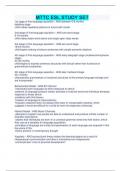
MTTC ESL STUDY SET 1st stage of first-language aquisition - ANS-between 6-8 months babbling stage child makes repetitive patterns of sound with mouth 2nd stage of first-language aquisition - ANS-one-word stage 9-18 months child makes basic word stems and single open-class words 3rd stage of first-language aquisition - ANS-two-word stage 18-24 months child begins making miniature sentences with simple semantic relations 4th stage of first-language aquisition - ANS-early telegraph stage (multiword/morpheme stage) 24-30 months child begins to express sentence structures with lexical rather than functional or grammatical morphemes 5th stage of first-language aquisition - ANS-later multiword stage 30+ months characteristic grammatical or functional structures of the primary language emerge and are incorporated Behavioralist Model - ANS-B.F Skinner -individuals learn language as direct response to stimuli -patterns of language produce certain activities in external world and individual develops response to those stimuli -problems with this theory= *creation of language is improvisionary *linguistic response does not always elicit clear or recognizable rewards, which suggests it would be difficult for a child to have his responses reinforced. Nativist Model - ANS-Noam Chomsky -attempts to explain how people are able to understand and produce infinite number of linguistic expressions -asserts that individuals are born w/ a universal grammar wired into their brains, which they use as a template for language acquisition. -principles of language are innate and parameters of each language are acquired in first few years of life. -theory present in contemporary thought Vygotsky - ANS-sociocultural theory states that learning begins as a result of interpersonal communication and then is internalized as intrapersonal -coined phrase "zone of proximal development" (difference b/t what a person knows & what they could know w/ a bit of assistance from someone else) Bronfenbrenner - ANS--his ecological model describes development in terms of four nested levels: (1) microsystem (child's immediate environment) (2) mesosystem (interactions between components of the microsystem) (3) exosystem (more general elements of child's environment) (4) macrosystem (overarching cultural influences, like cultural beliefs)...
Document information
- Uploaded on
- May 26, 2023
- Number of pages
- 8
- Written in
- 2022/2023
- Type
- Exam (elaborations)
- Contains
- Questions & answers