

SYG 2000 Chapter 1-3 Test-solved
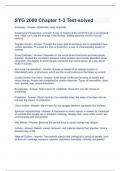
Sociology - Answer- Systematic study of society Sociological Perspective - Answer- A way of looking at the world through a sociological lens. Helps us to see the strange in the familiar. Seeing personal choice in social context. Auguste Comte - Answer- Thought the major goal of sociology was to understand how society operates. Proposed the idea of positivism- a way of understanding based on science. Emile Durkheim - Answer- Interested in the social factors that bond and hold people together. Studied the correlation between social isolation and suicide. Identified social integration- the degree to which people are tied to their social group, as a key social factor in suicide. Structural Functionalism - Answer- Society is viewed of an ordered system of interrelated parts, or structures, which are the social institutions that make up society Conflict theory: Karl Marx - Answer- Sees social conflict as the basis of society and social change. People are competing for scarce resources. Types of inequalities: class, race, gender, age, sexual orientation. Bourgeoisie - Answer- Marx's term for capitalists, those who own the means of production Proletariat - Answer- Marx's term for the exploited class, the mass of workers who do not own the means of production Class conflict - Answer- Marx's term for the struggle between capitalists and workers Symbolic interactionists - Answer- A framework in which society is viewed as composed of symbols that people use to establish meaning, develop their views of the world, and communicate with one another Max Weber - Answer- Believed the central force in social change was religion. Culture - Answer- Beliefs, values, behavior, and material objects that, together, form a people's way of life. Material Culture - Answer- The material objects that distinguish a group of people, such as their art, buildings, weapons, utensils, machines, hairstyles, clothing, and jewelry. Nonmaterial Culture - Answer- A group's way of thinking (including its beliefs, values, and other assumptions about the world) and doing (its common patterns of behavior, including language and other forms of interaction); also called symbolic culture Culture Shock - Answer- Disorientation due to the inability to make sense out of one's surroundings. Language - Answer- System of symbols that allows people to communicate with one another. It is the key to cultural transmission. Sapir-Whorf Thesis - Answer- Language shapes thought and perception. Norms - Answer- Rules of behavior Mores - Answer- Norms that are widely observed and have great moral significance. Folkways - Answer- Norms for routine, casual interaction
Document information
- Uploaded on
- May 26, 2023
- Number of pages
- 3
- Written in
- 2022/2023
- Type
- Exam (elaborations)
- Contains
- Questions & answers


