Written by students who passed Immediately available after payment Read online or as PDF Wrong document? Swap it for free 4.6 TrustPilot
logo-home
Document preview thumbnail
Preview 2 out of 9 pages
Summary

Summary Guide to Supply Chain Management - International Supply Chain Management 1 (1000IS1_22)

Document preview thumbnail
Preview 2 out of 9 pages

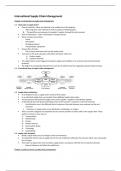
This is a summary of the book, chapters 1,3 and 4

Content preview

International Supply Chain Management
Chapter 1: introduction to supply chain management

1.1 what starts a supply chain?
 Flow of materials—these are depicted in the middle part of the diagram.
- They range from raw materials work in progress finished goods.
 This good flow encompasses the supplier’s supplier through the end consumer.
 Flow of information—order confirmation or dispatch advice.
 There are also reverse flows.
- Goods
- Information
- Packaging material
- Transportation equipment
 Reverse flow of funds.
- This is money that flows back into the supply chain.
 Two forces in the chain of goods, information and funds, which are:
1) Product supply
2) Customer demand
 The supply chains can be triggered by product supply (commodities) or by costumer demand (customized
products).
 The degree of customization dictates how much and in which format the supplying company holds inventory.
1.2 A functional view of supply chain management


1.3 Supply chain architecture
 in its simplest format, a supply chain consist of three nodes.
 In an extended supply chain, we consider three additional supply chain nodes.
 On the upstream side (towards supply), there is the supplier’s supplier or the ultimate supplier.
 At the downstream side (towards demand), there is the customer’s customer or the end consumer.
- the distinction here is the different kind of customers that exist between your company and the end
consumer.
 Customers in supply chain can be distributors, wholesalers or retailers.
 There are entire categories of companies that are service providers to other nodes in the supply chain. These
perform services in areas such as:
1) Transportation
2) Warehousing
3) Finance
4) Market research
5) New product design
6) Technology
7) Sustainability
1.4 supply chain dynamics
 ideally, supply chains react to changes in their environments.
 It is important that the rate of supply mirrors the rate of demand; otherwise the outcome will be very unfavorable
for Las Vegas.
 Their task is to balance the rate of product supply chain in accordance with the rate of customer demand.
- External influences will affect the equilibrium.

Chapter 3: guide to source in supply chain management

, 3.1 Introduction to sourcing

examples of direct and indirect items

Direct Indirect
Glass Factory security
Label Consultants
Sugar Cleaning products
Closure (cap) Electricity
Flavoring Protective clothing
Carbon Dioxide Stationery


 Sourcing in product companies generally involves dividing products or services into two distinct groups: direct and
indirect.
 Direct items are directly related to the product’s manufacturing process.
 Indirect items describe all other products and services that are needed to run the company.
- In organizations, sourcing is not exclusive to the supply chain, as it is deployed in all companies regardless of
whether they have a supply chain or not.
 Different organization refer to sourcing by different names.
3.1.1 The purchasing process: pre-order steps
 The purchasing process is also known as the purchase-to-pay process.
 NeedSpecificationsourcingTendering negotiation selectioncontracts
3.1.2 The purchasing process: Post-order steps
 Placing and handling orders Progressing and delivery Payment and review Performance indicators
3.1.3 Tactical sourcing
 The purchasing process of pre-order and post-order steps will continue on an operational basis daily.
 Tactical sourcing activities may be used in conjunction with the pre- and post-order steps or may sit outside.
- Market research
- Commodity analysis
- Forecasting requirements
- Supplier performance analysis and benchmarking
- Price and cost analysis
 Continual market research is essential to establish what is happening in the market for a particular item or
commodity.
 Suppliers efficiency can be raised by communicating better forecast requirements.
 by improving supplier efficiency, reduced costs and improved service are juxtaposed for both parties.
3.2 Strategic sourcing initiatives
 The category sourcing concept also aims to achieve a shift in customer and supplier relationship, striving for joint
benefits and co-ownership of the sale.
 Category sourcing (CS) or Category management (CM) are concepts where the products or services an
organization requires are broken down into discrete groups.
 The steps for a category sourcing process adapted from O’Brian (2009) are:
1. Profile the category group
2. Select the sourcing strategy
3. Generate the supplier portfolio
4. Follow the purchasing process
5. Negotiation
- going back to step one of the category sourcing process, the sourcing
strategy matrix adapted from Kraljic (1983) is a tool to segment the
different category groups.

3.2.2 Supplier Relationship Management

 breaking down functional barriers and functional mindsets
 promoting innovation and joint thinking for “doing things better”
 Improving supply chain visibility for buyer and supplier
 Sharing assets across supply chain, removing duplications
 Enhancing forward looking visibility giving more reliability to all parties.

Connected book
 image
Colin Scott, Henriette Lundgren Guide to Supply Chain Management
Publisher: Unknown ISBN: 9783030083922 Edition: 1

Document information

Study
Summarized whole book?
No
Which chapters are summarized?
1,3 and 4
Uploaded on
May 23, 2023
Number of pages
9
Written in
2018/2019
Type
Summary
$5.96

Wrong document? Swap it for free Within 14 days of purchase and before downloading, you can choose a different document. You can simply spend the amount again.
Written by students who passed
Immediately available after payment
Read online or as PDF

Sold
0
Followers
0
Items
1
Last sold
-


Why students choose Stuvia

Created by fellow students, verified by reviews

Quality you can trust: written by students who passed their tests and reviewed by others who've used these notes.

Didn't get what you expected? Choose another document

No worries! You can instantly pick a different document that better fits what you're looking for.

Pay as you like, start learning right away

No subscription, no commitments. Pay the way you're used to via credit card and download your PDF document instantly.

Student with book image

“Bought, downloaded, and aced it. It really can be that simple.”

Alisha Student

Working on your references?

Create accurate citations in APA, MLA and Harvard with our free citation generator.

Working on your references?

Frequently asked questions