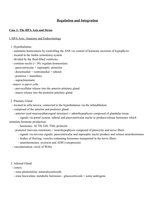
Regulation and Integration
Case 1: The HPA Axis and Stress
I. HPA Axis: Anatomy and Endocrinology
1. Hypothalamus
- maintains homeostasis by controlling the ANS via control of hormone secretion of hypophysis
- located in the limbic (emotions) system
- divided by the fluid-filled ventricles
- contains nuclei (> 30): regulate homeostasis
- paraventricular + supraoptic: posterior
- dorsomedial + ventromedial + tuberal
- posterior + mamillary
- suprachiasmatic
- macro vs parvo cells
- parvocellular release into the anterior pituitary gland
- macro release into the posterior pituitary gland
2. Pituitary Gland
- located in sella turcica, connected to the hypothalamus via the infundibulum
- composed of the anterior and posterior gland:
- anterior (oral mucosa/pharyngeal structure) = adenohypophysis composed of glandular tissue
- signals via portal system: tuberal and paraventricular nuclei to produce/release hormones which
stimulate hormone production
- hormones: ACTH, GH, TSH, prolactin
- posterior (nervous extension) = neurohypophysis composed of pituicytes and nerve fibers
- signals via nervous signals: paraventricular and supraoptic nuclei produce and release neurohormones
- bodies of Herring: vesicles containing hormones transported in the nerve fibers
- neurohormones: oxytocin and ADH (vasopressin)
- vascularisation: circle of Willis
3. Adrenal Gland
- cortex:
- zona glomerulosa: mineralocorticoids
- zona fasciculata: metabolic hormones - glucocorticoids + some androgens
Case 1: The HPA Axis and Stress
I. HPA Axis: Anatomy and Endocrinology
1. Hypothalamus
- maintains homeostasis by controlling the ANS via control of hormone secretion of hypophysis
- located in the limbic (emotions) system
- divided by the fluid-filled ventricles
- contains nuclei (> 30): regulate homeostasis
- paraventricular + supraoptic: posterior
- dorsomedial + ventromedial + tuberal
- posterior + mamillary
- suprachiasmatic
- macro vs parvo cells
- parvocellular release into the anterior pituitary gland
- macro release into the posterior pituitary gland
2. Pituitary Gland
- located in sella turcica, connected to the hypothalamus via the infundibulum
- composed of the anterior and posterior gland:
- anterior (oral mucosa/pharyngeal structure) = adenohypophysis composed of glandular tissue
- signals via portal system: tuberal and paraventricular nuclei to produce/release hormones which
stimulate hormone production
- hormones: ACTH, GH, TSH, prolactin
- posterior (nervous extension) = neurohypophysis composed of pituicytes and nerve fibers
- signals via nervous signals: paraventricular and supraoptic nuclei produce and release neurohormones
- bodies of Herring: vesicles containing hormones transported in the nerve fibers
- neurohormones: oxytocin and ADH (vasopressin)
- vascularisation: circle of Willis
3. Adrenal Gland
- cortex:
- zona glomerulosa: mineralocorticoids
- zona fasciculata: metabolic hormones - glucocorticoids + some androgens