
BIOPSYCHOLOGY
THE NERVOUS SYSTEM
A primary internal communication system- transmits messages
between different parts of the body via specialised network of nerve
cells
2 main functions:
o To collect, process + respond to info in environment
o To coordinate working of different organs + cells in body
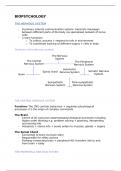
Divisions of the Nervous system
The Nervous
System
The Central The Peripheral
Nervous System Nervous System
Autonomic
Spinal chord Nervous System Somatic Nervous
Brain System
Sympathetic Para-sympathetic
Nervous System Nervous System
THE CENTRAL NERVOUS SYSTEM
Function: The CNS controls behaviour + regulates physiological
processes- it’s the origin of complex commands
The Brain
Centre of all conscious awareness/psychological processes including
higher order thinking e.g. problem solving + planning, interpreting
and storing info
Interprets + stores info + sends orders to muscles, glands + organs
The Spinal Chord
Connected to brain via brain stem
Responsible for reflex actions
Pathway connecting brain + peripheral NS- transfers info to and
from brain + body
THE PERIPHERAL NERVOUS SYSTEM
,Function: consists of nerves that lie outside the brain + spinal chord and
transmits info to and from CNS
Sensory neurons receive info from senses + carry messages to the
brain
Motor neurons carry messages from brain to body, on what action to
take
Somatic Nervous System
Associated w voluntary muscle movement, communication w
outside world + under conscious control
Integrates brain w outside world
Carries sensory info from sensory receptor cells to CNS
Carries motor signals from CNS to skeletal muscles to produce
voluntary movements
Some movements involuntary e.g. reflex arc
Autonomic Nervous System
Involuntary, regulates internal environment + controls smooth
muscles and glands
Carries signals from internal body organs + glands to CNS and from
CNS to organs + glands
Divided into sympathetic + parasympathetic NS
Sympathetic NS
Messages travel from sympathetic NS to organs in body to help
prepare for action when faced w dangerous situation
Noradrenaline is main neurotransmitter
Parasympathetic NS
Maintains body functions under ordinary conditions
Restores body to normal functioning after arousal- saves energy
Acetylcholine is main neurotransmitter
NEURONS
Definition: neuron is the basic working unit of the brain
Nerve cells communicate with each other via electrical + chemical signals
Structure of a neurone
, Types of neurones
Relay neuron Sensory neuron Motor neuron
Sensory neuron
Carries info (nerve impulses) from sensory receptors to CNS via PNS
When nerve impulses reach brain, they’re translated into sensations
such as hearing, taste, touch
Not all sensory neurons reach brain, as some neurons stop at spinal
chord for reflex actions
Relay neuron
Connects sensory neurons to motor neurons or other relay neurons
Transmits info from one area of CNS to another- analyses
sensations, decides how to respond
Found only in brain, visual system + spinal chord
Motor neuron
For complex/voluntary motor responses- carry info from CNS to
effectors such as muscles or glands
For reflex movements motor neurons respond directly to sensory
info via relay neurons
Release neurotransmitters when stimulated that bind to receptors
on muscles, leads to movement
Strength of muscle contraction depends on rate of firing neuron
NEUROTRANSMITTERS + NEURAL COMMUNICATION
Neurotransmitters
Definition: chemical messengers that transit nerve impulses across
synaptic gap during synaptic transmission
Identified in brain, spinal chord + some glands and each
neurotransmitter has specific molecular structure that fits perfectly
into a post-synaptic receptor site
Can have different effects when they bind to the receptor
o Excitatory: make the post-synaptic neuron more likely to fire
o Inhibitory: make the post-synaptic neuron less likely to fire
THE NERVOUS SYSTEM
A primary internal communication system- transmits messages
between different parts of the body via specialised network of nerve
cells
2 main functions:
o To collect, process + respond to info in environment
o To coordinate working of different organs + cells in body
Divisions of the Nervous system
The Nervous
System
The Central The Peripheral
Nervous System Nervous System
Autonomic
Spinal chord Nervous System Somatic Nervous
Brain System
Sympathetic Para-sympathetic
Nervous System Nervous System
THE CENTRAL NERVOUS SYSTEM
Function: The CNS controls behaviour + regulates physiological
processes- it’s the origin of complex commands
The Brain
Centre of all conscious awareness/psychological processes including
higher order thinking e.g. problem solving + planning, interpreting
and storing info
Interprets + stores info + sends orders to muscles, glands + organs
The Spinal Chord
Connected to brain via brain stem
Responsible for reflex actions
Pathway connecting brain + peripheral NS- transfers info to and
from brain + body
THE PERIPHERAL NERVOUS SYSTEM
,Function: consists of nerves that lie outside the brain + spinal chord and
transmits info to and from CNS
Sensory neurons receive info from senses + carry messages to the
brain
Motor neurons carry messages from brain to body, on what action to
take
Somatic Nervous System
Associated w voluntary muscle movement, communication w
outside world + under conscious control
Integrates brain w outside world
Carries sensory info from sensory receptor cells to CNS
Carries motor signals from CNS to skeletal muscles to produce
voluntary movements
Some movements involuntary e.g. reflex arc
Autonomic Nervous System
Involuntary, regulates internal environment + controls smooth
muscles and glands
Carries signals from internal body organs + glands to CNS and from
CNS to organs + glands
Divided into sympathetic + parasympathetic NS
Sympathetic NS
Messages travel from sympathetic NS to organs in body to help
prepare for action when faced w dangerous situation
Noradrenaline is main neurotransmitter
Parasympathetic NS
Maintains body functions under ordinary conditions
Restores body to normal functioning after arousal- saves energy
Acetylcholine is main neurotransmitter
NEURONS
Definition: neuron is the basic working unit of the brain
Nerve cells communicate with each other via electrical + chemical signals
Structure of a neurone
, Types of neurones
Relay neuron Sensory neuron Motor neuron
Sensory neuron
Carries info (nerve impulses) from sensory receptors to CNS via PNS
When nerve impulses reach brain, they’re translated into sensations
such as hearing, taste, touch
Not all sensory neurons reach brain, as some neurons stop at spinal
chord for reflex actions
Relay neuron
Connects sensory neurons to motor neurons or other relay neurons
Transmits info from one area of CNS to another- analyses
sensations, decides how to respond
Found only in brain, visual system + spinal chord
Motor neuron
For complex/voluntary motor responses- carry info from CNS to
effectors such as muscles or glands
For reflex movements motor neurons respond directly to sensory
info via relay neurons
Release neurotransmitters when stimulated that bind to receptors
on muscles, leads to movement
Strength of muscle contraction depends on rate of firing neuron
NEUROTRANSMITTERS + NEURAL COMMUNICATION
Neurotransmitters
Definition: chemical messengers that transit nerve impulses across
synaptic gap during synaptic transmission
Identified in brain, spinal chord + some glands and each
neurotransmitter has specific molecular structure that fits perfectly
into a post-synaptic receptor site
Can have different effects when they bind to the receptor
o Excitatory: make the post-synaptic neuron more likely to fire
o Inhibitory: make the post-synaptic neuron less likely to fire


