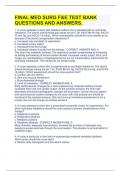
FINAL MED SURG F&E TEST BANK QUESTIONS AND ANSWERS.
FINAL MED SURG F&E TEST BANK QUESTIONS AND ANSWERS. 1. A nurse assesses a client with diabetes mellitus who is admitted with an acid-base imbalance. The client's arterial blood gas values are pH 7.36, PaO2 98 mm Hg, PaCO2 33 mm Hg, and HCO3- 18 mEq/L. Which manifestation should the nurse identify as an example of the client's compensation mechanism? a. Increased rate and depth of respirations b. Increased urinary output c. Increased thirst and hunger d. Increased release of acids from the kidneys - CORRECT ANSWER-ANS: A This client has metabolic acidosis. The respiratory system compensates by increasing its activity and blowing off excess carbon dioxide. Increased urinary output, thirst, and hunger are manifestations of hyperglycemia but are not compensatory mechanisms for acid-base imbalances. The kidneys do not release acids. 2. A nurse assesses a client who is experiencing an acid-base imbalance. The client's arterial blood gas values are pH 7.34, PaO2 88 mm Hg, PaCO2 38 mm Hg, and HCO3- 19 mEq/L. Which assessment should the nurse perform first? a. Cardiac rate and rhythm b. Skin and mucous membranes c. Musculoskeletal strength d. Level of orientation - CORRECT ANSWER-ANS: A Early cardiovascular changes for a client experiencing moderate acidosis include increased heart rate and cardiac output. As the acidosis worsens, the heart rate decreases and electrocardiographic changes will be present. Central nervous system and neuromuscular system changes do not occur with mild acidosis and should be monitored if the acidosis worsens. Skin and mucous membrane assessment is not a priority now, but will change as acidosis worsens. 3. A nurse assesses a client who is prescribed furosemide (Lasix) for hypertension. For which acid-base imbalance should the nurse assess to prevent complications of this therapy? a. Respiratory acidosis b. Respiratory alkalosis c. Metabolic acidosis d. Metabolic alkalosis - CORRECT ANSWER-ANS: D Many diuretics, especially loop diuretics, increase the excretion of hydrogen ions, leading to excess acid loss through the renal system. This situation is an acid deficit of metabolic origin. 4. A nurse is caring for a client who is experiencing moderate metabolic alkalosis. Which action should the nurse take? a. Monitor daily hemoglobin and hematocrit values. b. Administer furosemide (Lasix) intravenously. c. Encourage the client to take deep breaths. d. Teach the client fall prevention measures. - CORRECT ANSWER-ANS: D The priority nursing care for a client who is experiencing moderate metabolic alkalosis is providing client safety. Clients with metabolic alkalosis have muscle weakness and are at risk for falling. The other nursing interventions are not appropriate for metabolic alkalosis. 5. A nurse is assessing a client who has acute pancreatitis and is at risk for an acid-base imbalance. For which manifestation of this acid-base imbalance should the nurse assess? a. Agitation b. Kussmaul respirations c. Seizures d. Positive Chvostek's sign - CORRECT ANSWER-ANS: B The pancreas is a major site of bicarbonate production. Pancreatitis can cause a relative metabolic acidosis through underproduction of bicarbonate ions. Manifestations of acidosis include lethargy and Kussmaul respirations. Agitation, seizures, and a positive Chvostek's sign are manifestations of the electrolyte imbalances that accompany alkalosis. 6. A nurse assesses a client who is admitted with an acid-base imbalance. The client's arterial blood gas values are pH 7.32, PaO2 85 mm Hg, PaCO2 34 mm Hg, and HCO3- 16 mEq/L. What action should the nurse take next? a. Assess client's rate, rhythm, and depth of respiration. b. Measure the client's pulse and blood pressure. c. Document the findings and continue to monitor. d. Notify the physician as soon as possible. - CORRECT ANSWER-ANS: A Progressive skeletal muscle weakness is associated with increasing severity of acidosis. Muscle weakness can lead to severe respiratory insufficiency. Acidosis does lead to dysrhythmias (due to hyperkalemia), but these would best be assessed with cardiac monitoring. Findings should be documented, but simply continuing to monitor is not sufficient. Before notifying the physician, the nurse must have more data to report. 7. A nurse is caring for a client who has the following arterial blood values: pH 7.12, PaO2 56 mm Hg, PaCO2 65 mm Hg, and HCO3- 22 mEq/L. Which clinical situation should the nurse correlate with these values? a. Diabetic ketoacidosis in a person with emphysema b. Bronchial obstruction related to aspiration of a hot dog c. Anxiety-induced hyperventilation in an adolescent d. Diarrhea for 36 hours in an older, frail woman - CORRECT ANSWER-ANS: B Arterial blood gas values indicate that the client has acidosis with normal levels of bicarbonate, suggesting that the problem is not metabolic. Arterial concentrations of oxygen and carbon dioxide are abnormal, with low oxygen and high carbon dioxide levels. Thus, this client has respiratory acidosis from inadequate gas exchange. The fact that the bicarbonate level is normal indicates that this is an acute respiratory problem rather than a chronic problem, because no renal compensation has occurred. 8. A nurse is caring for a client who has just experienced a 90-second tonic-clonic seizure. The client's arterial blood gas values are pH 6.88, PaO2 50 mm Hg, PaCO2 60 mm Hg, and HCO3- 22 mEq/L. Which action should the nurse take first? a. Apply oxygen by mask or nasal cannula. b. Apply a paper bag over the client's nose and mouth. c. Administer 50 mL of sodium bicarbonate intravenously. d. Administer 50 mL of 20% glucose and 20 units of regular insulin. - CORRECT ANSWER-ANS: A The client has experienced a combination of metabolic and acute respiratory acidosis through heavy skeletal muscle contractions and no gas exchange. When the seizures have stopped and the client can breathe again, the fastest way to return acid-base balance is to administer oxygen. Applying a paper bag over the client's nose and mouth would worsen the acidosis. Sodium bicarbonate should not be administered because the client's arterial bicarbonate level is normal. Glucose and insulin are administered together to decrease serum potassium levels. This action is not appropriate based on the information provided. 9. After teaching a client who was malnourished and is being discharged, a nurse assesses the client's understanding. Which statement indicates the client correctly understood teaching to decrease risk for the development of metabolic acidosis? a. "I will drink at least three glasses of milk each day." b. "I will eat three well-balanced meals and a snack daily." c. "I will not take pain medication and antihistamines together." d. "I will avoid salting my food when cooking or during meals." - CORRECT ANSWER-ANS: B Starvation or a diet with too few carbohydrates can lead to metabolic acidosis by forcing cells to switch to using fats for fuel and by creating ketoacids as a by-product of excessive fat metabolism. Eating sufficient calories from all food groups helps reduce this risk. 10. A nurse evaluates the following arterial blood gas values in a client: pH 7.48, PaO2 98 mm Hg, PaCO2 28 mm Hg, and HCO3- 22 mEq/L. Which client condition should the nurse correlate with these results? a. Diarrhea and vomiting for 36 hours b. Anxiety-induced hyperventilation c. Chronic obstructive pulmonary disease (COPD) d. Diabetic ketoacidosis and emphysema - CORRECT ANSWER-ANS: B The elevated pH level indicates alkalosis. The bicarbonate level is normal, and so is the oxygen partial pressure. Loss of carbon dioxide is the cause of the alkalosis, which would occur in response to hyperventilation. Diarrhea and vomiting would cause metabolic alterations, COPD would lead to respiratory acidosis, and the client with emphysema most likely would have combined metabolic acidosis on top of a mild, chronic respiratory acidosis. 11. After providing discharge teaching, a nurse assesses the client's understanding regarding increased risk for metabolic alkalosis. Which statement indicates the client needs additional teaching? a. "I don't drink milk because it gives me gas and diarrhea." b. "I have been taking digoxin every day for the last 15 years." c. "I take sodium bicarbonate after every meal to prevent heartburn." d. "In hot weather, I sweat so much that I drink six glasses of water each day." - CORRECT ANSWER-ANS: C Excessive oral ingestion of sodium bicarbonate and other bicarbonate-based antacids can cause metabolic alkalosis. Avoiding milk, taking digoxin, and sweating would not lead to increased risk of metabolic alkalosis. 12. A nurse is caring for a client who is experiencing excessive diarrhea. The client's arterial blood gas values are pH 7.28, PaO2 98 mm Hg, PaCO2 45 mm Hg, and HCO3- 16 mEq/L. Which provider order should the nurse expect to receive? a. Furosemide (Lasix) 40 mg intravenous push b. Sodium bicarbonate 100 mEq diluted in 1 L of D5W c. Mechanical ventilation d. Indwelling urinary catheter - CORRECT ANSWER-ANS: B This client's arterial blood gas values represent metabolic acidosis related to a loss of bicarbonate ions from diarrhea. The bicarbonate should be replaced to help restore this client's acid-base balance. Furosemide would cause an increase in acid fluid and acid elimination via the urinary tract; although this may improve the client's pH, the client has excessive diarrhea and cannot afford to lose more fluid. Mechanical ventilation is used to treat respiratory acidosis for clients who cannot keep their oxygen saturation at 90%, or who have respirator muscle fatigue. Mechanical ventilation and an indwelling urinary catheter would not be prescribed for this client. 13. A nurse evaluates a client's arterial blood gas values (ABGs): pH 7.30, PaO2 86 mm Hg, PaCO2 55 mm Hg, and HCO3- 22 mEq/L. Which intervention should the nurse implement first? a. Assess the airway. b. Administer prescribed bronchodilators. c. Provide oxygen. d. Administer prescribed mucolytics. - CORRECT ANSWER-ANS: A All interventions are important for clients with respiratory acidosis; this is indicated by the ABGs. However, the priority is assessing and maintaining an airway. Without a patent airway, other interventions will not be helpful. 14. A nurse is planning care for a client who is hyperventilating. The client's arterial blood gas values are pH 7.30, PaO2 94 mm Hg, PaCO2 31 mm Hg, and HCO3- 26 mEq/L. Which question should the nurse ask when developing this client's plan of care? a. "Do you take any over-the-counter medications?" b. "You appear anxious. What is causing your distress?" c. "Do you have a history of anxiety attacks?" d. "You are breathing fast. Is this causing you to feel light-headed? - CORRECT ANSWER-ANS: B The nurse should assist the client who is experiencing anxiety-induced respiratory alkalosis to identify causes of the anxiety. The other questions will not identify the cause of the acid-base imbalance. 15. A nurse is caring for a client who has chronic emphysema and is receiving oxygen therapy at 6 L/min via nasal cannula. The following clinical data are available: Arterial Blood Gases Vital Signs pH = 7.28 Pulse rate = 96 beats/min PaO2 = 85 mm Hg Blood pressure = 135/45 PaCO2 = 55 mm Hg Respiratory rate = 6 breaths/min HCO3- = 26 mEq/L O2 saturation = 88% Which action should the nurse take first? a. Notify the Rapid Response Team and provide ventilation support. b. Change the nasal cannula to a mask and reassess in 10 minutes. c. Place the client in Fowler's position if he or she is able to tolerate it. d. Decrease the flow rate of oxygen to 2 to 4 L/min, and reassess. - CORRECT ANSWER-ANS: A The primary trigger for respiration in a client with chronic respiratory acidosis is a decreased arterial oxygen level (hypoxic drive). Oxygen therapy can inhibit respiratory efforts in this case, eventually causing respiratory arrest and death. The nurse could decrease the oxygen flow rate; eventually, this might improve the client's respiratory rate, but the priority action would be to call the Rapid Response Team whenever a client with chronic carbon dioxide retention has a respiratory rate less than 10 breaths/min. Changing the cannula to a mask does nothing to improve the client's hypoxic drive, nor would it address the client's most pressing need. Po
Document information
- Uploaded on
- May 18, 2023
- Number of pages
- 20
- Written in
- 2022/2023
- Type
- Exam (elaborations)
- Contains
- Questions & answers