Bio 140 Final Exam 100% PASS
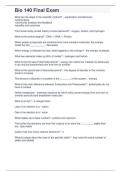
What are the steps in the scientific method? - -exploration and discovery -testing ideas -community analysis and feedback -benefits and outcomes The human body consist mainly of what elements? - oxygen, carbon, and hydrogen What is the central dogma? - DNA - RNA - Protein When simple compounds are combined into more complex molecules, the entropy inside the cell __________. - decreases When energy is released as heat, what happens to the entropy? - the entropy increases What two elements make up 99% of matter? - hydrogen and helium What is the first law of thermodynamics? - energy can neither be created nor destroyed; it can only be transformed from one form to another What is the second law of thermodynamics? - the degree of disorder in the universe tends to increase The amount of disorder in a system is the ________ of the system. - entropy What is the main difference between Eukaryotes and Prokaryotes? - prokaryotes do not have a nucleus Define metabolism - chemical reactions by which cells convert energy from one form to another and build and breakdown molecules What is an ion? - a charged atom Loss of an electron is a - cation Gain of an electron is a - anion What makes up a mass number? - protons and neutrons The further the electrons are from the nucleus of an atom the _________ stable they are - less stable Carbon has how many valence electrons? - 4 What is unique about the rows of the periodic table? - they have the same number of shells and orbitals Bio 140 Final Exam What is unique about the columns of the periodic table? - same number of valence electrons What are the three shapes carbon is usually found in? - -tetrahedron -pyramidal -linear Why could carbon form a linear bond? - because three carbon could form double bonds Define isomer - same atoms different arrangements Define covalent bonds - chemical bond that involves the sharing of electron pairs between atoms What is needed to break a covalent bond? - enzyme Are non-covalent bonds weak or strong? - weak What is needed to break non-covalent bonds? - heat What are the types of non-covalent bonds? - -ionic -hydrogen What are the categories of covalent bonds? - -polar -non-polar Does oxygen share electrons equally? - no what is the partial charge of oxygen in water? - negative What is the partial charge of hydrogen in water? - positive Finding electronegativity - Electronengative atoms will have a __________ negative charge. - partial Define hydrogen bond - weak "attraction" between electronegative atom and a hydrogen bonded to an electronegative atom What bonds holds oxygen and hydrogen together in a water molecule? - covalent bonds Define ionic bond - Formed when electrons are transferred from one atom to another and for ions
Document information
- Uploaded on
- May 10, 2023
- Number of pages
- 21
- Written in
- 2022/2023
- Type
- Exam (elaborations)
- Contains
- Questions & answers