Infectious and non-infectious diseases.
P1:
Bacteria:
Structure of bacteria:
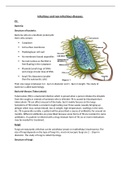
Bacteria cells are unicellular prokaryotic
their cells contain:
Cytoplasm
Cell surface membrane
Peptidoglycan cell wall
No membrane bound organelles
No real nucleus as the DNA is
free floating in the cytoplasm
Plasmids (small rings of DNA)
and a large circular loop of DNA
Small 70s ribosomes (smaller
than the eukaryotic cells)
Their size range is between 0.2 - 2µm in diameter and 1 - 8µm in length. The study of
bacteria is called bacteriology.
Bacterial disease (Tuberculosis):
Tuberculosis (TB) is a bacterial infection which is spread when a person inhales the droplets
from the coughs or sneezes of someone who is infected. TB is caused by Mycobacterium
tuberculosis. TB can affect any part of the body, but it mainly focuses on the lungs.
Symptoms of TB include a constant cough lasting over three weeks (usually bringing up
phlegm which may contain blood), loss in weight, high temperature, swellings in the neck,
etc. TB is generally curable; a patient will be prescribed a course of antibiotics for around six
months. Different antibiotics are prescribed because some forms of TB are resistant to some
antibiotics. If a patient is infected with a drug resistant form of TB, six or more medications
may be needed for treatment.
Fungi:
Fungi are eukaryotic cells that can be unicellular (yeast) or multicellular (mushrooms). The
size of fungi depends on the type of fungi it is, most microscopic fungi are 2 – 10µm in
diameter. The study of fungi is called Mycology.
Structure of fungi:
, Unicellular:
This unicellular yeast cell has a
well-defined nucleus (DNA is
enclosed in the nucleus) and a
cell wall made up of chitin (a
type of carbohydrate).
Organelles found in the
cytoplasm of this cell are
ribosomes, mitochondria,
endoplasmic reticulum, and
lipid inclusion.
Multicellular:
Hyphae are made up of many individual cells
that form long tubular thread-like filaments.
Some hyphae are segmented by septum, if
septa are present, they are called Septate
hyphae. If septate are not present they are
called Coenocytic hyphae. A network of
hyphae is called a mycelium. The average
size of hyphae is 5 – 50 micrometres in
length.
Fungal disease (Athlete’s foot):
Athlete's foot is a common fungal infection that affects the feet. Athlete’s foot is caused by
many different fungi which all belong to the same group called dermatophytes, Athlete’s
foot is usually caught from other people with the infection. For example, walking barefoot in
the same areas where someone infected has walked barefoot (commonly in changing rooms
and showers) or touching the infected area of the person’s skin. A person is more likely to
get infected if they have wet or sweaty feet or skin damage on the feet. Symptoms of
athlete’s foot include itchy white patches between the toes, red, sore, and flaky patches on
the feet, it can also affect the soles or sides of the feet. If left untreated it can spread to the
toenails and cause a fungal nail infection. Athlete’s foot can be treated with antifungal
P1:
Bacteria:
Structure of bacteria:
Bacteria cells are unicellular prokaryotic
their cells contain:
Cytoplasm
Cell surface membrane
Peptidoglycan cell wall
No membrane bound organelles
No real nucleus as the DNA is
free floating in the cytoplasm
Plasmids (small rings of DNA)
and a large circular loop of DNA
Small 70s ribosomes (smaller
than the eukaryotic cells)
Their size range is between 0.2 - 2µm in diameter and 1 - 8µm in length. The study of
bacteria is called bacteriology.
Bacterial disease (Tuberculosis):
Tuberculosis (TB) is a bacterial infection which is spread when a person inhales the droplets
from the coughs or sneezes of someone who is infected. TB is caused by Mycobacterium
tuberculosis. TB can affect any part of the body, but it mainly focuses on the lungs.
Symptoms of TB include a constant cough lasting over three weeks (usually bringing up
phlegm which may contain blood), loss in weight, high temperature, swellings in the neck,
etc. TB is generally curable; a patient will be prescribed a course of antibiotics for around six
months. Different antibiotics are prescribed because some forms of TB are resistant to some
antibiotics. If a patient is infected with a drug resistant form of TB, six or more medications
may be needed for treatment.
Fungi:
Fungi are eukaryotic cells that can be unicellular (yeast) or multicellular (mushrooms). The
size of fungi depends on the type of fungi it is, most microscopic fungi are 2 – 10µm in
diameter. The study of fungi is called Mycology.
Structure of fungi:
, Unicellular:
This unicellular yeast cell has a
well-defined nucleus (DNA is
enclosed in the nucleus) and a
cell wall made up of chitin (a
type of carbohydrate).
Organelles found in the
cytoplasm of this cell are
ribosomes, mitochondria,
endoplasmic reticulum, and
lipid inclusion.
Multicellular:
Hyphae are made up of many individual cells
that form long tubular thread-like filaments.
Some hyphae are segmented by septum, if
septa are present, they are called Septate
hyphae. If septate are not present they are
called Coenocytic hyphae. A network of
hyphae is called a mycelium. The average
size of hyphae is 5 – 50 micrometres in
length.
Fungal disease (Athlete’s foot):
Athlete's foot is a common fungal infection that affects the feet. Athlete’s foot is caused by
many different fungi which all belong to the same group called dermatophytes, Athlete’s
foot is usually caught from other people with the infection. For example, walking barefoot in
the same areas where someone infected has walked barefoot (commonly in changing rooms
and showers) or touching the infected area of the person’s skin. A person is more likely to
get infected if they have wet or sweaty feet or skin damage on the feet. Symptoms of
athlete’s foot include itchy white patches between the toes, red, sore, and flaky patches on
the feet, it can also affect the soles or sides of the feet. If left untreated it can spread to the
toenails and cause a fungal nail infection. Athlete’s foot can be treated with antifungal