Fitzsimmons 8-Chapter 2-Blackboard Notes-Service 1
Strategy Management 3121
Instructor: N.P. Loomba
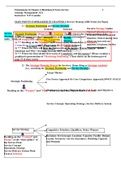
MAIN POINTS EMPHASIZED IN CHAPTER 2 (Service Strategy) [BB Notes] [24 Pages]
1) Strategic Positioning and Service Strategy
External Internal The term “Strategy” implies
“Optimal” allocation of resources
Service Strategic Positioning: [Main Focus is External. That is, what is the relative position of the
to achieve corporate goals and
Strategy: firm
Thewith respect to other external firms and external environment?]
Strategy Strategic Service objectives. Think of playing chess
main focus is Perspectives
Three on Strategic Positioning
Positioning Strategy where you have only one
Internal.1) *** Deciding on the “Purpose” and “Place” of the Service Firm. [Customers,
Competitors, Government][Front
[PleaseOffice
note the EXTERNAL focus] opponent. In business, the firm
Execution [Back Office
2) *** Where the firm will fit in the framework of the Service Processhas
Operations] Operations]
many?opponents
Matrix Which
Quadrant and Why? [See page 16 of my BBN on Ch.1]
3) *** Where the firm should fit in terms of Complexity and Divergence? [Please examine a
graphical representation of “Marketing Positioning” Chart shown on the bottom part of
page 23 of these notes]
2) The Strategic Planning Process for Services: [Same thing as Strategic Analysis]
[i.e., searching for Strategic Positioning and Service Strategy.]
Target Market
Five Forces Approach Or Core Competence Approach [SWOT ANALYS
Strategic Positioning
Decisions:
Deciding on the: “Purpose” and “Place” Corporate
of the Service Firm.Mission; HighisLevel
Main Focus Goals and Objectives
External.
Service Concept; Operating Strategy; Service Delivery System
Service Strategy Competitive Priorities; Qualifiers; Order Winners
Deciding on the: “Content” and Decisions: Servicescape; Location; Capacity; Facility Design;
“Scope” of the “three pillars” of Layout; Inventory; Service Encounter; Matching Capacity
the Service Firm. and Demand.
Service Concept
Operations Strategy
Service Delivery System Main
Focus is Internal.
,Fitzsimmons 8-Chapter 2-Blackboard Notes-Service 2
Strategy Management 3121
Instructor: N.P. Loomba
Front Office Operational Decisions:
[Managing Day-to-Day Operations]
[Service Design; Service Encounter; Staffing Levels; Training]
Execution (Tactical)
Back Office Operational Decisions: [Managing Day-to-Day Operations] [Decoup
3) The environment for services is extremely competitive due to: low entry
barriers; product substitution; and limited opportunities for economies of
scale.
4) Three generic competitive service strategies are: Overall Cost
Leadership; Differentiation; and Focus.
5) Four Elements (Pillars) of the Strategic Service Vision:
**** (1) Target Market Segmentation [Needs Analysis: Whom the firm
will serve; who are our potential customers?] [Main Focus External]
[e.g., Customers who want inexpensive air transportation; Customers who want
fresh, organic, food for home cooking; Customers who want expert tax advice;
customers who want luxury cars]
[Basis for Target Market Segmentation include: Buying behavior,
geography, demographics, sales volume, profitability, expected level of
service]
[Have you seen the USAA Advertisement on the T V? The Target Market for USAA is the mil
**** (2) Service Concept [Stated from the Customer Point of View. Seen through the “Custom
[e.g., time efficiency and low cost]; a set of Competitive Priorities that are valued by the targe
[Competitive Priority is any dimension along which the firm decides to compete in order to ob
[Examples of Competitive Priorities: Quality; Cost; Flexibility; Time; Innovation; Speed] [See
, Fitzsimmons 8-Chapter 2-Blackboard Notes-Service 3
Strategy Management 3121
Instructor: N.P. Loomba
[Designing features of the service to satisfy the customer requirements and
competitive priorities of the target market segment (e.g., providing nine gears to
obtain gas efficiencies)]
**** (3) Operating Strategy [Stated from the Company’s Point of View. Seen
through the Providers Eyes. How the company should be structured in order
to meet the service concept; company’s internal operations; set of competitive
priorities that the internal operations will emphasize (both winners and
qualifiers)] [Main Focus Internal]
[e.g., Number and type of employees; type of equipment and machines; Quality
and Cost; Organizational Structure, Marketing, Finance]
[Allocation of resources to the internal issues e.g., expansion by innovation or
by acquisitions --- keeping competitive priorities in mind]
**** (4) Service Delivery System [sets in place physical and procedural assets
that are needed to execute the service concept; specific set of operational
decisions that need to be made in order to deliver the service. [Putting
together people, technology, and systems for an efficient and effective service
delivery] [Main Focus Internal]
[Design of Service Encounter in terms of people, technology and procedural
systems] [Includes facility location and layout, the Servicescape, service
processes, job design, technology and information support systems, and
organizational structure]
6) Strategic Analysis (Same thing as the Strategic Planning Process): [Analysis
required for identifying Strategic Positioning and Service Strategy. The
issues involved in seeking an Optimal Service-Market Mix]
[Shown, schematically, earlier on pages 1-2 of these notes] Repetition, but it
won’t hurt.
Strategic Positioning [External Focus]
(1) Target Market Segmentation [Identification of our customers]
(2) Porter’s Five Forces Analysis: [Industry and Competitor
Analysis Approach; and SWOT Analysis]. [Please note the sequence]
[Also see the Diagram on page 10 of these notes]
(3) Core Competence Approach: (SWOT Analysis; and Analysis of
the Industry and Competitors) [Please note the sequence]
Service Strategy [Three components of Service Strategy]
(1) Service Concept
(2) Operations Strategy
(3) Service Delivery System
Strategy Management 3121
Instructor: N.P. Loomba
MAIN POINTS EMPHASIZED IN CHAPTER 2 (Service Strategy) [BB Notes] [24 Pages]
1) Strategic Positioning and Service Strategy
External Internal The term “Strategy” implies
“Optimal” allocation of resources
Service Strategic Positioning: [Main Focus is External. That is, what is the relative position of the
to achieve corporate goals and
Strategy: firm
Thewith respect to other external firms and external environment?]
Strategy Strategic Service objectives. Think of playing chess
main focus is Perspectives
Three on Strategic Positioning
Positioning Strategy where you have only one
Internal.1) *** Deciding on the “Purpose” and “Place” of the Service Firm. [Customers,
Competitors, Government][Front
[PleaseOffice
note the EXTERNAL focus] opponent. In business, the firm
Execution [Back Office
2) *** Where the firm will fit in the framework of the Service Processhas
Operations] Operations]
many?opponents
Matrix Which
Quadrant and Why? [See page 16 of my BBN on Ch.1]
3) *** Where the firm should fit in terms of Complexity and Divergence? [Please examine a
graphical representation of “Marketing Positioning” Chart shown on the bottom part of
page 23 of these notes]
2) The Strategic Planning Process for Services: [Same thing as Strategic Analysis]
[i.e., searching for Strategic Positioning and Service Strategy.]
Target Market
Five Forces Approach Or Core Competence Approach [SWOT ANALYS
Strategic Positioning
Decisions:
Deciding on the: “Purpose” and “Place” Corporate
of the Service Firm.Mission; HighisLevel
Main Focus Goals and Objectives
External.
Service Concept; Operating Strategy; Service Delivery System
Service Strategy Competitive Priorities; Qualifiers; Order Winners
Deciding on the: “Content” and Decisions: Servicescape; Location; Capacity; Facility Design;
“Scope” of the “three pillars” of Layout; Inventory; Service Encounter; Matching Capacity
the Service Firm. and Demand.
Service Concept
Operations Strategy
Service Delivery System Main
Focus is Internal.
,Fitzsimmons 8-Chapter 2-Blackboard Notes-Service 2
Strategy Management 3121
Instructor: N.P. Loomba
Front Office Operational Decisions:
[Managing Day-to-Day Operations]
[Service Design; Service Encounter; Staffing Levels; Training]
Execution (Tactical)
Back Office Operational Decisions: [Managing Day-to-Day Operations] [Decoup
3) The environment for services is extremely competitive due to: low entry
barriers; product substitution; and limited opportunities for economies of
scale.
4) Three generic competitive service strategies are: Overall Cost
Leadership; Differentiation; and Focus.
5) Four Elements (Pillars) of the Strategic Service Vision:
**** (1) Target Market Segmentation [Needs Analysis: Whom the firm
will serve; who are our potential customers?] [Main Focus External]
[e.g., Customers who want inexpensive air transportation; Customers who want
fresh, organic, food for home cooking; Customers who want expert tax advice;
customers who want luxury cars]
[Basis for Target Market Segmentation include: Buying behavior,
geography, demographics, sales volume, profitability, expected level of
service]
[Have you seen the USAA Advertisement on the T V? The Target Market for USAA is the mil
**** (2) Service Concept [Stated from the Customer Point of View. Seen through the “Custom
[e.g., time efficiency and low cost]; a set of Competitive Priorities that are valued by the targe
[Competitive Priority is any dimension along which the firm decides to compete in order to ob
[Examples of Competitive Priorities: Quality; Cost; Flexibility; Time; Innovation; Speed] [See
, Fitzsimmons 8-Chapter 2-Blackboard Notes-Service 3
Strategy Management 3121
Instructor: N.P. Loomba
[Designing features of the service to satisfy the customer requirements and
competitive priorities of the target market segment (e.g., providing nine gears to
obtain gas efficiencies)]
**** (3) Operating Strategy [Stated from the Company’s Point of View. Seen
through the Providers Eyes. How the company should be structured in order
to meet the service concept; company’s internal operations; set of competitive
priorities that the internal operations will emphasize (both winners and
qualifiers)] [Main Focus Internal]
[e.g., Number and type of employees; type of equipment and machines; Quality
and Cost; Organizational Structure, Marketing, Finance]
[Allocation of resources to the internal issues e.g., expansion by innovation or
by acquisitions --- keeping competitive priorities in mind]
**** (4) Service Delivery System [sets in place physical and procedural assets
that are needed to execute the service concept; specific set of operational
decisions that need to be made in order to deliver the service. [Putting
together people, technology, and systems for an efficient and effective service
delivery] [Main Focus Internal]
[Design of Service Encounter in terms of people, technology and procedural
systems] [Includes facility location and layout, the Servicescape, service
processes, job design, technology and information support systems, and
organizational structure]
6) Strategic Analysis (Same thing as the Strategic Planning Process): [Analysis
required for identifying Strategic Positioning and Service Strategy. The
issues involved in seeking an Optimal Service-Market Mix]
[Shown, schematically, earlier on pages 1-2 of these notes] Repetition, but it
won’t hurt.
Strategic Positioning [External Focus]
(1) Target Market Segmentation [Identification of our customers]
(2) Porter’s Five Forces Analysis: [Industry and Competitor
Analysis Approach; and SWOT Analysis]. [Please note the sequence]
[Also see the Diagram on page 10 of these notes]
(3) Core Competence Approach: (SWOT Analysis; and Analysis of
the Industry and Competitors) [Please note the sequence]
Service Strategy [Three components of Service Strategy]
(1) Service Concept
(2) Operations Strategy
(3) Service Delivery System