

Week 1 Corporate finance
− Types of enterprises
o Sole proprietorship
▪ Most common one
▪ Small businesses → easy to be started
▪ Owner always liable for debts of business → no separation between
ownership funds and business
▪ By owner controlled
o Partnership
▪ Often when to skills need to be combined
▪ Simple to establish
▪ Shared control and ownership
▪ Broader skills and resources
▪ Does not have a separation between ownership and business → liable
o Corporation
▪ Separation owner/controlled
▪ Easier to transfer ownership → will not affect the management style
of cooperation
▪ Limited liability → shareholders is not legally responsible for the depth
of corporation
▪ Entity by itself → owned by shareholders
▪ Separation between management and ownership
− Financial management
o The role of the financial manager
▪
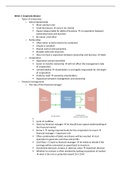
▪ Cycle of cashflow
▪ Starts by financial manager → he should have a good understanding of
the financial market
▪ Arrow 1 → raising required funds for the corporation to invest →
financial manager = important role
▪ Often combination of debts and shares will be invested → start
operation to generate cash flow and profits
▪ Cash flow = 3, back to financial manager → he needs to decide if the
earnings will be reinvested or payed back to investors
▪ Investment decisions creates or destroys value → important decision
▪ Whether to reinvest is often decided by looking at payment of market
→ what is the risk or potential reward 10 à 15%?
, ▪ 1, 4a & 4b are financial decisions
▪ 2 is investment decision
o Financial goal of corporation
▪ Goal = maximize shareholder (stockholder) value
• Increasing value of corporation → increase price of share →
increase wealth of shareholder
▪ Stockholders often agree/want three things
• Maximize current wealth
• Transform wealth into most desirable time pattern of
consumption, invest now or consume now? → shareholders
could do this on their own, corporation does not need to do
this
• To manage risk characteristics of chosen consumption plan →
shareholders could do this on their own, corporation does not
need to do this
▪ Compare to other goals like maximizing profits, maximize market
share, avoid bankruptcy → complete story
• Maximizing profits → on which terms? Long/short run
• Increasing market share → at which losses?
• Avoid bankruptcy → what if further losses are made?
• Furthermore, ethics and trust manners need to be held up,
many shareholders care about long term
− Time value of money
o Interest rates
▪ Positive interest rates imply money you invest today will be worth
more in the future
▪ 5% annual interest → 110, - will be 105, - a year later
o Future value
▪ Future value (FV) = the amount an investment is worth after one or
more periods
▪ FV of the 100 = 105 at an interest rate of 5%
▪ Period can be several lengths → not a year per se, more or less than a
year is possible
o Time convention
▪ Year 0 = end of year 0
▪ Next year = end of year 1
o Terminology
▪ Simple interest = interest earned only on the original principal amount
invested
▪ Compound interest = interest earned on both the initial principal and
the interest reinvested from prior periods
▪ Compound interest starts showing after the first period
▪ Original amount = V0
▪ Interest rate = r
, ▪
▪
▪
▪ How can we see what the components are of the interest? → Total
interest after two years
▪
▪ Compounding is powerful over much time or with much money →
small amount, but in the end, it matters
− Present value and discounting
o Present value
▪ The current value of future cash flows discounted at the appropriate
discount rate
▪ Assuming you have an amount in the future, how much is it worth
today?
▪ If I receive more than one cashflow in the future, all discount them to
the value
▪
, o Present value discount factor = DF
▪ Discount factor = DF = PV/FV → present value/future value
▪ Discount factor = discount factors can be used to compute present
value of any cash flow
▪ PV = Vt * DF
▪
o Cash flows in multiple periods
▪ Discounting to present values enables you to add up multiple cash
flows
▪
▪ R = discount rate?
− Net present value (NPV)
o NPV
▪ Difference between the invested amount and the future cash flows
discounted till today
▪ Adding present values of cash flows from multiple periods can be
extremely useful because it can tell you if an investment is profitable
▪ Invested an amount today, realizing you’re going to receive different
cash flows in the future
▪
▪ If NPV > 0, investment is profitable
▪ If NPV < 0, investment is not profitable
o Exercise NPV
▪ Investment of 5 mln generates cashflow of 3 mln for the next two
years, discount rate of 5%
▪
o Tying PV and FV together
▪
o Difference in definitions
− Types of enterprises
o Sole proprietorship
▪ Most common one
▪ Small businesses → easy to be started
▪ Owner always liable for debts of business → no separation between
ownership funds and business
▪ By owner controlled
o Partnership
▪ Often when to skills need to be combined
▪ Simple to establish
▪ Shared control and ownership
▪ Broader skills and resources
▪ Does not have a separation between ownership and business → liable
o Corporation
▪ Separation owner/controlled
▪ Easier to transfer ownership → will not affect the management style
of cooperation
▪ Limited liability → shareholders is not legally responsible for the depth
of corporation
▪ Entity by itself → owned by shareholders
▪ Separation between management and ownership
− Financial management
o The role of the financial manager
▪
▪ Cycle of cashflow
▪ Starts by financial manager → he should have a good understanding of
the financial market
▪ Arrow 1 → raising required funds for the corporation to invest →
financial manager = important role
▪ Often combination of debts and shares will be invested → start
operation to generate cash flow and profits
▪ Cash flow = 3, back to financial manager → he needs to decide if the
earnings will be reinvested or payed back to investors
▪ Investment decisions creates or destroys value → important decision
▪ Whether to reinvest is often decided by looking at payment of market
→ what is the risk or potential reward 10 à 15%?
, ▪ 1, 4a & 4b are financial decisions
▪ 2 is investment decision
o Financial goal of corporation
▪ Goal = maximize shareholder (stockholder) value
• Increasing value of corporation → increase price of share →
increase wealth of shareholder
▪ Stockholders often agree/want three things
• Maximize current wealth
• Transform wealth into most desirable time pattern of
consumption, invest now or consume now? → shareholders
could do this on their own, corporation does not need to do
this
• To manage risk characteristics of chosen consumption plan →
shareholders could do this on their own, corporation does not
need to do this
▪ Compare to other goals like maximizing profits, maximize market
share, avoid bankruptcy → complete story
• Maximizing profits → on which terms? Long/short run
• Increasing market share → at which losses?
• Avoid bankruptcy → what if further losses are made?
• Furthermore, ethics and trust manners need to be held up,
many shareholders care about long term
− Time value of money
o Interest rates
▪ Positive interest rates imply money you invest today will be worth
more in the future
▪ 5% annual interest → 110, - will be 105, - a year later
o Future value
▪ Future value (FV) = the amount an investment is worth after one or
more periods
▪ FV of the 100 = 105 at an interest rate of 5%
▪ Period can be several lengths → not a year per se, more or less than a
year is possible
o Time convention
▪ Year 0 = end of year 0
▪ Next year = end of year 1
o Terminology
▪ Simple interest = interest earned only on the original principal amount
invested
▪ Compound interest = interest earned on both the initial principal and
the interest reinvested from prior periods
▪ Compound interest starts showing after the first period
▪ Original amount = V0
▪ Interest rate = r
, ▪
▪
▪
▪ How can we see what the components are of the interest? → Total
interest after two years
▪
▪ Compounding is powerful over much time or with much money →
small amount, but in the end, it matters
− Present value and discounting
o Present value
▪ The current value of future cash flows discounted at the appropriate
discount rate
▪ Assuming you have an amount in the future, how much is it worth
today?
▪ If I receive more than one cashflow in the future, all discount them to
the value
▪
, o Present value discount factor = DF
▪ Discount factor = DF = PV/FV → present value/future value
▪ Discount factor = discount factors can be used to compute present
value of any cash flow
▪ PV = Vt * DF
▪
o Cash flows in multiple periods
▪ Discounting to present values enables you to add up multiple cash
flows
▪
▪ R = discount rate?
− Net present value (NPV)
o NPV
▪ Difference between the invested amount and the future cash flows
discounted till today
▪ Adding present values of cash flows from multiple periods can be
extremely useful because it can tell you if an investment is profitable
▪ Invested an amount today, realizing you’re going to receive different
cash flows in the future
▪
▪ If NPV > 0, investment is profitable
▪ If NPV < 0, investment is not profitable
o Exercise NPV
▪ Investment of 5 mln generates cashflow of 3 mln for the next two
years, discount rate of 5%
▪
o Tying PV and FV together
▪
o Difference in definitions


