

Thinking like a population geneticist:
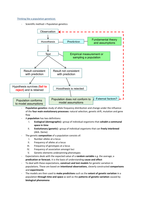
- Scientific method + Population genetics:
Observation
Fundamental theory
Hypothesis Prediction and assumptions
Test Empirical measurement or
sampling a population
Result consistent Result not consistent
with prediction with prediction
Hypothesis survives (fail to
reject) and is retained Hypothesis is rejected
Population does not conform to External factors?
Population conforms
to model assumptions model assumptions
- Population genetics: study of allele frequency distribution and change under the influence
of the four main evolutionary processes: natural selection, genetic drift, mutation and gene
flow
- A population has two definitions:
I. Ecological (demographic) : group of individual organisms that cohabit a communal
space in time
II. Evolutionary (genetic) : group of individual organisms that can freely interbreed
(AKA. Deme)
- The genetic composition of a population consists of:
I. Number alleles at a locus
II. Frequency of alleles at a locus
III. Frequency of genotypes at a locus
IV. Frequency of association amongst loci
V. Genetic elements underpinning phenotypes
- Expectations deals with the expected value of a random variable e.g. the average; a
predication or forecast. It is the basis of understanding cause and effect
- To deal with these expectations, construct and test models for genetic variation in
populations. These are based on intentional observations, cleverly constructed comparisons
and experiments
- The models are then used to make predictions such as the extent of genetic variation in a
population through time and space as well as the patterns of genetic variation caused by
biological phenomena
- Scientific method + Population genetics:
Observation
Fundamental theory
Hypothesis Prediction and assumptions
Test Empirical measurement or
sampling a population
Result consistent Result not consistent
with prediction with prediction
Hypothesis survives (fail to
reject) and is retained Hypothesis is rejected
Population does not conform to External factors?
Population conforms
to model assumptions model assumptions
- Population genetics: study of allele frequency distribution and change under the influence
of the four main evolutionary processes: natural selection, genetic drift, mutation and gene
flow
- A population has two definitions:
I. Ecological (demographic) : group of individual organisms that cohabit a communal
space in time
II. Evolutionary (genetic) : group of individual organisms that can freely interbreed
(AKA. Deme)
- The genetic composition of a population consists of:
I. Number alleles at a locus
II. Frequency of alleles at a locus
III. Frequency of genotypes at a locus
IV. Frequency of association amongst loci
V. Genetic elements underpinning phenotypes
- Expectations deals with the expected value of a random variable e.g. the average; a
predication or forecast. It is the basis of understanding cause and effect
- To deal with these expectations, construct and test models for genetic variation in
populations. These are based on intentional observations, cleverly constructed comparisons
and experiments
- The models are then used to make predictions such as the extent of genetic variation in a
population through time and space as well as the patterns of genetic variation caused by
biological phenomena



