Capsstone Week 5 Discussion: Interprofessional Collaboration (Latest Update) Already Graded A+
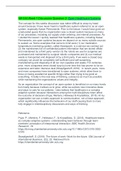
Week 5 Discussion: Interprofessional Collaboration (graded) 11 unread reply.11 reply. Purpose This week's graded topic relates to the following Course Outcome (CO). CO7: Integrates the professional role of leader, teacher, communicator, and manager of care to plan cost-effective, quality healthcare to consumers in structured and unstructured settings. (PO#7) Due Date • Answer post due by Wednesday 11:59 PM MT in Week 5 • Two replies to classmates and/or instructor due by Sunday 11:59 PM MT at the end of Week 5 Directions • Discussions are designed to promote dialogue between faculty and students, and students and their peers. In discussions students: • Demonstrate understanding of concepts for the week • Integrate scholarly resources • Engage in meaningful dialogue with classmates • Express opinions clearly and logically, in a professional manner • Use the rubric on this page as you compose your answers. Discussion Questions Planning for our patients during times of transitions (for example: hospital to home, home to rehabilitation facility) involves collaboration with a number of healthcare professionals. Please address the following questions: • How does your facility promote interprofessional collaboration during times of patient transitions? Every weekday at 10:00 AM we have a meeting called OFT in where we talk about every patient and their barriers to discharge. With talking about barriers to we talk about what is keeping the in the hospital and what we can to get them closer to discharge. ANA (2015) as registered nurse you must participate in interprofessional activities such as education, consultation, research, and management. (Standard 10). During these meeting there is a case manager, social worker, manager, clinical nurse specialist, and doctor. With having many interprofessional at these morning meetings it is easier to figure out the timeline with every patient as to what will be happening. Schub & Walsh (2019) as case management they provide many directions with discharges such as hospital equipment for patients going home. Case manager provide an individualized discharge plan for each patient leaving the hospital such as going to different hospital, skilled nursing facilities, long-term facilities, or home. (p. 1). Nurses work with case management to keep them up to date on any discharge needs for patient so there is not a delay with discharge. • What is the role of the nurse in patient transitions? When it comes to patient transitions nurse are usually the ones to get the ball rolling. To make it a successful transition nurses must identify any barriers that would hold up discharge. Something that would hold up discharge is if a patient needed IV antibiotics and they do not have anything set up for outpatient. The patient would need a PICC line for a RN to come to their home or have Ambulatory Treatment Center (ATC) visits set up for daily antibiotic treatments. For both of things a nurse would just be the initiator with these cares but other interprofessional would finish the process. Nurses must engage patients in learning about the health which would than make them advocates for their health. Most of these steps are put into place because of EBP to make transitions for patient and nurse easier. Patel et al. (2011) EBP is put into place to promote awareness with new and current research. EBP has led to a decrease in medical errors along with a decrease in mortality rates. When decreases the healthcare cost for both the patient and the organization. (p. 228). It has been found that EBP is used to help clarify any uncertainty with education and policy changes. Having EBP is a reliable source to give to patients and families if they need more education or resources. • What gaps can you identify in this process related to quality of care? (If you are not currently in practice, please use a previous role or clinical experience in your answers.) Communication is one of the gaps when it comes to quality care with patients. There have been times I walk into a patient's room and they ask where their pain medications are and that the doctor was here and said I could have some. As nurses you sometimes you have to say generalized statements these situations, I would say I will have to check the orders and call your doctor if they are not there. I would ask the patient did the doctor say what pain medication they were putting in. I understand that doctors see a lot of patients and they sometimes forget to put in orders. I would rather have a doctor call me and tell me they are putting something new so if they forget I can put it later under a verbal order. This is unrealistic sometimes because of the volume of patient's certain doctors have. If this communication was better patients could be receiving treatments faster. Instead of time being spent trying to see if they actually wanted the order in or not. American Nursing Association. (ANA, 2015). Nursing: Scope and standards of practice (3rd ed.). American Nurses Publishing. Patel, P. C., Panzera, A., DeNigris, J., Dunn, R., Chabot, J., & Conners, S. (2011). Evidence-based practice and a nursing journal club: An equation for positive patient outcomes and nursing empowerment. Journal for Nurses in Staff Development, 27(5), 227-230. Schub, T. B., & Walsh, K. R. M. C. (2019). Case Management: Discharge Planning. CINAHL Nursing Guide.
Geschreven voor
Documentinformatie
- Geüpload op
- 19 april 2023
- Aantal pagina's
- 2
- Geschreven in
- 2022/2023
- Type
- Essay
- Docent(en)
- Onbekend
- Cijfer
- A+
Onderwerpen
-
week 5 discussion interprofessional collaboration graded 11 unread reply11 reply purpose this weeks graded topic relates to the following course outcome co co7 integrates the professional