

Consumer Behaviour and Marketing Management
Lecture 1: Tourism as services
• Theories are a way to think about or look at reality
o The more theories you know, the better equiped you are to face problems
o Theories are not true or wrong, but useful or not useful
•
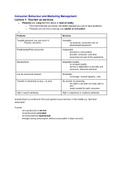
Products Services
Tangible (physical, you can touch it) Intangible
- Pictures, souvenirs - not physical, consumers rely on
place/people/equipment
Prefabricated/Post-consumed Inseparable
- provision is consumption
- provider, consumer, and other
consumers are part of the experience
Standardized Adaptable/variable
- no constant quality
- service is dependent on provider and
consumer, tailored to demand
Can be stored and stocked Perishable
- no storage, unused capacity = lost
Transfer of ownership (to buy = to own) No transfer of ownership
- the right to use does not imply right to
own
- newly created for each consumer
High in search attributes High in experience or credence attributes
Actually there is a continuum from pure goods to pure services: In the middle e.g. “fast food
restaurants”
Tourism:
- not a product but a service
- not produced but provided
- not consumed but experienced
- emerges during consumption (without consumption it does not exist)
, Technical quality: outcome of the process
Functional quality: the process itself
Quality is difficult to evaluate because differences
between attributes:
Search (price, location, facilities) > evaluated Goods – easy
before the purchase decision is made to evaluate
Experience (comfort, functional quality) >
evaluated during use > “post-purchase
satisfaction formation”
Credence (geloof) (safety, authenticity) > can not Services –
be evaluated by the consumer, but may be difficult to
important > consumer has to trust others evaluate
Quality of services: quantity
1. We know what customers expects of the service
2. We design our service according to customer driven standards
3. We deliver the service according to our design & standards
4. We communicate our delivery standards to the consumer
5. The customer perceives our delivered service
6. Customer compares this with expected service > matches > satisfied
The gaps of SERVQUAL
1. (mis) perception of consumer expectations
2. (failure to) specify the required design and standards
3. (failure to) meet the specified standards at the “front desk”
4. (over) communication of delivered service (that’s advertising)
Leading to:
5. (mis) match between expectations and perceived delivery and unsatisfied customers
Limitation: Service experience is created by the (physical) environment of the service
encounter
For the provider:
- Bridging the gap between EXPECTATION and PERCEPTION
- On the following service quality dimensions
- Responsiveness
- Assurance
- Tangibles
- Empathy
- Reliability
Servicescapes [Bitner, 1992]
- Creating environmental conditions
- I.e. transforming physical environment
- To facilitate customer satisfaction
, - I.e. creating satisfactory interactions
- To deliver the desired experience
- I.e. creating a symbolic interpretation
Consumer behaviour
The consumer in services
- As risk avoider > perceived risk = consequence * uncertainty > consumer looks for risk
reduction strategies.
- As rational decision maker > driven by subjective expected utility > alternatives compared
on critical attributes > minimum effort is invested in comparison > focus only on the best
- As searching for control > personal influence on outcome, freedom to anticipate, tension
with organisational procedures
- As actor within a script > ‘all the world is a stage’ > appropriate role taking > script & cues >
deviation from script disturbs service encounter (e.g. at a hotel reception)
- Consumer as partial employee > service encounter requires active participation of consumer
Note: New clients create problem, don’t know what is expected or why employee is missing
(e.g. self service at a gas station)
Note: Since all the models have strengths/weaknesses they should be considered complementary
rather than mutually exclusive.
, Competing as service provider
Basic formula
- Target segment: Tightly defined
- Customer benefit: Clear & simple
- Service provision: Focused
- Service image: Clear
→ Easy to provide, accept, defend
Multi site strategy = replication of basic formula > choosing new locations
Basic competitive choice (blue=description, black=strategy)
→place independet = internet
Catchment area = area from where guests/ customers come
→ high destination value → large catchment area
Creating destination value: -High marketing costs/investments
-Hard to build, hard to attack (high entry barriers)
Lecture 1: Tourism as services
• Theories are a way to think about or look at reality
o The more theories you know, the better equiped you are to face problems
o Theories are not true or wrong, but useful or not useful
•
Products Services
Tangible (physical, you can touch it) Intangible
- Pictures, souvenirs - not physical, consumers rely on
place/people/equipment
Prefabricated/Post-consumed Inseparable
- provision is consumption
- provider, consumer, and other
consumers are part of the experience
Standardized Adaptable/variable
- no constant quality
- service is dependent on provider and
consumer, tailored to demand
Can be stored and stocked Perishable
- no storage, unused capacity = lost
Transfer of ownership (to buy = to own) No transfer of ownership
- the right to use does not imply right to
own
- newly created for each consumer
High in search attributes High in experience or credence attributes
Actually there is a continuum from pure goods to pure services: In the middle e.g. “fast food
restaurants”
Tourism:
- not a product but a service
- not produced but provided
- not consumed but experienced
- emerges during consumption (without consumption it does not exist)
, Technical quality: outcome of the process
Functional quality: the process itself
Quality is difficult to evaluate because differences
between attributes:
Search (price, location, facilities) > evaluated Goods – easy
before the purchase decision is made to evaluate
Experience (comfort, functional quality) >
evaluated during use > “post-purchase
satisfaction formation”
Credence (geloof) (safety, authenticity) > can not Services –
be evaluated by the consumer, but may be difficult to
important > consumer has to trust others evaluate
Quality of services: quantity
1. We know what customers expects of the service
2. We design our service according to customer driven standards
3. We deliver the service according to our design & standards
4. We communicate our delivery standards to the consumer
5. The customer perceives our delivered service
6. Customer compares this with expected service > matches > satisfied
The gaps of SERVQUAL
1. (mis) perception of consumer expectations
2. (failure to) specify the required design and standards
3. (failure to) meet the specified standards at the “front desk”
4. (over) communication of delivered service (that’s advertising)
Leading to:
5. (mis) match between expectations and perceived delivery and unsatisfied customers
Limitation: Service experience is created by the (physical) environment of the service
encounter
For the provider:
- Bridging the gap between EXPECTATION and PERCEPTION
- On the following service quality dimensions
- Responsiveness
- Assurance
- Tangibles
- Empathy
- Reliability
Servicescapes [Bitner, 1992]
- Creating environmental conditions
- I.e. transforming physical environment
- To facilitate customer satisfaction
, - I.e. creating satisfactory interactions
- To deliver the desired experience
- I.e. creating a symbolic interpretation
Consumer behaviour
The consumer in services
- As risk avoider > perceived risk = consequence * uncertainty > consumer looks for risk
reduction strategies.
- As rational decision maker > driven by subjective expected utility > alternatives compared
on critical attributes > minimum effort is invested in comparison > focus only on the best
- As searching for control > personal influence on outcome, freedom to anticipate, tension
with organisational procedures
- As actor within a script > ‘all the world is a stage’ > appropriate role taking > script & cues >
deviation from script disturbs service encounter (e.g. at a hotel reception)
- Consumer as partial employee > service encounter requires active participation of consumer
Note: New clients create problem, don’t know what is expected or why employee is missing
(e.g. self service at a gas station)
Note: Since all the models have strengths/weaknesses they should be considered complementary
rather than mutually exclusive.
, Competing as service provider
Basic formula
- Target segment: Tightly defined
- Customer benefit: Clear & simple
- Service provision: Focused
- Service image: Clear
→ Easy to provide, accept, defend
Multi site strategy = replication of basic formula > choosing new locations
Basic competitive choice (blue=description, black=strategy)
→place independet = internet
Catchment area = area from where guests/ customers come
→ high destination value → large catchment area
Creating destination value: -High marketing costs/investments
-Hard to build, hard to attack (high entry barriers)


