
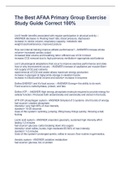
The Best AFAA Primary Group Exercise Study Guide Correct 100%
8 health benefits associated with regular participation in physical activity. - ANSWER decrease in: Resting heart rate, blood pressure, depression increase in: stroke volume, respiratory List capacity, metabolic rate weight loss/maintenance, improved posture How can interval training improve athletic performance? - ANSWER increase stroke volume= increased cardiac output increased tidal volume and breathing ratio= efficient use of O2 in blood increase CO2 removal due to high pulmonary ventilation= appropriate acid balance List 3 physiological adaptations that occur to improve exercise performance and state how or why improvement occurs. - ANSWER increase of capillaries per muscle fiber= rich supply of O2 and nutrients rapid removal of CO2 and waste allows maximum energy production increase in glycogen & triglycoride storage in skeletal muscle increase in mitochondrial volume and activity= increase in enzymes Define ENERGY and it's food source. - ANSWER Energy= the ability to do work. Food source is carbohydrates, protein, and fats. Define ATP. - ANSWER High energy phosphate molecule required to provide energy for cellular function. Produced both anaerobically and aerobically and stored in the body. ATP-CP/ phosphagen system - ANSWER Simplest of 3 systems- short bursts of energy fuel source= creatine phosphate intensity= very high 95% of max intensity duration= 15-20 seconds Uses of this system= sprinting, jumping, lifting heavy things quickly, throwing a ball, kicking Lactic acid system - ANSWER anaerobic glycolytic, sustained high intensity effort lasting 1-2 minutes fuel source= glucose- carbs breaking down into sugars intensity= short rallies, bursts, high-moderate 85-94% of max intensity duration= 1-2 minutes Uses of this system= prolonged sprints, rallies in soccer, floor routine in gymnastics, Aerobic system - ANSWER oxidative metabolism fuel source= glucose, fat, or protein intensity= moderate 75-85% of max intensity duration= 3-5 minutes or more Uses of this system= resting activities, walking, jogging, swimming, AEROBIC - ANSWER with oxygen; requiring oxygen to be sustained ANAEROBIC - ANSWER without oxygen; short bursts w/o oxygen, explosive movements STEADY STATE - ANSWER constant submaximal exercise below lactate level so that energy production and oxygen absorption meets requirements of imposed exercise EXCESS POST-OXYGEN CONSUMPTION (EPOC) - ANSWER O2 remaining elevated above resting levels for several minutes during recovery OXYGEN DEFICIT - ANSWER O2 consumption is lower than necessary to supply appropriate ATP production required of any exercise ANAEROBIC THRESHOLD - ANSWER The point at which the body can no longer meet its demand for oxygen and anaerobic metabolism is accelerated AEROBIC CAPACITY - ANSWER Ability of the body to remove O2 from the air and transfer it thru lung and blood to working muscles LACTIC ACID - ANSWER By-product of anaerobic metabolism of glucose. AEROBIC QUALITIES - ANSWER -complete breakdown of glucose -can utilize carbs, fats, or proteins as fuel -long duration activity -smaller EPOC -submaximal work (moderate intensity) -CO2 and H2) are end products -uses oxygen in chemical breakdown ANAEROBIC QUALITIES - ANSWER -partial breakdown of glucose -can only use carbs as fuel -short duration activity
Document information
- Uploaded on
- April 18, 2023
- Number of pages
- 19
- Written in
- 2022/2023
- Type
- Exam (elaborations)
- Contains
- Questions & answers


