

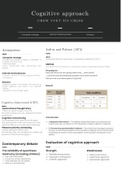
Cognitive approach
CHOW YUET TIN CHLOE
Computer analogy Internal mental process Schema
Assumptions Loftus and Palmer (1974)
Computer analogy Aim
-Compare the process of taking in information of
concerned with the inaccuracy of eyewitness testimony (EWT).
computer and human mind
-multi store model: Method
sensory memory>short term memory>long term
two experiments conducted in a laboratory using an independent groups design.
memory
Procedure
Internal mental process how fast were the cars going when they _ each other?
-Perception, attention, memory, language, thinking _=(hit/smashed/collided/bumped/contacted/recorded)
-introspection
Did you see any broken glass? (yes/no)
Schema
-organised packets of information that are built up
through experience, and stored in our long-term Result
memory.
-dog schema: furry, four legs, loyalty
Cognitive-behavioural (CBT)
Dysfunctional thought diary
-clients are asked to keep a record of
the events leading up to any unpleasant emotions
experienced
Cognitive restructuring Conclusion
-By challenging these dysfunctional thoughts,
1. Response-bias factors – The different speed estimates occur because the
and replacing them with more constructive ones,
critical word (e.g. ‘smashed’ or ‘hit’) influences or biases a person’s response.
clients are able to try out new ways of behaving.
Pleasant activity scheduling 2. The memory representation is altered – The critical word changes a person’s
involves asking the client to plan memory so that their perception of the accident is affected. Some critical words
for each day (say, over the period of a week), one would lead someone to have a perception of the accident having been more
pleasant activity they will engage in. serious.
Contemporary debate Evaluation of cognitive approach
The reliability of eyewitness Strength Weaknesses
testimony (including children) Mediational processes Nature and nurture
Post-event information Important contributions Determinist approach
Crimes are emotive experiences Scientific approach Mechanistic approach
Child witnesses are not reliable
Memory is reconstructive
CHOW YUET TIN CHLOE
Computer analogy Internal mental process Schema
Assumptions Loftus and Palmer (1974)
Computer analogy Aim
-Compare the process of taking in information of
concerned with the inaccuracy of eyewitness testimony (EWT).
computer and human mind
-multi store model: Method
sensory memory>short term memory>long term
two experiments conducted in a laboratory using an independent groups design.
memory
Procedure
Internal mental process how fast were the cars going when they _ each other?
-Perception, attention, memory, language, thinking _=(hit/smashed/collided/bumped/contacted/recorded)
-introspection
Did you see any broken glass? (yes/no)
Schema
-organised packets of information that are built up
through experience, and stored in our long-term Result
memory.
-dog schema: furry, four legs, loyalty
Cognitive-behavioural (CBT)
Dysfunctional thought diary
-clients are asked to keep a record of
the events leading up to any unpleasant emotions
experienced
Cognitive restructuring Conclusion
-By challenging these dysfunctional thoughts,
1. Response-bias factors – The different speed estimates occur because the
and replacing them with more constructive ones,
critical word (e.g. ‘smashed’ or ‘hit’) influences or biases a person’s response.
clients are able to try out new ways of behaving.
Pleasant activity scheduling 2. The memory representation is altered – The critical word changes a person’s
involves asking the client to plan memory so that their perception of the accident is affected. Some critical words
for each day (say, over the period of a week), one would lead someone to have a perception of the accident having been more
pleasant activity they will engage in. serious.
Contemporary debate Evaluation of cognitive approach
The reliability of eyewitness Strength Weaknesses
testimony (including children) Mediational processes Nature and nurture
Post-event information Important contributions Determinist approach
Crimes are emotive experiences Scientific approach Mechanistic approach
Child witnesses are not reliable
Memory is reconstructive


