

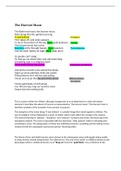
The Harvest Moon
The flame-red moon, the harvest moon,
Rolls along the hills, gently bouncing,
A vast balloon, *metaphor
Till it takes off, and sinks upward
To lie on the bottom of the sky, like a gold doubloon. *similes
The harvest moon has come,
Booming softly through heaven, like a bassoon. *onomatopoeia
And the earth replies all night, like a deep drum.
So people can't sleep,
So they go out where elms and oak trees keep
A kneeling vigil, in a religious hush.
The harvest moon has come! *celebratory exclamation
And all the moonlit cows and all the sheep
Stare up at her petrified, while she swells
Filling heaven, as if red hot, and sailing
Closer and closer like the end of the world. *Biblical allusion
Apocalypse
Till the gold fields of stiff wheat
Cry `We are ripe, reap us!' and the rivers
Sweat from the melting hills.
This is a poem written for children although it progresses to an ending that has a dark and sinister
element. It describes the advent of harvest as represented by “the harvest moon”. The harvest moon is
therefore symbolic of the transition from summer to autumn.
The metaphor of the moon being “A vast balloon” is a playful image that would appeal to children. The
use of metaphor is then followed by a series of similes which could reflect the change in the seasons.
The internal rhyming of “balloon”; “doubloon” and “bassoon” is playful and mimics the bouncing of the
metaphoric balloon. The moon is described with the oxymoron “sinks upward” which is indicating that
something is amiss. The juxtaposition of these two antithetical words is unsettling and this feeling is then
reinforced with the subsequent oxymoronic phrase “Booming softly”.
The theme of fear and death become more obvious in the subsequent verses with people being unable
to sleep and the animals being fearful. The reference to “the end of the world” is a Biblical allusion to the
Apocalypse which is reinforced by the cry of “Reap us” from the “gold fields”. It is a reference to the
The flame-red moon, the harvest moon,
Rolls along the hills, gently bouncing,
A vast balloon, *metaphor
Till it takes off, and sinks upward
To lie on the bottom of the sky, like a gold doubloon. *similes
The harvest moon has come,
Booming softly through heaven, like a bassoon. *onomatopoeia
And the earth replies all night, like a deep drum.
So people can't sleep,
So they go out where elms and oak trees keep
A kneeling vigil, in a religious hush.
The harvest moon has come! *celebratory exclamation
And all the moonlit cows and all the sheep
Stare up at her petrified, while she swells
Filling heaven, as if red hot, and sailing
Closer and closer like the end of the world. *Biblical allusion
Apocalypse
Till the gold fields of stiff wheat
Cry `We are ripe, reap us!' and the rivers
Sweat from the melting hills.
This is a poem written for children although it progresses to an ending that has a dark and sinister
element. It describes the advent of harvest as represented by “the harvest moon”. The harvest moon is
therefore symbolic of the transition from summer to autumn.
The metaphor of the moon being “A vast balloon” is a playful image that would appeal to children. The
use of metaphor is then followed by a series of similes which could reflect the change in the seasons.
The internal rhyming of “balloon”; “doubloon” and “bassoon” is playful and mimics the bouncing of the
metaphoric balloon. The moon is described with the oxymoron “sinks upward” which is indicating that
something is amiss. The juxtaposition of these two antithetical words is unsettling and this feeling is then
reinforced with the subsequent oxymoronic phrase “Booming softly”.
The theme of fear and death become more obvious in the subsequent verses with people being unable
to sleep and the animals being fearful. The reference to “the end of the world” is a Biblical allusion to the
Apocalypse which is reinforced by the cry of “Reap us” from the “gold fields”. It is a reference to the


