Summary AQA A Level Tudors
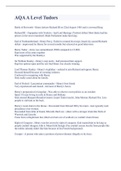
AQA A Level Tudors Battle of Bosworth - Henry defeats Richard III on 22nd August 1485 and is crowned King. Richard III - Unpopular with Yorkists - had Lord Hastings (Yorkist) killed. Most likely had the princes in the tower murdered. Made Parliament make him king. Earl of Northumberland - Henry Percy. Failed to commit his troops. Inactivity caused Richards defeat - imprisoned by Henry for several months but released on good behaviour. Henry Tudor - Army was outnumbered (5000 compared to 15,000) Kept most of his army together Was supported by the Stanleys. Sir William Stanley - Henry's step uncle - half promised him support. Kept his options open until he saw that Henry was clearly winning. Lord Thomas Stanley - Henry's stepfather - ordered to join Richard and oppose Henry. Excused himself because of sweating sickness. Confessed to conspiring with Henry. Only really cared about his family. Earl of Oxford - Lancastrian commander - Henry's best friend. Very experienced and trusted - led most of Henry's forces. Henry's preparation for kingship - Was able to observe court politics as an outsider. Spent 14 years living in exile in France and Brittany. Only trusted Margaret Beaufort (mum), Jasper Tudor (uncle), John Morton, Richard Fox. Less people to stab him in the back. Henry's weak claim to the throne - Descended from Edward III by his mum - men typically took precedence over women. Descended from John of Gaunt, Edwards third son - others with a stronger claim like Earls of Warwick and Lincoln. Came from a illegitimate line (third son born out of wedlock) so couldn't claim throne. Right of Conquest - Henry won the crown by right of conquest; God wanted him to be king so people couldn't disagree with it. Meant little though if he couldn't ensure loyalty from people like the nobles (already didn't like him because of his French background). Usurper - A person who takes a position of power (throne) illegally or by force. Parliamentary Sanction - An official confirmation or ratification of a law given by Parliament as the acclaimed body of the State; by the laws of the time, King Henry VII's tenuous claims to the throne would normally have had to be fortified by a parliamentary sanction. Act of Attainder - This declared a landowner guilty of rebelling against a monarch; the attended noble lost his title, lands and sometimes his head; his heirs were disinherited. Tonnage and Poundage - The right to raise revenue for the whole reign from imports and exports. Legitimising his succession as king - Jan. 86. married Elizabeth of York. Son was born - Prince Arthur. Created Tudor Rose - gave him a dual claim. Predated reign to day before Battle of Bosworth - made anyone fighting for York a traitor. 86. went on royal progress to the north to demonstrate his power. Gaining greater control over the nobility - Imprisoned those with a better claim - Earl of Warwick and Elizabeth of York. Rewarded supporters - created 11 knighthoods. Made key appointments - William Stanley became Chamberlain of the Household. Earl of Surrey imprisoned until 1489. Earl of Northumberland given control of north. Strengthening his support and financial basis - Parliament granted him tonnage and poundage. Acts of Attainder against those who fought for Richard. Jasper Tudor made Duke of Bedford in control of Wales. Thomas Stanley became Earl of Derby. John Morton appointed Chancellor and Archbishop of Canterbury in 1486. Feudal System - God King Nobles Midlings Commoners. (Nobles get too powerful). Mercenaries - Hired soldiers who work simply for pay and have no specific commitment to the cause for which they are fighting. Lovell Stafford Uprising - April 1486 Dynastic Lovell Stafford Uprising Causes - Led by Viscount Lovell and Stafford brothers who were pro-Yorkist and wanted to gain financially and in social standing. Lovell Stafford Uprising - what happened? - Lovell fled after Battle of Bosworth with the Staffords. Lovell tried to start a rebellion in Yorkshire and the Staffords in Worcestershire - little traction as no Yorkist pretender to rally around. Henry came with an army and Lovell escaped and went to support Simnel. No foreign support and little domestic support. Lovell Stafford Uprising - actions of Henry VII - Word of rebellion reached him in Lincoln so he hurried to York and sent Jasper to the countryside with a pardon for every rebel except Lovell - this drained support. Henry sent army to Worcestershire to support collapsed. Humphrey S executed and Thomas S imprisoned. Lovell Stafford Uprising - serious? - Wanted to overthrow Henry who already had a weak claim. Had little support and Henry was more concerned with the general instability of his rule than any threat from the rebels. Lambert Simnel Rebellion - 1486-87 Dynastic Lambert Simnel Rebellion - Causes - Simnel had a striking resemblance to princes in the tower. Symonds, a Yorkist, decided to pass him off as the Earl of Warwick. The Yorkist wanted to overthrow Henry. Lambert Simnel Rebellion - what happened? - Symonds took Simnel to Ireland - centre of Yorkist support. Lord Lieutenant (Earl of Kildare) proclaimed Simnel King. Organised by John de la Pole, earl of Lincoln. Duchess of Burgundy sent 2000 German soldiers to Ireland to support them. Rebels landed in England but defeated at Stoke. Lincoln was killed and Simnel made Henry's kitchen boy. Lambert Simnel Rebellion - actions of Henry VII - Had real Earl of Warwick exhibited in London to counter the hoax. Pardoned rebels like Thomas Broughton to get them on his side. Prepared for Lincoln at Stoke (12,000 men compared to 8000). Symonds sentence to life, 28 nobles had estates confiscated. Lambert Simnel Rebellion - serious? - Had foreign support (Burgundy, Ireland) and posed biggest military threat. Ended with last battle of the War of the Roses - Battle of Stoke Field. Simnel was just a pretender with no real claim. Battle only lasted 3 hours. Yorkshire Rebellion - April 1489 Socio Economic Yorkshire Rebellion - Causes - Henry planned to help Brittany maintain independence in France. £100,000 had to be raised by taxation (only £27,000 actually raised). Yorkshire had been hit by a poor harvest so tax was too far and they were angry that some northern were exempt as they defended the Scottish border. Yorkshire Rebellion - what happened? - Henry Percy, Earl of Northumberland, represented the people but Henry refused to listen to him as he didn't want to be seen as a weak leader. Percy told Yorkshire this - instantly murdered (known to support the tax to stay on Henry's good side). Sir John Egremont led the rebels; easily put down by Earl of Surrey so he fled to Flanders. Yorkshire Rebellion - actions of Henry VII - Refused to listen to Northumberland and sent army of 8000 when rebels demanded a pardon. Rebel leader before Egremont (John a Chambre) hanged for treason - taxes stopped and rebels granted royal pardon. Henry realised how loyal north were to Yorkists so sent Earl of Surrey to be lieutenant in north - many years reconciling the region to Tudor rule. Yorkshire Rebellion - serious? - Only £27,000 raised so Henry couldn't ally with Brittany and showed him as a weak leader as he couldn't even raise money from own people. Rebellion only stayed in Yorkshire and their representative was quick killed. Never about actually dethroning Henry so he was safe. Cornish Rebellion - 1497 Socio Economic Cornish Rebellion - Causes - In January, Parliament voted for a tax to fund the campaign against James IV and Warbeck. The Cornish didn't want to contribute as it didn't affect them. Cornish Rebellion - what happened? - Cornish rebels refused to pay the tax to help the north. Joseph and Flammank led the rebels from Bodmin in May until they gained a leader, Lord Audley. Reached outskirts of London in June and 15,000 camped on Blackheath. Supported by Audley, a noble, and Flammank, gentry. No foreign support. Cornish Rebellion - actions of Henry VII - Recalled army back to London and the 25,000 soldiers easily defeated 15,000 rebels - 1000 killed. Some rebels arrested and all 3 leaders executed. Severe financial penalties placed on rebels afterwards. Cornish Rebellion - serious? - Marched from Bodmin to Blackheath without being challenged - Henry's efforts placed on Scotland. Had to take soldiers away from Scottish border - could've posed a threat from the north. Almost no support outside Cornwall. Wasn't a plan to dethrone Henry so after he refused to negotiate, there was little they could do. Suffolk Threat - Dynastic Suffolk Threat - Causes - Edmund de la Pole, Earl of Suffolk, was a Yorkist heir to the throne - his brother, Lincoln, was killed in Simnel Rebellion. Appeared loyal to Henry but wanted to claim the throne. Suffolk Threat - what happened? - Suffolk fled to Flanders in 1498 and Henry feared France would use him to launch an invasion. Persuaded to return to England but fled again in 1501 and sought refuge at court of Holy Roman Emperor Maximilian, other Yorkists joined. Safe as long as Margaret of Burgundy opposed Henry. Suffolk Threat - actions of Henry VII - Treaty of Windsor in 1506 meant friendly relations restored - Maximilian gave up Suffolk and imprisoned in Tower of London. Suffolk family in
Document information
- Uploaded on
- April 15, 2023
- Number of pages
- 11
- Written in
- 2022/2023
- Type
- Summary