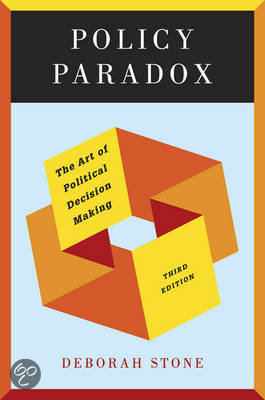
Policy paradox
Introduction
Aims
1. The rationality project misses the point of politics. I aim to construct a mode of policy
analysis that recognizes the dark, self-interested side of a political conflict but also sees
politics as a valuable creative process for social harmony.
2. The rationality project worships objectivity and seeks modes of analysis that will lead to the
objectively best results for society. I aim to construct a mode of policy analysis that
recognizes analytic concepts, problem definitions, and policy instruments as political claims
themselves, instead of granting them privileged status as universal truths. decision
makers must bring their own values into the picture.
3. The field of public policy is dominated by economics and its model of society as a market.
I start from a model of community where individuals live in a dense web of relationships,
dependencies and loyalties.
Chapter 1: The market and the polis
Polis: Name for a model of political society because it conjures up an entity small enough to have
very simple forms of organization yet large enough to embody the essential elements of political
society collective will and collective effort.
- Include a distinction between political community (a group of people who live under the
same political rules and structure of governance) and cultural community (a group of people
who share a culture and draw their identities from a shared language, history and traditions.
Market: Social system in which individuals pursue their own welfare by exchanging things with
others whenever trades are mutually beneficial. Participants in a market compete with each other for
scarce resources. Individuals act only to maximize their own self-interest.
Membership policies: policies about who gets to become a resident or a citizen of any political
jurisdiction, and what social and civic rights will be accorded them.
Altruism: acting in order to benefit others rather than oneself (taking care of children/helping the
sick).
- Polis: can be just as fierce as self-interest.
Public interest:
- Market theory: The net result of all individuals pursuing their self-interest. The empty box of
public interest gets filled as an afterthought with the side effects of other activities.
- Polis theory: people fill the box intentionally, with forethought, planning and conscious
effort.
Commons problems: situations where self-interest and public interest work against each other
collective action problems
, Polis: how to have both private benefits and collective benefits. Policy problems are common
problems.
Market: the exception rather than the rule. Most actions in the market model do not have social
consequences.
Influence The gap is bridged by some potent forces: influence, cooperation and loyalty
Cooperation
In the polis, cooperation is every bit as important as competition.
Politics involves seeking allies and cooperating with them in order to compete with
opponents. Whenever there are two sides of an issue, there must be alliances among the
people on one side.
It is essential to power. Cooperation is often a more effective form of subordination than
coercion.
Loyalty
Market: when a store hikes his prices or lets its products and service deteriorate, a shrewd buyer will
switch stores. (buyers and sellers)
In politics: relationships involve gifts, favors, support and future obligations. (enemy’s and friends)
Groups
Groups and organizations, rather than individuals, are the building blocks of the polis.
- People belong to institutions and organizations, even when they aren’t formal members.
- Policy making isn’t only about solving public problems but about how groups are formed,
split and re-formed to achieve public purposes. (groups confront each other, using
individuals only as their spokes people)
- Groups are important because decisions of the polis are collective. They are explicitly
collective through formal procedures (voting) and through public bodies.
- The pluralist theory holds that all important interests have the capacity to form interest
groups and that these interest groups have relatively equal chances to make their voices
heard in the political system. not polis
Information
Information is accurate, complete and available to everyone at no cost.
Polis: information is ambiguous, incomplete, often strategically shaded and sometimes deliberately
withheld. People act on what they believe to be the financial health of company. Information is never
complete (information is never fully and equally available to all participants in politics political
actors very often deliberately keep crucial information secret)
Who tells us the information and how is it presented?
Political actors strive to control interpretations.
Passion
Market: economic resources are governed by the laws of matter. Resources are finite, scarce and
used up when they are used. People and material can do only one thing at the time.
Introduction
Aims
1. The rationality project misses the point of politics. I aim to construct a mode of policy
analysis that recognizes the dark, self-interested side of a political conflict but also sees
politics as a valuable creative process for social harmony.
2. The rationality project worships objectivity and seeks modes of analysis that will lead to the
objectively best results for society. I aim to construct a mode of policy analysis that
recognizes analytic concepts, problem definitions, and policy instruments as political claims
themselves, instead of granting them privileged status as universal truths. decision
makers must bring their own values into the picture.
3. The field of public policy is dominated by economics and its model of society as a market.
I start from a model of community where individuals live in a dense web of relationships,
dependencies and loyalties.
Chapter 1: The market and the polis
Polis: Name for a model of political society because it conjures up an entity small enough to have
very simple forms of organization yet large enough to embody the essential elements of political
society collective will and collective effort.
- Include a distinction between political community (a group of people who live under the
same political rules and structure of governance) and cultural community (a group of people
who share a culture and draw their identities from a shared language, history and traditions.
Market: Social system in which individuals pursue their own welfare by exchanging things with
others whenever trades are mutually beneficial. Participants in a market compete with each other for
scarce resources. Individuals act only to maximize their own self-interest.
Membership policies: policies about who gets to become a resident or a citizen of any political
jurisdiction, and what social and civic rights will be accorded them.
Altruism: acting in order to benefit others rather than oneself (taking care of children/helping the
sick).
- Polis: can be just as fierce as self-interest.
Public interest:
- Market theory: The net result of all individuals pursuing their self-interest. The empty box of
public interest gets filled as an afterthought with the side effects of other activities.
- Polis theory: people fill the box intentionally, with forethought, planning and conscious
effort.
Commons problems: situations where self-interest and public interest work against each other
collective action problems
, Polis: how to have both private benefits and collective benefits. Policy problems are common
problems.
Market: the exception rather than the rule. Most actions in the market model do not have social
consequences.
Influence The gap is bridged by some potent forces: influence, cooperation and loyalty
Cooperation
In the polis, cooperation is every bit as important as competition.
Politics involves seeking allies and cooperating with them in order to compete with
opponents. Whenever there are two sides of an issue, there must be alliances among the
people on one side.
It is essential to power. Cooperation is often a more effective form of subordination than
coercion.
Loyalty
Market: when a store hikes his prices or lets its products and service deteriorate, a shrewd buyer will
switch stores. (buyers and sellers)
In politics: relationships involve gifts, favors, support and future obligations. (enemy’s and friends)
Groups
Groups and organizations, rather than individuals, are the building blocks of the polis.
- People belong to institutions and organizations, even when they aren’t formal members.
- Policy making isn’t only about solving public problems but about how groups are formed,
split and re-formed to achieve public purposes. (groups confront each other, using
individuals only as their spokes people)
- Groups are important because decisions of the polis are collective. They are explicitly
collective through formal procedures (voting) and through public bodies.
- The pluralist theory holds that all important interests have the capacity to form interest
groups and that these interest groups have relatively equal chances to make their voices
heard in the political system. not polis
Information
Information is accurate, complete and available to everyone at no cost.
Polis: information is ambiguous, incomplete, often strategically shaded and sometimes deliberately
withheld. People act on what they believe to be the financial health of company. Information is never
complete (information is never fully and equally available to all participants in politics political
actors very often deliberately keep crucial information secret)
Who tells us the information and how is it presented?
Political actors strive to control interpretations.
Passion
Market: economic resources are governed by the laws of matter. Resources are finite, scarce and
used up when they are used. People and material can do only one thing at the time.