
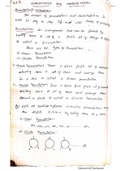
Summary Mathematics chapter name permutations and combinations.
Permutations and Combinations are two fundamental concepts in combinatorics, which is a branch of mathematics concerned with counting and arranging objects. In the context of this chapter, we are interested in studying how many ways we can select or arrange a group of objects. Permutations refer to the number of ways we can arrange a set of objects in a particular order. The order in which the objects are arranged matters. For example, if we have three objects A, B, and C, there are six permutations: ABC, ACB, BAC, BCA, CAB, and CBA. The formula for finding the number of permutations of n objects taken r at a time is: P(n,r) = n! / (n-r)! Where n! represents n factorial, which is the product of all positive integers up to n. Combinations refer to the number of ways we can select a subset of objects from a larger set, without regard to the order in which they are chosen. For example, if we have three objects A, B, and C, there are three combinations of two objects: AB, AC, and BC. The formula for finding the number of combinations of n objects taken r at a time is: C(n,r) = n! / r!(n-r)! Both permutations and combinations have various applications in mathematics, statistics, and computer science. They are used in problems involving probability, statistics, cryptography, and algorithm design.
Document information
- School year
- 1
- Uploaded on
- April 4, 2023
- Number of pages
- 3
- Written in
- 2022/2023
- Type
- Summary


