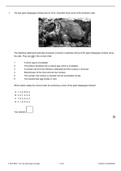
1 The last giant Galapagos tortoise died in 2012. Scientists froze some of the tortoise's cells.
The following statements describe processes involved in potential cloning of the giant Galapagos tortoise using
the cells. They are not in the correct order.
1 A donor egg is enucleated.
2 The embryo develops into a mature egg, which is incubated.
3 A somatic cell from the tortoise is defrosted and the nucleus is removed.
4 Electrofusion of the host cell and new nucleus.
5 The somatic cell nucleus is inserted into the enucleated oocyte.
6 The transformed egg divides in vitro.
Which option states the correct order for producing a clone of the giant Galapagos tortoise?
A 1, 3, 4, 5, 6, 2
B 3, 5, 1, 4, 2, 6
C 1, 6, 3, 5, 4, 2
D 3, 1, 5, 4, 6, 2
Your answer
[1]
© OCR 2023. You may photocopy this page. 1 of 53 Created in ExamBuilder
, 2(a) It is possible to clone animals using a technique called somatic cell nuclear transfer (SCNT).
The most well-known example of this was the cloning of Dolly the sheep in 1996.
Thirty years before Dolly the sheep, successful cloning of an animal was carried out using a frog, Xenopus
laevis.
Frogs lay eggs in water. These eggs then develop and hatch into swimming tadpoles. When the tadpoles grow to
a certain size they develop into adult frogs.
The cloning process is outlined in Fig. 19.1.
© OCR 2023. You may photocopy this page. 2 of 53 Created in ExamBuilder
, Fig. 19.1
(i) Describe what is happening at stage A and suggest a practical procedure that could allow this to occur.
© OCR 2023. You may photocopy this page. 3 of 53 Created in ExamBuilder
, [2]
(ii) Identify a key difference between the processes between stages A and C and the cloning of Dolly the sheep.
[1]
(iii) The frog produced by the process in Fig. 19.1 is not a complete clone of the donor tadpole.
Suggest why the cloned frog might not be considered a complete clone of the donor tadpole.
[1]
(b) One measure of the success of cloning procedures is the number of pregnancies that result in live births.
Table 19 shows information from the work of many scientists about the success of SCNT in four different
species.
Species Number of pregnancies Number of live births
Goat 26 8
Monkey 3 2
Mouse 438 56
Sheep 110 48
Table 19
(i) Calculate the percentage of pregnancies that resulted in live births in goats and mice.
live births in goats = ........................................................... %
© OCR 2023. You may photocopy this page. 4 of 53 Created in ExamBuilder
The following statements describe processes involved in potential cloning of the giant Galapagos tortoise using
the cells. They are not in the correct order.
1 A donor egg is enucleated.
2 The embryo develops into a mature egg, which is incubated.
3 A somatic cell from the tortoise is defrosted and the nucleus is removed.
4 Electrofusion of the host cell and new nucleus.
5 The somatic cell nucleus is inserted into the enucleated oocyte.
6 The transformed egg divides in vitro.
Which option states the correct order for producing a clone of the giant Galapagos tortoise?
A 1, 3, 4, 5, 6, 2
B 3, 5, 1, 4, 2, 6
C 1, 6, 3, 5, 4, 2
D 3, 1, 5, 4, 6, 2
Your answer
[1]
© OCR 2023. You may photocopy this page. 1 of 53 Created in ExamBuilder
, 2(a) It is possible to clone animals using a technique called somatic cell nuclear transfer (SCNT).
The most well-known example of this was the cloning of Dolly the sheep in 1996.
Thirty years before Dolly the sheep, successful cloning of an animal was carried out using a frog, Xenopus
laevis.
Frogs lay eggs in water. These eggs then develop and hatch into swimming tadpoles. When the tadpoles grow to
a certain size they develop into adult frogs.
The cloning process is outlined in Fig. 19.1.
© OCR 2023. You may photocopy this page. 2 of 53 Created in ExamBuilder
, Fig. 19.1
(i) Describe what is happening at stage A and suggest a practical procedure that could allow this to occur.
© OCR 2023. You may photocopy this page. 3 of 53 Created in ExamBuilder
, [2]
(ii) Identify a key difference between the processes between stages A and C and the cloning of Dolly the sheep.
[1]
(iii) The frog produced by the process in Fig. 19.1 is not a complete clone of the donor tadpole.
Suggest why the cloned frog might not be considered a complete clone of the donor tadpole.
[1]
(b) One measure of the success of cloning procedures is the number of pregnancies that result in live births.
Table 19 shows information from the work of many scientists about the success of SCNT in four different
species.
Species Number of pregnancies Number of live births
Goat 26 8
Monkey 3 2
Mouse 438 56
Sheep 110 48
Table 19
(i) Calculate the percentage of pregnancies that resulted in live births in goats and mice.
live births in goats = ........................................................... %
© OCR 2023. You may photocopy this page. 4 of 53 Created in ExamBuilder