

Components of the Inner and Outer Solar System
The Known Planets
There are eight known planets in our solar system and along with them a number of dwarf
planets, which are too small to be considered a planet. A planet is a celestial body which has
these three traits, as defined by the International Astronomical Union in 2006; being in orbit
around the sun, being large enough to have enough gravity to mold it into a spherical shape,
and lastly being big enough so that its gravity clears away any similar sized objects from its
orbit around the sun. This definition has had to be changed and refined over the years due to
changes in planetary science and discoveries. (NASA) A dwarf planet, such as Pluto which
was once considered as a planet, is a celestial body that also orbits the sun and is not a moon,
but only has enough mass to form a nearly spherical shape and also cannot clear its orbit
around the sun. (JPL NASA)
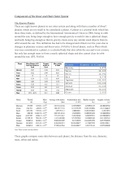
These graphs compare some data between each planet; the distance from the sun, diameter,
mass, orbits and radius.
,Forces Involved
Gravity is the main force that causes the orbit of planets around the sun. Each planet’s
gravitational force differs depending on its size and the speed it travels; however, orbit
around the Sun depends solely on the Sun’s Gravity. The gravity of the Sun is not too much
so that it pulls the planets into it but is enough to make them orbit around it. The planet’s
gravity also helps keep them from being pulled into the sun.
Johannes Kelper (1571-1630) was a German astronomer and astrologer. He established the
three laws of planetary motion. They are as follows:
1. The orbit of every planet is an ellipse with the Sun at the focus.
2. A line joining a planet and the sun covers an equal area in an equal period of time.
3. The square of the orbital period of a planet is proportional to the cube of the
semi-major axis of its orbit.
(NASA)
This graph shows how many Earth days it takes for each planet to orbit the Sun, so it shows
how long a year is on each planet. The shortest is the closest; mercury, and the longest is the
furtherance; neptune.
Planetary Axis
, This diagram shows the planetary axis or tilt of each Planet. Every planet in the solar system
rotates on an axis which is an invisible line that an object rotates around. Thus each planet
has a north and south pole which is where the line reaches the surface at either end. The
rotation period is the time it takes for a planet to make one rotation around its axis.
Order of Planets
This image shows the order of the planets as well as dwarf planets in our solar system,
closest being Mercury and furthest being Eris.
Rocky and Gaseous planets
There are four rocky, terrestrial planets, and there are four gaseous planets. Jupiter, Saturn,
Uranus and Neptune are all gaseous planets meaning they are composed of mainly hydrogen
The Known Planets
There are eight known planets in our solar system and along with them a number of dwarf
planets, which are too small to be considered a planet. A planet is a celestial body which has
these three traits, as defined by the International Astronomical Union in 2006; being in orbit
around the sun, being large enough to have enough gravity to mold it into a spherical shape,
and lastly being big enough so that its gravity clears away any similar sized objects from its
orbit around the sun. This definition has had to be changed and refined over the years due to
changes in planetary science and discoveries. (NASA) A dwarf planet, such as Pluto which
was once considered as a planet, is a celestial body that also orbits the sun and is not a moon,
but only has enough mass to form a nearly spherical shape and also cannot clear its orbit
around the sun. (JPL NASA)
These graphs compare some data between each planet; the distance from the sun, diameter,
mass, orbits and radius.
,Forces Involved
Gravity is the main force that causes the orbit of planets around the sun. Each planet’s
gravitational force differs depending on its size and the speed it travels; however, orbit
around the Sun depends solely on the Sun’s Gravity. The gravity of the Sun is not too much
so that it pulls the planets into it but is enough to make them orbit around it. The planet’s
gravity also helps keep them from being pulled into the sun.
Johannes Kelper (1571-1630) was a German astronomer and astrologer. He established the
three laws of planetary motion. They are as follows:
1. The orbit of every planet is an ellipse with the Sun at the focus.
2. A line joining a planet and the sun covers an equal area in an equal period of time.
3. The square of the orbital period of a planet is proportional to the cube of the
semi-major axis of its orbit.
(NASA)
This graph shows how many Earth days it takes for each planet to orbit the Sun, so it shows
how long a year is on each planet. The shortest is the closest; mercury, and the longest is the
furtherance; neptune.
Planetary Axis
, This diagram shows the planetary axis or tilt of each Planet. Every planet in the solar system
rotates on an axis which is an invisible line that an object rotates around. Thus each planet
has a north and south pole which is where the line reaches the surface at either end. The
rotation period is the time it takes for a planet to make one rotation around its axis.
Order of Planets
This image shows the order of the planets as well as dwarf planets in our solar system,
closest being Mercury and furthest being Eris.
Rocky and Gaseous planets
There are four rocky, terrestrial planets, and there are four gaseous planets. Jupiter, Saturn,
Uranus and Neptune are all gaseous planets meaning they are composed of mainly hydrogen


