

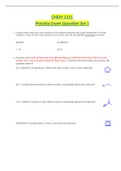
CHEM 1315 Practice Exam Question Set 1
CHEM 1315 Practice Exam Question Set 1 1. (3 points each) Draw the Lewis structure of the following species with proper assignment of formal charge(s). If any of them have resonance structure(s), give all the possible reasonable structures. (a) HNO3 (b) [B(OH)4]– (c) N – (d) O3 2. (6 points each) Most of these are more difficult than you will find on the exam. But if you can answer them, you’re in good shape for these topics. Draw the indicated orbital and answer the question about it. (a) π orbital of cyclopentene. What’s the most acidic H atom in the molecule? (b) * orbital of bromoethane. Where would a nucleophile attack this molecule? Br (c) π* orbital of 3-butyn-1-one. Where would a nucleophile attack this molecule? O (d) HOMO of cyclobutadiene. Is this a symmetrical molecule? 3. (6 points each) Draw additional resonance forms for each of the following, identify which is the most important contributor to the resonance hybrid, and briefly explain why. (a) H2C CH3 CH3 (b) H2C C N (c) CH3 N 4. (6 points each) Draw the resonance structures for the following structures, and identify their nucleophilic (Nuc) (electron-rich) and electrophilic (E) (electron poor) sites. (a) HO H3C CH3 CH3 O (b) HO H O CH3 O (c) C C 5. (6 points) The structure of benzyne is drawn here. It is very reactive. Why? H H H H 6. (2 points each) Use the symbols and to indicate the polarity of the labeled bonds. Br Cl H2N OH H Li H3C 7. (2-4 points each) Identify the hybridization of each of the nitrogen atoms in the following compounds: (a) N(CH3)3 (b) CH3CH2NO2 (c) (d) H3C N N N pyridine methyl azide 8. (6 points) Write numbers below the following compounds in order of their C-N bond length (1 = longest; 4 = shortest). NH NH2 O C N NH2 9. (4 points each) Draw two different structures corresponding to the following formulas: (a) One alcohol and one ether of the formula C4H8O2. Which of your two structures is more likely to dissolve in water? (b) One alkene and one ketone of the formula C6H12O. Which of your two structures is more likely to dissolve in hexane (shown at the right)? H C CH3 hexane (c) One ester and one carboxylic acid of the formula C7H14O2. Which of your two structures is more likely to dissolve in water? 10. (10 points) The following amines are constitutional isomers and have seemingly similar structures. Comment on their different boiling points. 11. (10 points) (a) In which of the following structures does every ring have significant aromatic character? B C N N NH2 A H D E F G H N N CH3 H K (b) Which structures have aromatic components, but are not completely aromatic? I O O C O J K L 12. (6 points) Rank these acids in order of expected acidity (most acidic to least acidic): O O O O H3C OH F3C OH ClH2C OH F2ClC OH A B C D 13. (4 points each) Predict the positions of the equilibria by circling the appropriate relationship at the right of each reaction. (a) H2O + O O HO + O OH Keq 1 Keq 1 Keq ≈ 1 (b) + CH3OH + CH3O Keq 1 Keq 1 Keq ≈ 1 N (c) + OH H + O Keq 1 Keq 1 Keq ≈ 1 14. (6 points each) Using your pKa tables, calculate the approximate equilibrium constant for each reaction. (a) H2O + O O HO + O OH Keq = (b) + CH3OH + CH3O Keq = N (c) + OH H + Keq = 15. (4 points each) Identify which circled H atom in each structure is the more acidic by drawing a box over the circle around that H atom. In each case, there is a significant difference. You can use your pKa tables (but no other sources); however, try to predict them before you look them up. H H (a) O (c) N H O (b) H N N H H S (d) O 16. (3 points each) In each of the molecules below, there is one chiral center (stereocenter). Circle it. (a) (b) (c) (d) (e) (f) 17. (3-4 points each) Draw the enantiomer of each of the following compounds. (a) OH Cl HO (b) (c) HO CH3 H3C O (d) OCH3 18. (4 points each). What is the relationship between the following pairs of molecules (identical, diastereomers, constitutional isomers, or enantiomers)? You can just write I, D, C, or E to the right of the structures to indicate your answer. (a) HO2C OH CO2H OH HO 2C OH CO2H OH OH (b) HO C CO2H 2 OH HO2C OH CO2H OH (c) HO OH HO OH Cl (d) H OH Br HO Cl H Br (e) OH OH OH OH 19. (8 points) Enantiomers have identical physical properties except for optical activity. However, crystals of a pure enantiomer and of the racemic compound usually have different melting points. [A racemic (pronounced “ra-SEE-mick”) sample is composed of an equal mixture of the two enantiomers.) How can this be so? 20. (10 points) Predict the relative abilities of these compounds to dissolve in water (1 = most soluble in water; 6 = least soluble in water). O O OH OH O H3C O O OCH3 O H3C O O O OH OH HO HO O O O OCH3 21. (30 points) We will learn soon about reactions of this type (R1 and R2 denote substituents that can be the same or different). O + R1 R2 H3C CH2 Li H3C O Li R1 R2 (a) Predict the order of reactivity of the following carbonyl compounds with this nucleophilic reagent (1 = most reactive, 4 = least reactive) O O H CH3 O N(CH3)2 O OCH3 (b) Even though there are two aldehyde groups in the molecules shown below, you can limit the reaction to happening at only one of them by using the appropriate amount of the nucleophile. If you do this with A, shown below, predict the structure of the product. In other words, which aldehyde group will react? Why? H + H3C CH2 Li A (c) If this reaction happens only once on molecule B, predict the product and show your reasoning. + H3C CH2 Li O B (d) [extra credit] Trying the reaction with molecule C wouldn’t work. Why not? H H + H3C CH2 Li O C
Document information
- Uploaded on
- March 30, 2023
- Number of pages
- 8
- Written in
- 2022/2023
- Type
- Exam (elaborations)
- Contains
- Questions & answers


