NR 293 Week 5 Concepts; Nutrition
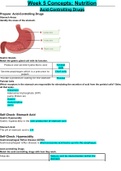
Prepare: Acid-Controlling Drugs Stomach Areas • Identify the areas of the stomach. Gastric Glands • Match the gastric gland cell with its function. Parietal Cells • Which receptors in the stomach are responsible for stimulating the secretion of acid from the parietal cells? Select all that apply. Self-Check: Stomach Acid Gastric Hyperacidity • Gastric hyperacidity is the over production of stomach acid. Stomach Acid • The pH of stomach acid is 1-4. Self-Check: Hyperacidity Gastro esophageal Reflux Disease (GERD) • Gastroesophageal reflux disease is when excessive acid backs up into the esophagus. Acid-controlling Drugs • Match the acid-controlling drugs with how they work. Self-Check: H. Pylori (Helicobacter pylori) Helicobacter pylori (H. pylori) • Helicobacter pylori (H. pylori) is a Bacteria that can infect the gastric track. Reflect: Acid-Controlling Drugs Acid-controlling Drugs • The telehealth nurse is responding to question send to the Hancock Healthcare Services’ social media page. Review the questions and choose the best response. Mandy345 asks: • I have heartburn and I am in the pharmacy. Do all acid controlling drugs work the same way? Choose your best response from the choices given below. MrTom2u wrote: • I take a lot of prescribed daily medication, including digoxin. Is it safe to take any type of acid controlling drugs with my medications? Choose your best response from the choices given below. Mavis52 wrote: • What lifestyle changes can I start that will prevent/reduce my heartburn (hyperacidity) symptoms? Choose the correct response from the choices given below. Mavis52 wrote back: • My husband said that smelling his food on the grill will make my stomach secrete digestive fluid. Is this true? Choose the correct response from the choices given below. Mav12 asks: • Do these work the same way to reduce acid in my stomach? Acid-reducing medication Effervescent tablet antacid Choose your best response from the choices given below. You just received a direct message (DM) from Twitter. Mary10 wrote: • @HHSH My Dad was just admitted to the intensive care unit. Why was he given an acid-controlling drug? He is intubated and not eating. Choose the best response from the choices given below. Parietal Cells • The secondary response of parietal cells activates the hydrogen–potassium–adenosine triphosphatase (ATP) pump. Antacids (magnesium carbonate, aluminum hydroxide, calcium carbonate, sodium bicarbonate) Prepare: Antacids Antacid • Which salt compounds are contained in antacid? (Select all that apply. Simethicone • What is the purpose of simethicone? Side Effect of Antacids • Antacids are made of salt compounds. Magnesium antacid salt compound can cause the side effect of diarrhea. Self-Check: Antacids Therapeutic Effects of Antacids • What are the expected therapeutic effects of antacids? Select all that apply. Self-Check: Drug Interactions • Match the interaction with the definitions. Self-Check: Antacid Compounds • Combining two salt compounds in an antacid has what beneficial effect? Antacid Side Effects • Drag the correct side effect for each of the antacid salt compounds given below: Reflect: Antacids Side Effects • A client takes an aluminum-containing antacid, such as aluminum hydroxide, for which side effect? Antacid Drug • Mike has chronic renal failure. Magnesium-containing antacids may not be the best based on the patient's medical condition. Antacid Table • Complete the table below by dragging the appropriate choices into the blank cells. Mechanism of Action • Antacids are effective in the treatment of hyperacidity based on which mechanism of action? Administration of Antacids • Antacids should not be taken 1 hour before or 2 hours after any prescription medications. Antacids • A client called asking about antacids. The client asked, "How fast and how long will they work?" The nurse responded, “Antacids start working within 15 minutes and last up to 4 hours. Onset and Duration of Antacids The onset and duration of action of antacids are onset 15 mins and duration 4 hours Antacid Drugs • Tums and Maalox are calcium containing antacids. H2 Receptor Antagonists ¬¬¬¬¬¬¬¬¬¬¬¬ Prepare: H2 Receptor Antagonists H2 Receptor Antagonists (H2RA) • Which statement about H2RA is correct? Route of Administration • Which routes can cimetidine be administered? Select all that apply. H2 Receptor Antagonists • Which of the following statements about H2 receptor antagonists (H2RA) is correct? Self-Check: H2 Receptor Antagonists (H2RA) Histamine 2 (H2) Receptor Antagonists • Which type of cells do H2 receptor antagonists bind to inhibit acid production? Histamine 2 (H2) Receptor Antagonist Administration • Which statement about H2 receptor antagonists administration is true? Self-Check: H2 Receptor Antagonists Histamine 2 (H2) Receptor Antagonists – Caution • Patients with renal and hepatic disease should use caution when taking H2 receptor antagonists. Histamine 2 (H2) Receptor Antagonists • Which statement(s) are correct concerning H2 receptor antagonists? (Select all that apply.) Reflect: H2 Receptor Antagonists Histamine 2 (H2) Receptor Antagonists: Drug Names • A H2 receptor antagonist will be prescribed for a client. Which medications are H2 receptor antagonists? Select all that apply. Histamine 2 (H2) Receptor Antagonist: Older Adult Population • The H2 receptor antagonist dose in the older adult population should be decreased due to slower renal function. Famotadine • The client has an order for famotadine once daily. The nurse schedules the medications for which of the following times? Cimetidine Dosing • Complete the cimetidine dosing information by dragging the missing values to the correct cell. Histamine 2 (H2) Receptor Antagonist Drugs • Which H2 receptor antagonist has the highest risk for drug interactions? Side Effects • A 75-year-old client has been admitted for a gastrointestinal bleed. The client is confused and disoriented after receiving several medications. Which medication can worsen confusion and disorientation for this client? Cimetidine Pharmacokinetics • Complete the cimetidine pharmacokinetics table by dragging the missing values to the correct cell. Proton Pump Inhibitors Prepare: Proton Pump Inhibitors Proton Pump Inhibitor: Indications • Which of the following are indications for a proton pump inhibitor? Select all that apply. Proton Pump Inhibitors • Proton pump inhibitors work in which cells in the body? Administration Routes • What are the possible administration routes for pantoprazole? Select all that apply. Self-Check: Proton Pump Inhibitors Proton Pump Inhibitors (PPI) • PPIs reduce acid in the stomach by blocking how hydrogen ions are released. Proton Pump Inhibitor: Drug Interactions • When should the nurse instruct the client to take their proton pump inhibitor? Self-Check: Proton Pump Inhibitors (PPI) Drugs Patient Teaching • The patient was prescribed lansoprazole. Which statements indicate additional teaching is needed? Select all that apply. Side Effects • The client is receiving pantoprazole intravenously. The nurse monitors the client for which possible side effects? Select all that apply. Self-Check: Proton Pump Inhibitor Administration Routes • The healthcare provider is considering ordering pantoprazole for the client. What are the possible administration routes for pantoprazole? Select all that apply. Reflect: Proton Pump Inhibitors Proton Pump Inhibitors • Which statements about proton pump inhibitors are true? Select all that apply. Proton Pump Inhibitor Medication • The nurse is caring for a patient in the intensive care unit after a myocardial infarction. The nurse notices that the patient’s medication list includes a proton pump inhibitor, but there is no mention of any gastrointestinal (GI) disorders on his chart. Drag and drop the correct reason into the space below. Proton Pump Inhibitor (PPI) Use • A PPI is indicated for which of the following conditions? Select all that apply. Omeprazole Dosing • Complete the omeprazole dosing information by dragging the missing values to the correct cell. Pantoprazole Pharmacokinetics • Complete the pantoprazole pharmacokinetics table by dragging the missing values to the correct cell. Proton Pump Inhibitor (PPI) – Mechanism of Action • What is the mechanism of action of a PPI? Medication • A 68-year-old, post-menopausal female presents to urgent care with pain in her right arm that started after a recent fall. An x-ray confirms fractures in both the radius and ulna, with indications of osteoporosis. Which medication regularly taken by the patient may have contributed to the fracture? Client Education • Which statements indicate the client requires additional education about proton pump inhibitor (PPI)? Select all that apply. Nursing Application: Acid-Controlling Drugs Prepare: Nursing Application: Acid-Controlling Drugs Medication for Hyperacidity • famotidine treats symptoms of hyperacidity by preventing parietal cells’ stimulation from histamine. Medication • Which medication neutralizes acid in the stomach? Hyperacidity Medication • pantoprazole reduces hyperacidity by preventing the parietal cell from excreting acid (hydrogen ions). Explore: Mary’s Case Study Mary is a 54-year-old school administrator, being seen because antacids are not relieving her heartburn and abdominal pain. Mary describes her eating habits as follows: “I am so busy and my job is overwhelming , so stressful. I try to eat healthy, but all my meals are takeout and I am sure they are not healthy. I usually take my antacids during the day and before I go to bed. I started chewing 2 tabs with every dose and now the antacid is not working anymore. I am not sure what to take.” When asked about the medications she has tried to help her heartburn, Mary lists several. She said that one of them, she does not recall which, caused diarrhea so she stopped taking it. Of all that she tried, she still takes calcium carbonate for her bones, but it is not helping her stomach issues anymore. When asked, she explains that she forgot to take her calcium carbonate with her on a recent vacation and noticed her symptoms got worse. When she got home and started taking them again, they no longer helped her stomach. • Which antacid would most likely have had caused Mary’s diarrhea? • Which phenomenon explains the increased stomach pain when Mary stopped taking her calcium carbonate? • Mary was tested for H. pylori infection in the office and asked what information the test will provide. What is the best response by the health care provider? • Mary underwent further testing and was diagnosed with gastroesophageal reflux disease (GERD). Before prescribing pantoprazole, the health care provider screens for which contraindications for this medicine? (Select all that apply.) • Mary asked the health care provider what changes are needed to her diet. Indicate which food items she should eat (i.e. foods that will promote less acid reflux) and which food items should be avoided (i.e. foods that will irritate acid reflux). Reflect: Nursing Application: Acid-Controlling Drugs Proton Pump Inhibitor (PPI) • When educating an individual with a new prescription for omeprazole, what instruction is given for when to take the medication? Client Education • The client is in the pharmacy clinic to pick up her PPI prescription. As the pharmacist hands her the medicine, the client makes the following statement indicating that she needs additional education about her new prescription? Proton Pump Inhibitors: Side Effects • Which conditions are associated with long-term use of proton pump inhibitors? (Select all that apply.) Client Education • During the discussion with the client picking up their PPI medication, which statement should the pharmacist follow-up? Therapeutic Effect • For how long will PPIs have a therapeutic effect? 24 hours Treatment Plan • The client mentions that a friend uses famotidine for their acid reflux, and wants to know why she was prescribed pantoprazole? Which actions of PPI make them useful in the client's treatment plan? (Select all that apply.) Antacids • Antacids do not prevent the overproduction of acid in the stomach, they neutralize acids that are present. Antacid Contraindication • For each situation listed, select whether antacid therapy is or is not contraindicated. Antiemetic and Antinausea Drugs Prepare: Antiemetic Drugs Categories Of Antiemetic Drugs • There are seven categories of antiemetic drugs, which include anticholinergics, antihistamines, antidopaminergics, neurokinin receptor antagonists, prokinetics, serotonin blockers, and tetrahydrocannabinoids. Antiemetic Mechanism of Action • Though the seven categories of antiemetic drugs have different mechanisms of action, the majority work by blocking one of the vomiting pathways which block the neurologic stimulus that induces vomiting. Medication to Relieve Vomiting • Medications used to treat and relieve nausea and vomiting are called antiemetic drugs. Self-Check: Medication Indication • Anticholinergics are indicated for motion sickness, pre-op secretion reduction, nausea, and vomiting. Self-Check: How Do They Work? • Please drag and drop the correct site of action that block the neurologic stimulus that induces vomiting over the list of categories of antiemetic medications: Self-Check: Dry Mouth • Which categories of antiemetic medications may cause a dry mouth side effect? (Select all that apply.) Reflect: Antiemetic Drugs Antiemetics and CNS Depression • Which of the following categories of antiemetic medications may cause CNS depression? (Select all that apply.) Antiemetic Categories • What are the seven categories of antiemetic drugs? (Select all that apply.) Antiemetics and Motion Sickness • Which antiemetic medications would be appropriate for motion sickness? (Select all that apply.) Antiemetics and Gastroesophageal Reflux • Which antiemetic medications would be appropriate for nausea associated with gastroesophageal reflux? Therapeutic Effect of Antiemetics • What is the therapeutic action of antiemetic medications? Antiemetic Mechanism of Action • What is the mechanism of action in the majority of antiemetic medications? Antiemetics and Chemotherapy • Which antiemetic medications would be appropriate for chemotherapy nausea and vomiting? (Select all that apply.) How They Work Please drag and drop the correct category of antiemetic medication under the correct site of action. Each category can include more than one medication class, and each class can be used more than once. If you can’t read. • Labyrinth (inner ear) • Gastrointenstinal tract • Cerebral cortex • Chemoreceptor trigger zone (CTZ) • Vomiting center (medulla) Serotonin Blockers (ondansetron) Prepare: Serotonin Blockers (ondansetron) Classification of Serotonin Blockers • To which class of medications do serotonin blockers belong? Indications for Use of Serotonin Blockers • Ondansetron is a serotonin blocker that works to prevent nausea and vomiting. ondansetron Use • ondansetron may be given for chemotherapy, radiation and postoperative nausea and vomiting. Self-Check: Appropriate Usage • Which of the following are appropriate times to give ondansetron for nausea and vomiting? Self-Check: ondansetron Effects at the 5-HT3 Receptor Sites • Ondansetron works by blocking the serotonin effects at the 5-HT3 receptor sites, which are located in vagal nerve terminals and chemoreceptor trigger zone of the central nervous system. Therapeutic Effect • A therapeutic effect is clear when there is a(n) decrease in incidence and severity from nausea and vomiting after chemotherapy, radiation, and surgery. Safety: ondansetron • In general ondansetron is safe unless there is a known allergy to the medication. Contraindications include oral disintegrating tablets in patients with phenylketonuria, congenital long QT syndrome, and concurrent use of apomorphine. Current Use with ondansetron • Which of the following medication is safe to use with ondansetron? Reflect: Serotonin Blockers (ondansetron) Routes of Administration • Which of the following are routes of administration available for ondansetron? Half-Life: ondansetron • Please drag and drop the correct half-life for ondansetron on the chart below: Consult Health Care Provider • Before administering ondansetron, which of the following conditions require further follow-up with the health care provider? (Select all that apply.) ondansetron: Adverse Effects • Which of the following are possible adverse effects of ondansetron? (Select all that apply.) Adverse Drug Interaction • Administering ondansetron to a patient taking which medications may result in an adverse drug to drug interaction? (Select all that apply.) Pregnancy and Contraindication • Which of the following times during pregnancy would be contraindicated to administer ondansetron for hyperemesis gravidarum? Chemotherapy and Timing • When administering ondansetron for chemotherapy-related nausea and vomiting. What is the best time for the patient to receive this medication? Receptors Blocked • Which receptors are blocked by ondansetron thereby reducing nausea and vomiting? Nursing Application: Antiemetic and Antinausea Drugs Prepare: Nursing Application: Antiemetic and Antinausea Drugs Nausea and Vomiting Medications • What medications are used to treat and relieve nausea and vomiting? Antiemetic Medications • Which of the following antiemetic medications may cause a patient to have CNS depressant interactions? (Select all that apply.) Antiemetic Drug • Which of the following is not a type of antiemetic drug? Self-Check: Assessment Assessment: Antiemetic Medications • The nurse is caring for a patient with nausea and vomiting after an overdose of morphine. Which antiemetic medication class(es) should be avoided? (Select all that apply.) Priority Assessments • Which are the priority assessments when administering anticholinergics? (Select all that apply.) Self-Check: Interventions Medication Administration • A patient is prescribed an antiemetic to be given sublingual route. The nurse knows that this medication will be administered where? Subjective and Objective Data • Which assessment findings should the nurse monitor in a client receiving antiemetic medications? (Select all that apply.) Self-Check: Patient Teaching Patient Teaching • Which items should be included in your patient teaching regarding antiemetic medications? (Select all that apply.) Reflect: Nursing Application: Antiemetic and Antinausea Drugs Therapeutic Action • A patient was prescribed an antiemetic and asks why he needs to take another pill. What is the nurse’s best response related to the therapeutic action of antiemetic medications? Drug Interactions • Please drag the potential interaction(s) that can affect each class. Adverse Effects • Please drag in the appropriate adverse effects for each medication class. Medications A 25-year-old patient comes in with complaints of sickness when she is in the car. She also was very sick this past weekend when she was on a fishing boat with some friends. What medication class(es) do you anticipate will be ordered for her? (Please drag the class(es) that would be appropriate options for this patient.) • Appropriate • Inappropriate Nausea and Vomiting Medications A 40-year-old cancer patient states that she has been experiencing nausea and vomiting after her first chemotherapy treatment and is wondering if there is anything that can help. What medication class(es) do you anticipate will be ordered for her? (Please drag the class(es) that would be appropriate options for this patient.) • Appropriate • Inappropriate Prepping for Mouth Surgery Medications A 70-year-old patient is prepping for mouth surgery. The health care provider is explaining that they will need to dry up his secretions in his mouth to help with the procedure. What medication class(es) do you anticipate will be ordered for him? (Please drag the class(es) that would be appropriate options for this patient.) • Appropriate • Inappropriate Nausea and Vomiting Medications A 60-year-old post-operative patient is experiencing nausea and vomiting. All of his vital signs are within normal limits. What medication class(es) do you anticipate will be ordered for him? (Please drag the class(es) that would be appropriate options for this patient.) • Appropriate • Inappropriate Antiemetic Medication A 35-year-old patient has been experiencing gastroesophageal reflux for several months. What antiemetic medication class(es) do you anticipate will be ordered for her? (Please drag the class(es) that would be appropriate options for this patient.) • Appropriate • Inappropriate Week 5 Concepts: Elimination Prepare: Antidiarrheals Antidiarrheal Medications • What is the primary goal of antidiarrheal medications? Acute Diarrhea • It is essential to figure out the cause of the diarrhea in order to select appropriate medications. Which of the following would be regarded as acute diarrhea? (Select all that apply.) Antidiarrheal Drug Classes • Identify and select the four classes of antidiarrheal drugs. (Select all that apply.) Self-Check: Therapeutic Use • The therapeutic use of antidiarrheal medications are for control and symptom relief of acute and chronic diarrhea. Self-Check: Antidiarrheal Usage • Match the type of antidiarrheal used for the type of case: Self-Check: Antidiarrheal: Caution • What type of antidiarrheal should be used with caution for children and why? Self-Check: Anticholinergics • Anticholinergics work by decelerating peristalsis by reducing contractions and smooth muscle tone of the GI tract. Self-Check: Opiates • Which medications are opiates? (select all that apply.) Reflect: Antidiarrheals Therapeutic Use of Antidiarrheal • What is the therapeutic use of antidiarrheal medications? Therapeutic Action of Anticholinergic • What is the therapeutic action of anticholinergic antidiarrheal medications? Drag the correct answer in the box here. Action of Adsorbents • The primary action of adsorbent antidiarrheal medications is to coat the walls of the GI tract and bind the bacteria or toxin to the adsorbent surface for elimination. Examples of Probiotics • Identify and select the examples of probiotics from the list below. (Select all that apply.) Therapeutic Actions of Opiate • What are the therapeutic actions of Opiate antidiarrheal medications? Actions of Probiotics • What are the actions of probiotics on the GI system? (Select all that apply.) Contraindications of Antidiarrheals • Which of the following are contraindications of antidiarrheal medications? (Select all that apply.) Antidiarrheal Classes • Drag the drug examples to the appropriate antidiarrheal classes listed on the left side. Nursing Application: Antidiarrheals Prepare: Nursing Application: Antidiarrheals Goals of Antidiarrheal Treatments • What are the goals of antidiarrheal medication treatments? (Select all that apply.) Antidiarrheal Medications • Drugs are absorbed from the intestines into the bloodstream, so antidiarrheal medications can alter this process by either increasing or decreasing the absorption of some drugs. Adsorbents can decrease the absorption of digoxin, hypoglycemic drugs and quinidine. Increased bleeding times occur with warfarin due to adsorbents binding to vitamin K. Decreased anticholinergic antidiarrheal medications effects occur when administered with antacids. Opiate antidiarrheal medications can have increased depressant effects when given with other CNS depressants like alcohol. Contraindication of Adsorbents • A patient is about to receive an adsorbent antidiarrheal medication. Which of the following is a contraindication? Self-Check: Sedatives: Mr. Williams' Case Study Mr. Williams' Case Study: Sedatives Let’s explore sedatives through Mr. Williams’ case study. Review the slides below and answer the following questions. • Let’s explore sedatives through Mr. Williams’ case study. Review the slides below and answer the following questions. • Why is diphenoxylate-atropine (Opiate antidiarrheal) not appropriate for Mr. Williams? (Select all that apply.) Self-Check: Antidiarrheals: Samuel's Case Study Antidiarrheals Samuel’s Case Study Let’s explore the nursing application of antidiarrheals through Samuel’s case study. Samuel is a 2-year-old boy experiencing acute diarrhea. He is admitted to the pediatric unit and prescribed medications to stop the diarrhea and rehydrate him. Review the information and answer the question that follows. • Samuel has just recovered from the influenza and the diarrhea started the next day. What should the nurse include in her assessment. (Select all that apply.) • Due to the age of the patient, the interventions will be focused on educating the child's guardians, with inclusion of the child as appropriate. The medications arrive and the patient is to receive bismuth subsalicylate, an adsorbent antidiarrheal medication. What action should the nurse take prior to medication administration? • The health care provider revises the prescribed medication and Samuel receives treatment for several days. Samuel is also diagnosed with bacterial pneumonia and treated with IV antibiotics for several days. Samuel heals well and is ready to be discharged. The nurse enters the room to give discharge instructions, instructing the family to contact the health care provider if the diarrhea returns or if fever or abdominal pain occur. Samuel’s mom asks why her son was prescribed a probiotic and what it does. What is the best response? Reflect: Nursing Application: Antidiarrheals Opiate Antidiarrheals • Opiate antidiarrheal medications reduce bowel motility and rectal spasms. What should the nurse assess for in patients who are taking this medication? Drug Interactions • Anticholinergics can cause serious side effects if they are used inappropriately. Antacids decreases the therapeutic effect of anticholinergics when it is concurrently administered? Action of Probiotics • Which item describes the main action of probiotics? Patient Teaching • What patient teaching regarding side effects/adverse reactions should the nurse provide to a patient taking probiotics? Assessment Technique • What important assessment technique is important prior to antidiarrheal medication administration? Drag the correct answer in the box here. Auscultate the abdomen before you palpate. Antidiarrheal Classes and Alterations • Drugs are absorbed from the intestines into the bloodstream, so antidiarrheal medications can alter this process by either increasing or decreasing the absorption of some drugs. Please match the antidiarrheal class with the alteration below. Antidiarrheals Medications • Which of the following situations are appropriate or not to receive an antidiarrheal? Drag each situation to the proper column. Medication Contraindication • What medication is contraindicated in pediatric patients who recently recovered from chickenpox or influenza? Laxatives Prepare: Laxatives Medications • Laxatives can be bulk-forming, emollient, hyperosmotic, saline, or stimulant. Laxatives • Laxatives are available over the counter (OTC). Use of Laxatives • What is the main use of laxatives? Self-Check: Usage of Laxatives Use of Laxatives • Laxatives are medications used to treat constipation which is a symptom. Laxative Usage • What is a major concern about long-term laxative use? (Select all that apply.) Common Uses for Laxatives • Which of the following are common uses for laxatives? (Select all that apply.) Self-Check: Laxative Effects • Identify and select the proper laxative class based on its description. Self-Check: Laxatives Contraindications • Laxatives should be avoided in those with a drug allergy, appendicitis symptoms, intestinal obstruction, and undiagnosed abdominal pain. Reflect: Laxatives Laxatives: Drug Interactions • Laxatives may interact with several drugs since laxatives act on the intestines. The intestines are where many drugs are absorbed and then distributed through the bloodstream. Match the correct type of laxative with the correct interaction: Action of Bulk-forming Laxatives • What is the main action of bulk-forming laxatives? Laxative Groups • Identify what are the laxative groups from the medication groups listed on the left side column. Drag the correct laxative groups to the right side column. Action of Stimulant Laxatives • The main action of stimulant laxatives is to stimulate the nerves of the intestines resulting in increased peristalsis and increased fluid in the colon. Action of Hyperosmotic Laxatives • What is the main action of hyperosmotic laxatives? Constipation Medications • The main use of laxatives is to counteract constipation. They are often misused and are available over the counter (OTC). Long-term inappropriate use leads to dependence and bowel damage. Action of Saline Laxatives • The main action of saline laxatives is to increase osmotic pressure in the small intestine; this action produces a watery stool. Actions of Laxatives • Match the type of laxative with the main action. Nursing Application: Laxatives Prepare: Nursing Application: Laxatives Laxative Medication • Laxative medication class works with what symptom? Categories of Laxatives • Which of the following are the categories of laxatives? (Select all that apply.) Laxative Side Effect • What GI system issue is of concern with long-term laxative use? Explore: Laxatives: Norma's Case Study Laxatives Norma’s Case Study Let’s explore the nursing application of laxatives through Norma’s case study. Norma is a 70-year-old patient who was admitted with constipation. She just came up to the floor and I haven’t had a chance to assess her yet. Review the information and answer the question that follows. • Nurse knocks and enters the room and washes her hands and said. “Hi Norma, I will be your nurse today. I am going to start by asking you some questions.” What assessment questions the nurse will be sure to ask Norma during her assessment related to her constipation. • Nurse is talking with Norma. “Norma, you have been ordered a saline enema.” What is a accurate statement by the nurse? • What nursing actions are important when administering the enema? (Select all that apply.) • The nurse returns to evaluate the effectiveness of the enema. Which of the following findings indicate that the enema was effective? (Select all that apply.) • Norma is happy with these results. “Thank you for helping me. I feel much better. Next time I will ensure to use a laxative at home sooner, so I do not need to come to the hospital.” Which of the following are correct responses by the nurse? (Select all that apply.) Reflect: Nursing Application: Laxatives Assessment Technique • You are training a new nurse on the unit and are observing her assessment of a client admitted with influenza and constipation. Which of the following assessment techniques by the new nurse requires correction? Laxative Medication • Which of the following patients are candidates for a laxative medication? (Select all that apply.) Actions of Laxatives • Match the type of laxative with the main action. Laxative Abuse • Why are adolescents at risk for laxative abuse? Drag the best answer here. Eating disorders Assessment Questions • What type questions should be included in your assessment prior to administering laxative medications? (Select all that apply.) Drug Interaction • Your patient is on antibiotics and warfarin. What type of laxatives may cause drug interactions in this patient? (Select all that apply.) Client Teaching • Teaching for clients needing frequent laxative medications should include which of the following? (Select all that apply.) Types of Laxatives • What type of laxative may cause drug interactions in a client receiving anesthesia? Diuretics Prepare: Diuretics Nephron • The nephron is the functional unit of the kidneys. Identify the different parts of the nephron. Self-Check: Diuretic Classes: Mechanism of Action • Identify where the medication works on the nephron. Self-Check: Diuretic Classes and Drugs Diuretic Classes • What should be monitored for each diuretic class of medication? Drag what to assess on the right side column that matches with the correct diuretic class on the left side column. Drug Names Match the drug name with the correct information regarding them. • Hydrochlorothiazide • Spironolactone • Mannitol • Furosemide Reflect: Diuretics Loop Diuretics Diuretics Classes • Which class of diuretics, used to treat glaucoma, works by acting on the proximal tubule? Drag the correct answer in the box here. Carbonic anhydrase inhibitors Diuretic Drug Name • Which of the following diuretic is used to treat glaucoma? Thiazide Diuretics • What area of the nephron does thiazide diuretics target? • Diuretic Class: Mechanism of Action • Match the Mechanism of Action with the correct diuretic class. Loop Diuretics (furosemide) Prepare: Loop Diuretics (furosemide) Loop Diuretics • Loop diuretics have a rapidzzz onset. Loop Diuretics • Loop diuretics target the ascendingzzz loop of henle. Loop Diuretics • Loop Diuretics Loop diuretics decreases blood pressure by reducingzzz cardiac preload and vasodilationzzz of blood vessels. Self-Check: furosemide Tom’s Case Study Tom is a 67-year-old male with congestive heart failure. He is in the emergency department because of breathing difficulty. The healthcare provider prescribed a dose of furosemide. The client’s additional medications for drugs that could adversely affect the furosemide were reviewed. Review the information and answer the question that follows. • How fast do you expect furosemide 40 mg IV to work? • The Nurse Practitioner is monitoring the effectiveness of the diuretic Tom was given. Which outcomes are expected after administration of a diuretic? • How long is the half-life of furosemide? • Which assessment finding indicates the diuretic was effective? Assessment Findings • When assessing the nasal mucus membranes of an individual being treated with a diuretic, the examiner notes they are moist and pink. Based on these cues, which hypothesis best describes these findings? Reflect: Loop Diuretics (furosemide) Furosemide • Furosemide works on the ascending loop of henle by preventing the reabsorption of sodium and potassium. Patient Teaching • Your patient is taking a loop and thiazide like diuretic. The patient asks if is safe to take two water pills. What is the best response? Loop Diuretics Effects • Loop diuretics are effective with inhibiting sodium reabsorption within the nephron because it inhibits the sodium-potassiumchloride pump in the loop of henle. Administration Routes • What are the available routes to administer furosemide? (Select all that apply.) Loop Diuretics • Which medications are from the loop diuretics class? (Select all that apply.) Loop Diuretic • For which electrolyte imbalance will the nurse monitor the patient taking a loop diuretic? Drag the correct answer in the box here. furosemide Oral • How long will oral form of furosemide be effective? Heart Failure • The nurse is caring for a 78-year-old patient diagnosed with heart failure. The client takes baby aspirin, simvastatin, and albuterol. The healthcare provider increased the client's dose of furosemide to 40 mg a day. The client started complaining of dizziness, headaches, blurred vision, and dry mouth. The healthcare care provider obtained a Basic metabolic panel test during the client's clinic visit. What is the cause of the client's condition? Osmotic Diuretics (mannitol) Prepare: Osmotic Diuretics (mannitol) Mannitol • Mannitol has a rapid onset of action. Glomerular Filtrate • Which statements about glomerular filtrate are correct? (Select all that apply.) Movement • Osmosis is the movement of water through a semipermeable membrane from an area of low concentration to an area of higher concentration. Self-Check: mannitol: Adverse Reaction • The patient has just received a third dose of mannitol and has been producing a substantial amount of urine output. For which adverse reaction to mannitol is the patient at risk? Self-Check: mannitol Administration of mannitol • Which statements are true about the administration of mannitol? Mannitol • Mannitol increaseszzz glomerular filtration by vasodilationzzz. Mannitol: Monitoring • A patient with a closed head injury has an order for intravenous (IV) mannitol 20% concentration. What should the nurse monitor during the infusion? (Select all that apply.) mannitol: Mechanism of Action • Which of the following are correct statements about mannitol's, an osmotic diuretic, mechanism of action? (Select all that apply.) Reflect: Osmotic Diuretics (mannitol) mannitol Therapy The patient is receiving mannitol therapy after his heart catherization. He is complaining of headache and chills. His vital signs are within normal limits. What should the nurse’s next step be? Assessment Finding • What assessment finding requires immediate intervention if found while a patient is receiving mannitol? • Mannitol administration should be discontinued if which adverse effects occur? (Select all that apply.) Administering mannitol • Which electrolytes should you monitor when administering mannitol? (Select all that apply.) Mannitol Effects • Mannitol can be administered to achieve which outcomes? (Select all that apply.) mannitol by IV • The nurse is in the room preparing a mannitol infusion by attaching a filter to the IV tubing. What is the purpose of the filter? mannitol: Contraindications • What are the contraindications for the use of mannitol? (Select all that apply.) mannitol Use • A patient is receiving mannitol for increased intracranial pressure (ICP). Which statements are correct about this medication? Select all that apply. Nursing Application: Diuretics Prepare: Nursing Application: Diuretics Loop Diuretics • The nurse monitors patients receiving treatment with loop diuretics for which complications? (Select all that apply.) Diuretic Drugs • Of the currently available diuretic drugs, which of the following cannot be taken if the client has a sulfa allergy? Carbonic Acid Anhydrase Inhibitors • Carbonic acid anhydrase inhibitors work on which part of the nephron? Self-Check: Diuretics: Maria's Case Study Diuretic Drugs Apply your critical thinking skills and what you have learned about diuretic drugs in the case study below. Maria’s Case Study The nurse is caring for a 72-year-old Maria who has been hospitalized for left ventricular heart failure. Maria is currently taking losartan 50mg. The healthcare provider added furosemide 40 mg IV q12h. Review the information and answer the question that follows. • Which lab values should be reviewed prior to administering furosemide? (Select all that apply.) • The patient’s lab results (BMP values) are provided in the table above. Why is the low potassium a concern prior to administering furosemide? • The patient’s vital signs are provided in the table above. Why is the current blood pressure a concern prior to administering furosemide? • The patient’s vital signs are provided in the table above. How can the blood pressure and fluid status of the patient be assessed in more detail? • Which assessments provide baseline cues about the fluid status of an elderly patient prior to administering a diuretic medication? (Select all that apply.) Reflect: Nursing Application: Diuretics Client Education • Tom is starting furosemide at home. Medication instructions were explained to him and his family. Which statement indicates understanding of how the medication works. Medication Class • torsemide belongs to the loop diuretics class. Diuretic Drug • DM is a 62-year-old African-American man who has hypertension and now presents with signs of ankle edema, increased blood pressure, and abnormal lung sounds. Furosemide • What type of medication is furosemide? Drag the correct answer here. Loop Diuretic Acetazolamide • Friedrich, who has glaucoma, asks the nurse why he was recently prescribed acetazolamide. Which is the best response by the nurse? Nursing Interventions • The nurse is developing a plan of care for a client with fluid volume overload related to heart failure exacerbation. The healthcare provider has prescribed an IV loop diuretic. What nursing interventions should be included in the client’s plan of care? (Select all that apply.) Furosemide • The nurse is educating a client about furosemide. In which situation would the nurse instruct the client to stop taking the furosemide and contact their healthcare provider? Drug Group • Furosemide may increase the ototoxic potential of aminoglycoside antibiotics drug group?
Geschreven voor
- Instelling
-
Grand Canyon University
- Vak
-
NR 293
Documentinformatie
- Geüpload op
- 26 maart 2023
- Aantal pagina's
- 73
- Geschreven in
- 2022/2023
- Type
- Tentamen (uitwerkingen)
- Bevat
- Vragen en antwoorden
Onderwerpen
-
nr 293 week 5 concepts nutrition

Ook beschikbaar in voordeelbundel