
Costs of Production;
Short Run; when at least one factor of production is fixed which tends to be capital
Long Run; when all the factors of production are variable
Fixed Costs; A cost that remains the same whatever the level of output - Example;
insurance, rent
Variable Costs; A cost that changes depending on the level of output - Example; labour
Total Costs; Fixed costs plus variable costs
Marginal Costs; The extra cost of producing one more unit of output
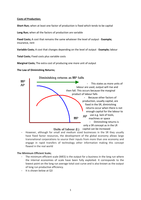
The Law of Diminishing Returns;
- This states as more units of
labour are used, output will rise and
then fall. This occurs because the marginal
product of labour falls
- Because other factors of
production, usually capital, are
fixed in the SR, diminishing
returns occur when there is not
enough capital for the labour to
use e.g. lack of tools,
machines or space
- Diminishing returns is
only a SR concept as in the LR
capital can be increased
- However, although for small and medium sized businesses in the SR they usually
have fixed factor resources, the development of the global economy allows large
transnational corporations to source their inputs from more than one economy and
engage in rapid transfers of technology other information making this concept
flawed in the real world
The Minimum Efficient Scale;
- The minimum efficient scale (MES) is the output for a business in the long run where
the internal economies of scale have been fully exploited. It corresponds to the
lowest point on the long run average total cost curve and is also known as the output
of long run productive efficiency.
- It is shown below at Q3
1



