
FRANKENSTEIN
Summary Overall
Preface & Letters
Chapters
Characters
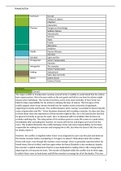
Themes Dangerous knowledge
Sublime Nature
Monstrosity
Secrecy
Texts
Family
Alienation
Ambition
Motifs Passive Women
Abortion
Symbols Light and fire
Protagonist Victor Frankenstein
Monster
Antagonist The monster
Victor Frankenstein
Setting Switzerland
Swiss Alps and Artic
Genre Gothic Novel
Science Fiction
Summary
Overall
The major conflict in Frankenstein revolves around Victor’s inability to understand that his actions
have repercussions. Victor focuses solely on his own goals and fails to see how his actions might
impact other individuals. The monster functions as the most stark reminder of how Victor has
failed to take responsibility for his actions in defying the laws of nature. The first signs of the
conflict appear when Victor throws himself into his studies at the University of Ingolstadt,
neglecting his family and fiancée. The conflict deepens when, having “succeeded in discovering the
cause of generation and life,” Victor becomes obsessed with creating a monster. He does not stop
to think about what the experiences of that monster might be like, nor is he fazed by the fact that
he ignores his family to pursue his work. He is so obsessed with his ambition that he does not
consider anything else. The rising action of his reckless quest to create life comes to a peak when,
immediately after animating the monster, he reacts with horror and disgust and runs from the
room. This incident illustrates the conflict between Victor and moral responsibility: he has been
responsible for making the monster and bringing him to life, but when he doesn’t like the result,
he simply rejects it
However, the conflict is reignited when Victor is too disgusted to carry out this plan and destroys
the female monster before completing it. Yet again, he doesn’t think about what this reckless
choice will mean, even though the monster vows revenge. Victor is genuinely surprised when his
friend Henry Clerval is killed, and then again when his fiancé Elizabeth is also murdered, despite
the monster’s explicit statements that he is now dedicated to making Victor’s life a living hell by
depriving him of everyone he loves. The murder of Elizabeth shifts the conflict into its final stage,
in which Victor vows to hunt down and kill the monster in revenge for all of the deaths. This vow
1
,FRANKENSTEIN
partially resolves the conflict in that it gives the monster what he wants: he now has the total
attention of his creator, and the fates of the two individuals are interlocked.
The tension increases when Victor learns of the death of his brother William and the false
accusation against Justine. The murder creates another situation in which Victor can choose to act,
or fail to take responsibility. He heightens the conflict by allowing Justine to be executed, rather
than disclosing what he knows about the monster. The conflict is heightened further when the
monster meets up with Victor amidst the mountain peaks and tells him the story of all the
suffering he has experienced, as well as his loneliness and alienation. The meeting between the
monster and his creator is another moment where Victor could potentially turn away from his
selfish path. The plot suggests potential resolution when Victor reluctantly agrees to fashion a
mate for the monster in exchange for the two of them going somewhere remote.
After Victor pursues the monster around the world, he arrives in the Arctic and encounters
Walton, bringing the story full-circle back the point at which the narration switched from Walton
to Victor. Victor’s travels have exhausted him so much that he dies aboard the ship after relaying
his tale, his role in the story fulfilled. The novel climaxes with Walton finding the monster in the
room, gazing at Victor’s dead body and weeping. Victor never acknowledges the role he played in
creating the chaos and tragedy that resulted in the deaths of several innocent people, as well as
the torment of his creation. Unlike Victor, the monster expresses remorse and self-loathing,
suggesting that he ultimately has become more “human” than his creator. Walton finally gets to
see and hear the monster from his own perspective, and he is able to feel “a mixture of curiosity
and compassion.” The falling action of the novel quickly concludes with the monster explaining his
plan to kill himself, then setting off alone to carry out his plan.
Chapters
Preface & Frankenstein opens with a preface, signed by Mary Shelley but commonly
Letters 1-4: supposed to have been written by her husband, Percy Bysshe Shelley. It states
that the novel was begun during a summer vacation in the Swiss Alps, when
unseasonably rainy weather and nights spent reading German ghost stories
inspired the author and her literary companions to engage in a ghost story
writing contest, of which this work is the only completed product.
The novel itself begins with a series of letters from the explorer Robert
Walton to his sister, Margaret Saville. Walton, a well-to-do Englishman with a
passion for seafaring, is the captain of a ship headed on a dangerous voyage to
the North Pole. In the first letter, he tells his sister of the preparations leading
up to his departure and of the desire burning in him to accomplish “some great
purpose”—discovering a northern passage to the Pacific, revealing the source
of the Earth’s magnetism, or simply setting foot on undiscovered territory.
In the second letter, Walton bemoans his lack of friends. He feels lonely and
isolated, too sophisticated to find comfort in his shipmates and too uneducated
to find a sensitive soul with whom to share his dreams. He shows himself a
Romantic, with his “love for the marvellous, a belief in the marvellous,” which
pushes him along the perilous, lonely pathway he has chosen. In the brief third
letter, Walton tells his sister that his ship has set sail and that he has full
confidence that he will achieve his aim.
In the fourth letter, the ship stalls between huge sheets of ice, and Walton and
his men spot a sledge guided by a gigantic creature about half a mile away. The
next morning, they encounter another sledge stranded on an ice floe. All but
one of the dogs drawing the sledge is dead, and the man on the sledge—not
the man seen the night before—is emaciated, weak, and starving. Despite his
condition, the man refuses to board the ship until Walton tells him that it is
2
, FRANKENSTEIN
heading north. The stranger spends two days recovering, nursed by the crew,
before he can speak. The crew is burning with curiosity, but Walton, aware of
the man’s still-fragile state, prevents his men from burdening the stranger with
questions. As time passes, Walton and the stranger become friends, and the
stranger eventually consents to tell Walton his story. At the end of the fourth
letter, Walton states that the visitor will commence his narrative the next day;
Walton’s framing narrative ends and the stranger’s begins.
The preface to Frankenstein sets up the novel as entertainment, but with a
serious twist—a science fiction that nonetheless captures “the truth of the
elementary principles of human nature.” The works of Homer, Shakespeare,
and Milton are held up as shining examples of the kind of work Frankenstein
aspires to be. Incidentally, the reference to “Dr. Darwin” in the first sentence is
not to the famous evolutionist Charles Darwin, who was seven years old at the
time the novel was written, but to his grandfather, the biologist Erasmus
Darwin.
In addition to setting the scene for the telling of the stranger’s narrative,
Walton’s letters introduce an important character—Walton himself—whose
story parallels Frankenstein’s. The second letter introduces the idea of loss and
loneliness, as Walton complains that he has no friends with whom to share his
triumphs and failures, no sensitive ear to listen to his dreams and ambitions.
Walton turns to the stranger as the friend he has always wanted; his search for
companionship, and his attempt to find it in the stranger, parallels the
monster’s desire for a friend and mate later in the novel. This parallel between
man and monster, still hidden in these early letters but increasingly clear as the
novel progresses, suggests that the two may not be as different as they seem.
Another theme that Walton’s letters introduce is the danger of knowledge. The
stranger tells Walton, “You seek for knowledge and wisdom, as I once did; and I
ardently hope that the gratification of your wishes may not be a serpent to
sting you, as mine has been.” The theme of destructive knowledge is developed
throughout the novel as the tragic consequences of the stranger’s obsessive
search for understanding are revealed. Walton, like the stranger, is entranced
by the opportunity to know what no one else knows, to delve into nature’s
secrets: “What may not be expected in a country of eternal light?” he asks.
Walton’s is only the first of many voices in Frankenstein. His letters set up a
frame narrative that encloses the main narrative—the stranger’s—and provides
the context in which it is told. Nested within the stranger’s narrative are even
more voices. The use of multiple frame narratives calls attention to the telling
of the story, adding new layers of complexity to the already intricate
relationship between author and reader: as the reader listens to Victor’s story,
so does Walton; as Walton listens, so does his sister.
By focusing the reader’s attention on narration, on the importance of the
storyteller and his or her audience, Shelley may have been trying to link her
novel to the oral tradition to which the ghost stories that inspired her tale
belong. Within each framed narrative, the reader receives constant reminders
of the presence of other authors and audiences, and of perspective shifts, as
Victor breaks out of his narrative to address Walton directly and as Walton
signs off each of his letters to his sister.
Chapters 1-2 The stranger, who the reader soon learns is Victor Frankenstein, begins his
narration. He starts with his family background, birth, and early childhood,
telling Walton about his father, Alphonse, and his mother, Caroline. Alphonse
3


