

Summary Organization and Management
Chapter 1
Organization = cooperating of people to achieve a common purpose
Companies = goal is accomplishing their mission
Enterprises = goal is making profit
Management means the leading and steering of an organization. A manager:
- Stimulates
- Directs / leads
- Responsible for financial results
- In charge of group
Organizational behavior = an interdisciplinary science concerned with the study of the behavior of
organizations, as well as the factors that determine this behavior.
Aspects of organizational behavior:
- A descriptive aspect: including motives and consequences
- A prescriptive aspect: advice about recommended organizational design and course of action
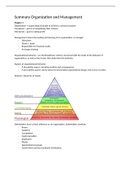
Maslow’s hierarchy of needs:
Stakeholders have a direct influence on an organization. Stakeholders could be:
- Buyers
- Suppliers
- Competition
- Capital providers
- Employees
- Media
- Special interest groups
- Government and local authority institutions
,Buyers:
- An organization exist through satisfy demands of buyers
- Changes in buyers demand lead to new products
Suppliers:
- An organization imposes demands on its suppliers by quality, price level, delivery time
- Choice of supplies has changed from local to international suppliers
- Organizations want to reduce their stocks: just in time delivery
Competitors:
- Determine the amount of flexibility of organizations: price, quality, distribution channels
- Important to monitor activities of competitors and to analyze their relative market positions
Capital providers:
- Organizations must maintain good relationship with financiers or capital providers
- Providers who become dissatisfied can turn off the financial supply
- In large enterprises, major financiers are represented by supervisory bodies, as board of
commissioners
Employees:
- Are critical success factor
- Employees from the 21st century have a higher education level, more emancipated induvial
than 20st century
- They play a greater roll in product, organizational innovations and quality improvements
Special interest groups:
- Employee federations (trade unions)
- Environmental activists
- Consumer organization
Government authorities:
- Influencing organization through the application of legislation to the organizational field:
Local authorities
Provinces
National government
European Union
External factors:
1. Environmental: economic growth accompanied by pollution and environmental exhaustion
of natural resources
2. Technological: ensure a constant improvements of production methods and innovations of
goods and services
3. Demographic: size, growth of population etc.
4. Economic: growth of national income, inflation etc.
5. Political: governmental authorizes use their political powers to try steer their economy in a
favorable direction (taxes, tree trade)
6. Social: refer to influence of society on organizations (planet, people, profit)
, The environment is very important for the strategy of organizations:
- Cleaning up current activities
- Listing new opportunities
- Working on a sustainable future
Process in the information technology with major consequences for:
- The way work is done
- An integration of functions
- Changes in economies of scale and decision-making
5 forms of economic integration between countries:
1. Free trade zone
2. Customs union
3. Common market
4. Economic unit
5. Complete political and economic union (USA)
Chapter 9
Manager = a person who can stimulate and direct the behavior of others within an organization
Leadership = the specific ability to make others follow a person who wants to lead others, has to earn
this right
If there is a growing organization, the separation between operational control and leadership .
Hierarchical levels:
1. Top management = they provide leadership to the organization
2. Middle management = they direct the activities of the operational levels
3. First line management = are heads of departments or group managers
Policy formulation tasks = tasks in the fields of diagnosis, prediction, planning and organizing
activities
Executive tasks = involve mainly the delegating of activities and the supervising and motivating of
employees.
Functional manager is responsible for a single activity (purchasing, marketing manager etc.)
General manager is responsible for all the activities (business unit manager, divisional manager)
Trends within the work of the management:
- Flattening: fewer management levels within an organization
- Coaching and guiding; the classical style of management disappears
- Shift from functional to general managers: organizations move shaped in autonomous
business units, for example all activities aimed at a certain product-market combination
Managerial roles: (Mintzberg)
1. Interpersonal roles: figurehead, leader, liaison officer
2. Information roles: observer, distributor, spokesperson
3. Decision-making roles: entrepreneur, trouble shooter, distributor, negotiator
Chapter 1
Organization = cooperating of people to achieve a common purpose
Companies = goal is accomplishing their mission
Enterprises = goal is making profit
Management means the leading and steering of an organization. A manager:
- Stimulates
- Directs / leads
- Responsible for financial results
- In charge of group
Organizational behavior = an interdisciplinary science concerned with the study of the behavior of
organizations, as well as the factors that determine this behavior.
Aspects of organizational behavior:
- A descriptive aspect: including motives and consequences
- A prescriptive aspect: advice about recommended organizational design and course of action
Maslow’s hierarchy of needs:
Stakeholders have a direct influence on an organization. Stakeholders could be:
- Buyers
- Suppliers
- Competition
- Capital providers
- Employees
- Media
- Special interest groups
- Government and local authority institutions
,Buyers:
- An organization exist through satisfy demands of buyers
- Changes in buyers demand lead to new products
Suppliers:
- An organization imposes demands on its suppliers by quality, price level, delivery time
- Choice of supplies has changed from local to international suppliers
- Organizations want to reduce their stocks: just in time delivery
Competitors:
- Determine the amount of flexibility of organizations: price, quality, distribution channels
- Important to monitor activities of competitors and to analyze their relative market positions
Capital providers:
- Organizations must maintain good relationship with financiers or capital providers
- Providers who become dissatisfied can turn off the financial supply
- In large enterprises, major financiers are represented by supervisory bodies, as board of
commissioners
Employees:
- Are critical success factor
- Employees from the 21st century have a higher education level, more emancipated induvial
than 20st century
- They play a greater roll in product, organizational innovations and quality improvements
Special interest groups:
- Employee federations (trade unions)
- Environmental activists
- Consumer organization
Government authorities:
- Influencing organization through the application of legislation to the organizational field:
Local authorities
Provinces
National government
European Union
External factors:
1. Environmental: economic growth accompanied by pollution and environmental exhaustion
of natural resources
2. Technological: ensure a constant improvements of production methods and innovations of
goods and services
3. Demographic: size, growth of population etc.
4. Economic: growth of national income, inflation etc.
5. Political: governmental authorizes use their political powers to try steer their economy in a
favorable direction (taxes, tree trade)
6. Social: refer to influence of society on organizations (planet, people, profit)
, The environment is very important for the strategy of organizations:
- Cleaning up current activities
- Listing new opportunities
- Working on a sustainable future
Process in the information technology with major consequences for:
- The way work is done
- An integration of functions
- Changes in economies of scale and decision-making
5 forms of economic integration between countries:
1. Free trade zone
2. Customs union
3. Common market
4. Economic unit
5. Complete political and economic union (USA)
Chapter 9
Manager = a person who can stimulate and direct the behavior of others within an organization
Leadership = the specific ability to make others follow a person who wants to lead others, has to earn
this right
If there is a growing organization, the separation between operational control and leadership .
Hierarchical levels:
1. Top management = they provide leadership to the organization
2. Middle management = they direct the activities of the operational levels
3. First line management = are heads of departments or group managers
Policy formulation tasks = tasks in the fields of diagnosis, prediction, planning and organizing
activities
Executive tasks = involve mainly the delegating of activities and the supervising and motivating of
employees.
Functional manager is responsible for a single activity (purchasing, marketing manager etc.)
General manager is responsible for all the activities (business unit manager, divisional manager)
Trends within the work of the management:
- Flattening: fewer management levels within an organization
- Coaching and guiding; the classical style of management disappears
- Shift from functional to general managers: organizations move shaped in autonomous
business units, for example all activities aimed at a certain product-market combination
Managerial roles: (Mintzberg)
1. Interpersonal roles: figurehead, leader, liaison officer
2. Information roles: observer, distributor, spokesperson
3. Decision-making roles: entrepreneur, trouble shooter, distributor, negotiator



