

Dystopia = a community or society that is
New Media Challenges undesirable or frightening.
Communication Science Functions of utopian worldview:
- Optimism about the future
- String belief in technological
Lecture 1: Introduction, utopian and
development
dystopian views on media infiltration
- Push to invest in technological
developments
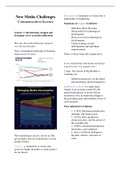
How has the media landscape changed - Cultural change toward
over the last decades? individuation and individual
empowerment
News consumption landscape in Germany
(main source of news) There is always been this utopian drive.
Is our relationship with media technology
a positive one or a negative one?
2 clips: The Jetsons & Big Brother is
watching you
- Different perspective on the future
and technology (positive/negative)
Industrial revolution = a rapid major
change in an economy marked by the
general introduction of power-driven
machinery or by an important change in
the prevailing types and methods of use of
such machines.
Four industrial revolutions
- 1. (1784) | Mechanical production,
railroads, and steam power
- 2. (1870) | Mass production,
electrical power, and the advent of
the assembly line
- 3. (1969) | Automated production,
electronics, and computers
- 4. (now) | Artificial intelligence,
New technologies can do a lot for us. But big data, robotics, and more to
governments also use technologies to track come
people (China).
Utopia = a community or society that
possesses highly desirable or nearly perfect
for its citizen
,Lecture 2: Introduction to Online Purposes & states of privacy
Privacy
Privacy is “the claim of individuals, groups
or institutions to determine for themselves
What is privacy? when, how, and to what extent information
about them is communicated to others”
Privacy is defined by cultures
Privacy has four purposes (or objectives)
Uncertainty avoidance: the extent to
and four states
which a society, or group relies on social
norms, rules, and produces to minimize the - Purposes of privacy: what is
unpredictability of future events. privacy for?
Privacy is defined by times
Privacy is defined by individuals
Three theoretical perspectives
Westin (1967): political-scientific
approach: privacy in interaction with
others / society as a whole
Privacy is a basic need which helps - States of privacy: how van privacy
us to adjust to day-to-day interpersonal be achieved?
interactions
Privacy is:
- A dynamic process (we regulate
privacy so as to serve momentary
needs and role requirements)
- Non-monotonic (you can have such
a thing as too little, just enough or
not enough privacy)
,Altman (1975): psychological approach: Bi-directional (inwards and outwards):
privacy for the self (wellbeing and identity individuals might have different
regulation) sensitivities for their actions towards
others’ privacy and others’ actions towards
Irwin Altman formulated the privacy
them
regulation theory, which aimed ate
understanding why individuals alternate
between states of sociality and solitude.
Privacy is “a selective control of access to
the self or to one’s group”
Five elements of privacy
Petronio (2002): communication
approach: privacy as information
ownership and sharing
Originally knows as Communication
Boundary Management
Privacy is “the selective control of access
to the self (Altman)
We need to regulate boundaries we put
between ourselves and others
Dynamic process: individuals regulate
what they (do or not) want to share
How do we manage our privacy?
differently, depending on the situational or
social context From physical privacy to information
privacy
Individual vs group levels: individuals
perceive their own privacy differently form According to Smith (2011) one of the big
that of their community/family shifts in how we understand and measure
privacy has been that of:
Desired vs actual level: desired level of
privacy might be lower/higher than - Progressively speaking less of
individuals have in a given context physical privacy (shared things,
spaced)
Non-monotonic: there is such a thing as
- And more about information
both too much and not sufficient privacy
privacy
- Stranger on the train - And more and more about what we
do “online”
, Functional self-disclosure in social H5: Disclosure goals are expected to affect
media disclosure intimacy.
Article of Bazarova & Choi (2014) H6: Less intimate disclosures are
associated with social validation goals
compared to other self disclosure goals,
especially the more personally involving
relational development goals.
H7: Disclosure goals are predicted to
mediate between Facebook communication
forms and disclosure intimacy.
Results: All hypotheses are true
How to study the article:
Mediation model - Rough idea of the type of study
(combination of content analysis
and survey)
- Understand the concepts
- What are the disclosure goals,
development goals, validation
goals, disclosure intimacy, etc
- Understand the outcomes
H1: People pursue different disclosure
- What are the direct effects
goals in Facebook status updates, wall
- What are the mediation effects
posts, and private, messages.
H2: Disclosures directed at a familiar
other, as via Facebook wall posts and
private messaging, are associated with
Who are our online audiences?
relational development goals more than
disclosures directed at general others, as Who is listening?
via Facebook status updates.
Context collapse by Danah Boyd and Alice
H3a: People pursue greater social Marwick
validation goals in nondirected status
updates compared to directed wall posts Context collapse = the
and private messages. phenomenon where technology
flattens multiple audiences into one
H3b: Social validation goals are more
salient in public wall posts compared to “the flattening out of multiple
private messages. distinct audiences in one’s social
network, such that people from
H4: SNS users can adapt to different different contexts become part of a
affordances by choosing to reveal less singular group of messages
intimate and private information via public recipients”
status updates and wall posts than via
private messaging on Facebook.
New Media Challenges undesirable or frightening.
Communication Science Functions of utopian worldview:
- Optimism about the future
- String belief in technological
Lecture 1: Introduction, utopian and
development
dystopian views on media infiltration
- Push to invest in technological
developments
How has the media landscape changed - Cultural change toward
over the last decades? individuation and individual
empowerment
News consumption landscape in Germany
(main source of news) There is always been this utopian drive.
Is our relationship with media technology
a positive one or a negative one?
2 clips: The Jetsons & Big Brother is
watching you
- Different perspective on the future
and technology (positive/negative)
Industrial revolution = a rapid major
change in an economy marked by the
general introduction of power-driven
machinery or by an important change in
the prevailing types and methods of use of
such machines.
Four industrial revolutions
- 1. (1784) | Mechanical production,
railroads, and steam power
- 2. (1870) | Mass production,
electrical power, and the advent of
the assembly line
- 3. (1969) | Automated production,
electronics, and computers
- 4. (now) | Artificial intelligence,
New technologies can do a lot for us. But big data, robotics, and more to
governments also use technologies to track come
people (China).
Utopia = a community or society that
possesses highly desirable or nearly perfect
for its citizen
,Lecture 2: Introduction to Online Purposes & states of privacy
Privacy
Privacy is “the claim of individuals, groups
or institutions to determine for themselves
What is privacy? when, how, and to what extent information
about them is communicated to others”
Privacy is defined by cultures
Privacy has four purposes (or objectives)
Uncertainty avoidance: the extent to
and four states
which a society, or group relies on social
norms, rules, and produces to minimize the - Purposes of privacy: what is
unpredictability of future events. privacy for?
Privacy is defined by times
Privacy is defined by individuals
Three theoretical perspectives
Westin (1967): political-scientific
approach: privacy in interaction with
others / society as a whole
Privacy is a basic need which helps - States of privacy: how van privacy
us to adjust to day-to-day interpersonal be achieved?
interactions
Privacy is:
- A dynamic process (we regulate
privacy so as to serve momentary
needs and role requirements)
- Non-monotonic (you can have such
a thing as too little, just enough or
not enough privacy)
,Altman (1975): psychological approach: Bi-directional (inwards and outwards):
privacy for the self (wellbeing and identity individuals might have different
regulation) sensitivities for their actions towards
others’ privacy and others’ actions towards
Irwin Altman formulated the privacy
them
regulation theory, which aimed ate
understanding why individuals alternate
between states of sociality and solitude.
Privacy is “a selective control of access to
the self or to one’s group”
Five elements of privacy
Petronio (2002): communication
approach: privacy as information
ownership and sharing
Originally knows as Communication
Boundary Management
Privacy is “the selective control of access
to the self (Altman)
We need to regulate boundaries we put
between ourselves and others
Dynamic process: individuals regulate
what they (do or not) want to share
How do we manage our privacy?
differently, depending on the situational or
social context From physical privacy to information
privacy
Individual vs group levels: individuals
perceive their own privacy differently form According to Smith (2011) one of the big
that of their community/family shifts in how we understand and measure
privacy has been that of:
Desired vs actual level: desired level of
privacy might be lower/higher than - Progressively speaking less of
individuals have in a given context physical privacy (shared things,
spaced)
Non-monotonic: there is such a thing as
- And more about information
both too much and not sufficient privacy
privacy
- Stranger on the train - And more and more about what we
do “online”
, Functional self-disclosure in social H5: Disclosure goals are expected to affect
media disclosure intimacy.
Article of Bazarova & Choi (2014) H6: Less intimate disclosures are
associated with social validation goals
compared to other self disclosure goals,
especially the more personally involving
relational development goals.
H7: Disclosure goals are predicted to
mediate between Facebook communication
forms and disclosure intimacy.
Results: All hypotheses are true
How to study the article:
Mediation model - Rough idea of the type of study
(combination of content analysis
and survey)
- Understand the concepts
- What are the disclosure goals,
development goals, validation
goals, disclosure intimacy, etc
- Understand the outcomes
H1: People pursue different disclosure
- What are the direct effects
goals in Facebook status updates, wall
- What are the mediation effects
posts, and private, messages.
H2: Disclosures directed at a familiar
other, as via Facebook wall posts and
private messaging, are associated with
Who are our online audiences?
relational development goals more than
disclosures directed at general others, as Who is listening?
via Facebook status updates.
Context collapse by Danah Boyd and Alice
H3a: People pursue greater social Marwick
validation goals in nondirected status
updates compared to directed wall posts Context collapse = the
and private messages. phenomenon where technology
flattens multiple audiences into one
H3b: Social validation goals are more
salient in public wall posts compared to “the flattening out of multiple
private messages. distinct audiences in one’s social
network, such that people from
H4: SNS users can adapt to different different contexts become part of a
affordances by choosing to reveal less singular group of messages
intimate and private information via public recipients”
status updates and wall posts than via
private messaging on Facebook.


