

Topics in Business Economics
Lecture one: Introduction
Origin of accounting theory
- Accounting research/theory relies often on other disciplines (e.g., economics, psychology,
organizational behaviour)
Examples:
- Agency theory
- Institutional theory
- Behavioral accounting theory
- Contingency theory
- Upper echelons theory
Theory, hypothesis and more
- Theory: a formal set of ideas that is intended to explain why something happens or exists
- I see something and some reasoning can explain it
- Hypothesis: an idea or explanation of something that is based on a few known facts but has
not yet been proven to be true or correct
- You have a theory and afterwards comes the hypothesis (more specific than theory)
- Proposition: similar to a hypothesis but the link cannot be verified by experiment
- Often used in qualitative research
- Theorem: a rule or principle, especially in mathematics, that can be proven to be true
- Numbers from which you can mathematically prove something is true
- Law: a generalized rule, especially in natural sciences, in the form of a mathematical
statement
Basic levels of research
1. Description: collection and reporting data (observations) and basic statistics
2. Classification: grouping (or clustering) of data based on similarities or differences
3. Explanation: make sense of the data by attempting to explain relationships (or causality);
generally concerned with the ‘Why?’
4. Prediction: provide models that allow testable predictions for (future) events
Some more distinctions
- Deductive reasoning: theory → observation
- Inductive reasoning: observation → theory
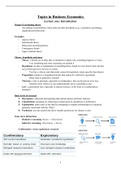
Confirmatory versus exploratory research
1
,Accounting +: classification of papers
Accounting+
- Accounting research often based on economic theoretical perspectives, but it does not need to be so
- Accounting research often performed on basis of quantitative models, but it does not need to be so
- Theoretical perspectives and research methods often correlate, but it does not need to be so
2
, Lecture two: Formulating a research question and transition to
hypotheses (Kinney (2019))
Paper: about helping beginning Ph.D. students identify, evaluate and
communicate essential components of proposed empirical accounting
research using a three-step process
1. Structured top-down approach: writing answers to three related
questions (What, Why, How) that emphasize the central role of
conceptual thinking in research design, as well as practical relevance
- Synopsis: give early attention to the purpose of the research
through preparation of a three-short-paragraph abstract
2. Predictive validity assessment: anticipates concerns likely to arise in
the scholarly review process (analyzes what, how, why questions)
3. Consideration of the likely outcome and potential problems to be
encountered if the proposal is implemented as planned
- Addresses the basis for Why that provides the link between What
and How and also anticipates critical research outcome perils that may disrupt implementation
Objective of accounting research: create legitimate, consequential belief revision about issues
associated with accounting-related decision settings
- Purpose of accounting research: change the way informed and creatively skeptical people
think about an accounting issue that is important to them or to others
Step I: three paragraphs for communicating research
Answering these three questions convert the core of what is in your head to a standard research
format that can be understood by others:
1. What are you trying to find out, conceptually? (What concepts or theories underlie your idea?)
- What response: expressed as a theory or policy positing a ‘causal’ connection between
conceptual factors, that in some way causes an effect on another conceptual factor
2. Why is an answer important and to whom? (Who will care about your answer and why should
they care?)
- Why response: explains the importance to others and usually depends on the sign and
magnitude of the connecting link between concepts
3. How will you find the answer, operationally? (What research method and data will you use to
find the answer?)
- How response: relates the research method applied, the context, the conceptual
factors, how you estimate covariance of these factors and how you satisfy other
things equal
Step II: predictive validity to assess ‘what’ and ‘how’
- Predictive validity: assessing the operationalization’s ability to predict something it should
theoretically be able to predict
- When we say something is valid: we make a judgment about the extent to which
relevant evidence supports that inference as being true or correct
Validity links implicit in the ‘What’ and ‘How’ paragraphs: it is more believable that the
theoretical X → Y presumed in your ‘What’ paragraph and your implicit X, Y, Vs and Zs analysis
from your How paragraph describe real-world behaviors, if the following links are satisfied
3
, The five common aspects of predictive validity:
Link 1: there is reason to believe that the X → Y|Vs, Zs result generalizes to other persons, times and
settings or X → Y (How)
- Defined by the ‘What’ paragraph: reflects the top (conceptual) row, the presumed cause and
effect relation between abstract theoretical concepts or policy prescriptions
- Link 1 has two roles:
- It describes the direction of causality predicted by the researcher’s theory or presumed by a
policy setter
- After evaluating links 2-5: it addresses whether the association from link 5 can
reasonably be extended to predict outcomes for other contexts
Link 2: there is reason to believe X reasonably measures X, (How, What) (construct validity of cause)
Link 3: there is reason to believe Y reasonably measures Y, (How, What) (construct validity of effect)
Link 4: other-than-X causes of Y are accounted for/ruled out by research design (i.e., rule out Vs → Y,
or Zs → Y, and Y → X), (How) (internal validity)
Link 5: X and Y are correlated, other things equal, (How) (statistical conclusion validity)
Different kinds of validity
- Construct validity: the extent to which your test/measure accurately assesses what it is supposed to
- Identification of causes, effects, settings and participants that are present in a study
- Internal validity: the extent to which the observed results represent the truth in the population we
are studying
- Examines whether the study design, conduct and analysis answer the research questions
without bias
- External validity: the extent to which you can generalize the findings of a study to other
situations, people, settings, and measures
- Examines whether the study findings can be applied to broader contexts
- Statistical conclusion validity: statistical methods are used whose sample behavior is accurate,
besides being logically capable of providing an answer to the research question
- Holds when conclusions of a research study are founded on an adequate analysis of data
Step III: outcome anticipation; is this proposal a good bet?
- Step III: relates to d and the illusive ‘Why’ importance and to possible implementation perils
ahead for r and n (both threats affect whether the proposal is a good bet for your success)
- Most common reason for not meeting the ‘Why’ important objective: likely effect size at the
conceptual level and at the operational level when the null hypothesis that Q = 0 cannot be rejected
- Second outcome risk to consider: practical problems arising when collecting and analyzing
archival or experimental data that determine your significance test results
- The risk that your idea will be scooped: that someone else will have the same idea, use
essentially the same model and data sources, and get on SSRN first
PH. D student experiences with the three steps
1. Your peers can and will help you
2. Paragraph order can matter
3. You can help yourself
4. You can help each other get started
5. Scholarly improv sessions can help
6. Choose words and concepts carefully, then repeat
4
Lecture one: Introduction
Origin of accounting theory
- Accounting research/theory relies often on other disciplines (e.g., economics, psychology,
organizational behaviour)
Examples:
- Agency theory
- Institutional theory
- Behavioral accounting theory
- Contingency theory
- Upper echelons theory
Theory, hypothesis and more
- Theory: a formal set of ideas that is intended to explain why something happens or exists
- I see something and some reasoning can explain it
- Hypothesis: an idea or explanation of something that is based on a few known facts but has
not yet been proven to be true or correct
- You have a theory and afterwards comes the hypothesis (more specific than theory)
- Proposition: similar to a hypothesis but the link cannot be verified by experiment
- Often used in qualitative research
- Theorem: a rule or principle, especially in mathematics, that can be proven to be true
- Numbers from which you can mathematically prove something is true
- Law: a generalized rule, especially in natural sciences, in the form of a mathematical
statement
Basic levels of research
1. Description: collection and reporting data (observations) and basic statistics
2. Classification: grouping (or clustering) of data based on similarities or differences
3. Explanation: make sense of the data by attempting to explain relationships (or causality);
generally concerned with the ‘Why?’
4. Prediction: provide models that allow testable predictions for (future) events
Some more distinctions
- Deductive reasoning: theory → observation
- Inductive reasoning: observation → theory
Confirmatory versus exploratory research
1
,Accounting +: classification of papers
Accounting+
- Accounting research often based on economic theoretical perspectives, but it does not need to be so
- Accounting research often performed on basis of quantitative models, but it does not need to be so
- Theoretical perspectives and research methods often correlate, but it does not need to be so
2
, Lecture two: Formulating a research question and transition to
hypotheses (Kinney (2019))
Paper: about helping beginning Ph.D. students identify, evaluate and
communicate essential components of proposed empirical accounting
research using a three-step process
1. Structured top-down approach: writing answers to three related
questions (What, Why, How) that emphasize the central role of
conceptual thinking in research design, as well as practical relevance
- Synopsis: give early attention to the purpose of the research
through preparation of a three-short-paragraph abstract
2. Predictive validity assessment: anticipates concerns likely to arise in
the scholarly review process (analyzes what, how, why questions)
3. Consideration of the likely outcome and potential problems to be
encountered if the proposal is implemented as planned
- Addresses the basis for Why that provides the link between What
and How and also anticipates critical research outcome perils that may disrupt implementation
Objective of accounting research: create legitimate, consequential belief revision about issues
associated with accounting-related decision settings
- Purpose of accounting research: change the way informed and creatively skeptical people
think about an accounting issue that is important to them or to others
Step I: three paragraphs for communicating research
Answering these three questions convert the core of what is in your head to a standard research
format that can be understood by others:
1. What are you trying to find out, conceptually? (What concepts or theories underlie your idea?)
- What response: expressed as a theory or policy positing a ‘causal’ connection between
conceptual factors, that in some way causes an effect on another conceptual factor
2. Why is an answer important and to whom? (Who will care about your answer and why should
they care?)
- Why response: explains the importance to others and usually depends on the sign and
magnitude of the connecting link between concepts
3. How will you find the answer, operationally? (What research method and data will you use to
find the answer?)
- How response: relates the research method applied, the context, the conceptual
factors, how you estimate covariance of these factors and how you satisfy other
things equal
Step II: predictive validity to assess ‘what’ and ‘how’
- Predictive validity: assessing the operationalization’s ability to predict something it should
theoretically be able to predict
- When we say something is valid: we make a judgment about the extent to which
relevant evidence supports that inference as being true or correct
Validity links implicit in the ‘What’ and ‘How’ paragraphs: it is more believable that the
theoretical X → Y presumed in your ‘What’ paragraph and your implicit X, Y, Vs and Zs analysis
from your How paragraph describe real-world behaviors, if the following links are satisfied
3
, The five common aspects of predictive validity:
Link 1: there is reason to believe that the X → Y|Vs, Zs result generalizes to other persons, times and
settings or X → Y (How)
- Defined by the ‘What’ paragraph: reflects the top (conceptual) row, the presumed cause and
effect relation between abstract theoretical concepts or policy prescriptions
- Link 1 has two roles:
- It describes the direction of causality predicted by the researcher’s theory or presumed by a
policy setter
- After evaluating links 2-5: it addresses whether the association from link 5 can
reasonably be extended to predict outcomes for other contexts
Link 2: there is reason to believe X reasonably measures X, (How, What) (construct validity of cause)
Link 3: there is reason to believe Y reasonably measures Y, (How, What) (construct validity of effect)
Link 4: other-than-X causes of Y are accounted for/ruled out by research design (i.e., rule out Vs → Y,
or Zs → Y, and Y → X), (How) (internal validity)
Link 5: X and Y are correlated, other things equal, (How) (statistical conclusion validity)
Different kinds of validity
- Construct validity: the extent to which your test/measure accurately assesses what it is supposed to
- Identification of causes, effects, settings and participants that are present in a study
- Internal validity: the extent to which the observed results represent the truth in the population we
are studying
- Examines whether the study design, conduct and analysis answer the research questions
without bias
- External validity: the extent to which you can generalize the findings of a study to other
situations, people, settings, and measures
- Examines whether the study findings can be applied to broader contexts
- Statistical conclusion validity: statistical methods are used whose sample behavior is accurate,
besides being logically capable of providing an answer to the research question
- Holds when conclusions of a research study are founded on an adequate analysis of data
Step III: outcome anticipation; is this proposal a good bet?
- Step III: relates to d and the illusive ‘Why’ importance and to possible implementation perils
ahead for r and n (both threats affect whether the proposal is a good bet for your success)
- Most common reason for not meeting the ‘Why’ important objective: likely effect size at the
conceptual level and at the operational level when the null hypothesis that Q = 0 cannot be rejected
- Second outcome risk to consider: practical problems arising when collecting and analyzing
archival or experimental data that determine your significance test results
- The risk that your idea will be scooped: that someone else will have the same idea, use
essentially the same model and data sources, and get on SSRN first
PH. D student experiences with the three steps
1. Your peers can and will help you
2. Paragraph order can matter
3. You can help yourself
4. You can help each other get started
5. Scholarly improv sessions can help
6. Choose words and concepts carefully, then repeat
4


