

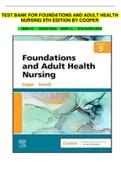
TEST BANK FOR FOUNDATIONS AND ADULT HEALTH NURSING 9TH EDITION BY COOPER • ISBN -10 : 0323812058 ISBN -13 : 978-0323812054 Chapter 01: Introduction to Anatomy and Physiology Cooper: Adult Health Nursing, 9th Edition MULTIPLE CHOICE 1. The anatomic term means toward the midline. a. anterior b. posterior c. medial d. cranial ANS: C The term medial indicates an anatomic direction toward the midline. DIF: Cognitive Level: Knowledge REF: 1 OBJ: 2 TOP: Anatomic terminology KEY: Nursing Process Step: Assessment MSC: NCLEX: Physiological Integrity 2. What are the smallest living components in our body? a. Cells b. Organs c. Electrons d. Osmosis ANS: A Cells are considered to be the smallest living units of structure and function in our body. DIF: Cognitive Level: KnowledUge RTEF: 4 OBJ: 6 TOP: Structural levels of organization KEY: Nursing Process Step: N/A MSC: NCLEX: Physiological Integrity 3. What is the largest organelle, responsible for cell reproduction and control of other organelles? a. Nucleus b. Ribosome c. Mitochondrion d. Golgi apparatus ANS: A The nucleus is the largest organelle within the cell. DIF: Cognitive Level: Knowledge REF: 5 OBJ: 8 TOP: Parts of the cell KEY: Nursing Process Step: Assessment MSC: NCLEX: Physiological Integrity 4. When the patienSttcuvoiam.cpomla-inThseoMfaprkaeitpnlaicne ttohBeuby laandddSeerll,yothureSptuadtyieMnattewriailll indicate discomfort in which body cavity? a. Pelvic b. Mediastinum c. Dorsal d. Abdominal ANS: A A subdivision called the pelvic cavity contains the lower portion of the large intestine (lower sigmoid colon, rectum), urinary bladder, and internal structures of the reproductive system. DIF: Cognitive Level: Comprehension REF: 3 OBJ: 5 TOP: Body cavity KEY: Nursing Process Step: Assessment MSC: NCLEX: Physiological Integrity 5. The four phases of cell division all occur in: a. diffusion. b. mitosis. c. osmosis. d. filtration. ANS: B During mitosis, the cell goes through four phases: prophase, metaphase, anaphase, and telophase. DIF: Cognitive Level: Knowledge REF: 7 OBJ: 9 TOP: Cell division KEY: Nursing Process Step: N/A MSC: NCLEX: Physiological Integrity 6. Telophase is which phase of cell reproduction during mitosis? a. First phase b. Latent phase c. Final phase d. Spindle phase ANS: C During this final phase of cell division, the two nuclei appear and the chromosomes disperse. DIF: Cognitive Level: Knowledge REF: 7 OBJ: 9 TOP: Cell division KEY: Nursing Process Step: N/A MSC: NCLEX: Physiological Integrity 7. The nurse is aware that which muscle group is both striated and involuntary? a. Skeletal b. Glial c. Cardiac d. Visceral ANS: C The cardiac muscle is both striated and involuntary. DIF: Cognitive Level: Knowledge REF: 9 OBJ: 11 TOP: Tissues KEY: Nursing Process Step: Planning MSC: NCLEX: Physiological Integrity 8. What is a group of several different kinds of tissues arranged so that together they can perform a more complex function than any tissue alone? a. Organ b. System c. Cell d. Endoplasmic reticulum ANS: A When several kinds of tissues are united to perform a more complex function than any tissue alone, they are called organs. DIF: Cognitive Level: Knowledge REF: 11 OBJ: 7 TOP: Organs KEY: Nursing Process Step: N/A MSC: NCLEX: Physiological Integrity 9. What traits describe visceral muscles? a. Smooth and voluntary b. Smooth and involuntary c. Striated and voluntary d. Striated and involuntary ANS: B Visceral (smooth) muscles will not function at will; thus, they act involuntarily. DIF: Cognitive Level: Knowledge REF: 9 OBJ: 7 TOP: Tissues KEY: Nursing Process Step: Assessment MSC: NCLEX: Physiological Integrity 10. How are the thoracic and abdominal cavities separated? a. By the pleura b. By the diaphragm c. Bythe sagittal plane d. By the peritoneum ANS: B The diaphragm (a muscle directly beneath the lungs) separates the ventral cavity into the thoracic (chest) and abdominal cavities. DIF: Cognitive Level: Knowledge REF: 2 OBJ: 3 TOP: Ventral cavity KEY: Nursing Process Step: Assessment MSC: NCLEX: Physiological Integrity 11. What is the broad section of biology dealing with the description of human structure? a. Hematology b. Anatomy c. Kinesiology d. Physiology ANS: B Anatomy is the study, classification, and description of the structure and organs of the body. DIF: Cognitive Level: Knowledge REF: 1 OBJ: 1 TOP: Terminology KEY: Nursing Process Step: N/A MSC: NCLEX: Physiological Integrity 12. explains the processes and functions of many structures of the body and how they interact with one another.
Preview 4 out of 878 pages
Exam (elaborations)
TEST BANK FOR FOUNDATIONS AND ADULT HEALTH NURSING 9TH EDITION BY KIM COOPER & KELLY GOSNELL
Preview 4 out of 878 pages
TEST BANK FOR FOUNDATIONS AND ADULT HEALTH NURSING 9TH EDITION BY KIM COOPER & KELLY GOSNELL
Content preview
Connected book
Document information
- Uploaded on
- March 11, 2023
- Number of pages
- 878
- Written in
- 2022/2023
- Type
- Exam (elaborations)
- Contains
- Questions & answers
$17.99
Wrong document? Swap it for free
Within 14 days of purchase and before downloading, you can choose a different document. You can simply spend the amount again.
Written by students who passed
Immediately available after payment
Read online or as PDF

Reputation scores are based on the amount of documents a seller has sold for a fee and the reviews they have received for those documents. There are three levels: Bronze, Silver and Gold. The better the reputation, the more your can rely on the quality of the sellers work.

