

Extract C (lines 10-11) suggests that ‘Increased protectionism could be damaging as the UK is placing
much of its hopes for export success on the growing Chinese market.’
Using the data in the extracts and your economic knowledge, evaluate the view that the use of
protectionism is inevitably damaging to economies. [25 marks]
Protectionism is the deliberate attempt to limit imports or promote exports by putting up barriers to
trade. Despite the advocacy for free trade in many countries and increased trade openness, degrees
of protectionism are still implemented in most economies. Examples of different types of
protectionism include tariffs, quotas, IP laws, domestic subsidies, administrative and technological
barriers, and managed exchange rates. There have been many disputes over whether taking a
protectionist or a free-market approach is more beneficial to economies, with protectionism tackling
dumping, promoting economy’s independence, and benefitting sunrise firms, however it can also be
damaging due to welfare loss and possible retaliation as a result of tariffs, and reduced competition.
Although many protectionist policies are damaging in the long run, the use of protectionism is not
necessarily inevitably damaging to economies, as seen through positive aspects such as subsidies,
which create long-run economic growth, therefore I agree with this view to a lesser extent.
Protectionism can be seen to inevitably damage
economies to a large extent when looking at the
effects of tariffs. Import tariffs are taxes or duties
on imported goods, designed to raise the price
level of, or above, the existing domestic price.
They are meant to protect the domestic
industries from overseas competition by
increasing the relative price on imports, causing a
fall in demand. It is also meant to improve the
domestic economy’s trade balance through
reduced imports and generate tax revenue for
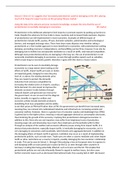
the government. As we can see from the diagram
below, benefits in regard to welfare and
economic activity include domestic producers
benefitting from less competition and the ability
to set their prices at PW+tariff rather than at PW, the government can benefit from increased taxes,
meaning they can reinvest into nationalised industries and infrastructure, increasing societal and
consumer welfare. However, there is a greater loss of consumer surplus and deadweight loss (DWL)
is gained due to the higher prices, meaning a reduced aggregate demand as consumption decreases,
thus hindering the growth of the economy, implying that protectionism damaged economies. In
addition to this, firms who are net importers may suffer from heightened costs of production,
meaning wage cuts and downsizing may result, thus employees and households suffer further.
Through an analysis of the welfare and economic efficiency issues arising from import tariffs, it is
obvious that protectionism, especially import tariffs, is inevitably damaging for economies, as it is
very damaging to consumers and households, which knocks onto aggregate demand. In addition to
the damaging effects of import tariffs in general, retaliation may occur as a result of implementing
protectionist policies, such as trade wars. Trade wars are when a country retaliates and raises import
tariffs or other restrictions on a country’s imports, possibly damaging the two countries’ relationship
in trade. This can be seen in Extract C, through China placing a levy on European wine in response to
anti-dumping tariffs on solar panels put in place by the EU, as seen through other countries in
Germany’s trading bloc being potentially affected, such as France and the UK. This implies that
protectionist policies are not only inherently flawed in regard to welfare issues, but also cause
further economic issues such as decreased international trade, thus causing falls in GDP, decreased
much of its hopes for export success on the growing Chinese market.’
Using the data in the extracts and your economic knowledge, evaluate the view that the use of
protectionism is inevitably damaging to economies. [25 marks]
Protectionism is the deliberate attempt to limit imports or promote exports by putting up barriers to
trade. Despite the advocacy for free trade in many countries and increased trade openness, degrees
of protectionism are still implemented in most economies. Examples of different types of
protectionism include tariffs, quotas, IP laws, domestic subsidies, administrative and technological
barriers, and managed exchange rates. There have been many disputes over whether taking a
protectionist or a free-market approach is more beneficial to economies, with protectionism tackling
dumping, promoting economy’s independence, and benefitting sunrise firms, however it can also be
damaging due to welfare loss and possible retaliation as a result of tariffs, and reduced competition.
Although many protectionist policies are damaging in the long run, the use of protectionism is not
necessarily inevitably damaging to economies, as seen through positive aspects such as subsidies,
which create long-run economic growth, therefore I agree with this view to a lesser extent.
Protectionism can be seen to inevitably damage
economies to a large extent when looking at the
effects of tariffs. Import tariffs are taxes or duties
on imported goods, designed to raise the price
level of, or above, the existing domestic price.
They are meant to protect the domestic
industries from overseas competition by
increasing the relative price on imports, causing a
fall in demand. It is also meant to improve the
domestic economy’s trade balance through
reduced imports and generate tax revenue for
the government. As we can see from the diagram
below, benefits in regard to welfare and
economic activity include domestic producers
benefitting from less competition and the ability
to set their prices at PW+tariff rather than at PW, the government can benefit from increased taxes,
meaning they can reinvest into nationalised industries and infrastructure, increasing societal and
consumer welfare. However, there is a greater loss of consumer surplus and deadweight loss (DWL)
is gained due to the higher prices, meaning a reduced aggregate demand as consumption decreases,
thus hindering the growth of the economy, implying that protectionism damaged economies. In
addition to this, firms who are net importers may suffer from heightened costs of production,
meaning wage cuts and downsizing may result, thus employees and households suffer further.
Through an analysis of the welfare and economic efficiency issues arising from import tariffs, it is
obvious that protectionism, especially import tariffs, is inevitably damaging for economies, as it is
very damaging to consumers and households, which knocks onto aggregate demand. In addition to
the damaging effects of import tariffs in general, retaliation may occur as a result of implementing
protectionist policies, such as trade wars. Trade wars are when a country retaliates and raises import
tariffs or other restrictions on a country’s imports, possibly damaging the two countries’ relationship
in trade. This can be seen in Extract C, through China placing a levy on European wine in response to
anti-dumping tariffs on solar panels put in place by the EU, as seen through other countries in
Germany’s trading bloc being potentially affected, such as France and the UK. This implies that
protectionist policies are not only inherently flawed in regard to welfare issues, but also cause
further economic issues such as decreased international trade, thus causing falls in GDP, decreased


