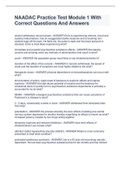
NAADAC Practice Test Module 1 With Correct Questions And Answers
simple phobia - ANSWER panic disorder characterized by an irrational fear of a specific thing or place (e.g. fear of snakes) obsessive compulsive disorder - ANSWER anxiety disorder characterized by uncontrollable intrusive thoughts and irresistible often distressing actions, such as repeated hand washing, to resolve those thoughts GAD (generalized anxiety disorder) - ANSWER unrealistic worry about several life situations that lasts for 6 months or longer dementia - ANSWER intellectual impairment found in some older people; includes loss of memory, personality changes, and impaired social skills, deterioration of intellectual ability, faulty memory, disorientation and diminished problem solving skills somatoform disorders - ANSWER disorders that have physical symptoms without a known or discoverable physical cause and are likely to be psychologically caused factitious disorder - ANSWER disorder in which the individual voluntarily produces the signs and symptoms of a disease in order to become a patient in a medical setting HPPD (hallucinogen persisting perceptual disorder) - ANSWER disorder in which hallucinations, paranoia and other symptoms last well past cessation of use and normal withdrawal from hallucinogens including marijuana amotivational syndrome - ANSWER lack of desire to complete tasks or to succeed, sometimes attributed to the long-term effects of marijuana psychotropic - ANSWER drugs used to treat mental illnesses, such as antidepressants, antipsychotics, and anxiolytics neuroleptics - ANSWER drugs used to treat psychosis psychopharmacology - ANSWER field of medicine that addresses the use of medications to help correct or help control mental illnesses and drug addiction SSRI (selective serotonin reuptake inhibitors) - ANSWER group of antidepressants that increase the levels of serotonin in the central nervous system tricyclic antidepressants - ANSWER older class of psychiatric medications that increase the activity of serotonin to elevate mood and counter depression lithium (carbonate) - ANSWER main drug used over the past 30 years to treat bipolar affective disorder phenothiazines - ANSWER class of psychiatric medications developed in the 1950s and use to treat schizophrenia; also called neuroleptics or antipsychotics Alcoholics Anonymous (AA) - ANSWER first 12-step, self-help, alcoholism recovery group founded in 1934 by Bill Wilson and Dr. Bob Smith prohibition - ANSWER supply reduction prevention technique that prohibits the importation, sale, or use of a drug like alcohol Volstead Act - ANSWER prohibited the sale and public consumption of alcohol; 1920 ethyl alcohol - ANSWER ethanol, or grain alcohol, the main psychoactive component in all alcoholic beverages methyl alcohol - ANSWER methanol or wood alcohol, a toxic solvent isopropyl alcohol - ANSWER propanol or rubbing alcohol, used in shaving lotion, shellac, antifreeze, antiseptics, and lacquer congeners - ANSWER by products of fermentation that add distinctive flavors, tastes, aromas, colors and bite to alcoholic beverages fermentation - ANSWER chemical process that uses yeast to convert grain, starch and fruit sugars into alcohol and carbon dioxide distillation - ANSWER chemical process that vaporizes the alcohol in fermented beverages and then collects the concentrated distillate proof - ANSWER measure of the amount of pure alcohol in an alcoholic beverage metabolism - ANSWER body's mechanism for processing, using, inactivating, and eventually eliminating food or drugs from the body ADH (alcohol dehydrogenase) - ANSWER principle enzyme in the liver that metabolizes alcohol ALDH (acetaldehyde) - ANSWER first substance that is formed when alcohol is metabolized by the liver; more toxic then alcohol BAC (blood alcohol concentration) - ANSWER concentration of alcohol in the blood, used legally to identify drunk drivers abstention - ANSWER nonuse experimentation - ANSWER use for curiosity with no subsequent drug-seeking behavior social - ANSWER sporadic infrequent drug-seeking behavior with no established pattern; also referred to as recreational habituation - ANSWER an established pattern of use with no major negative consequences abuse - ANSWER continued use despite negative consequences addiction - ANSWER compulsion to use, inability to stop use, major life dysfunction with continued use cortex - ANSWER outer part of an organ, e.g. the outer part of the brain limbic system - ANSWER emotional center of the central nervous system's midbrain that alters moods and emotions serotonin - ANSWER key mood neurotransmitter whose scarcity causes depression dopamine - ANSWER neurotransmitter that gives a surge of pleasure by stimulating reward/reinforcement center in the brain mesolimbic dopaminergic reward pathway - ANSWER another name for the reward/reinforcement center norepinephrine - ANSWER energy neurotransmitter that can stimulate the reward/reinforcement pathway met-enkephalin - ANSWER painkilling neurotransmitter released by alcohol endorphin - ANSWER painkilling neurotransmitter that can stimulate the reward/reinforcement pathway anadamide - ANSWER neurotransmitter released by alcohol whose effects are similar to those caused by the THC in marijuana NMDA receptors - ANSWER subtype of glutamate receptors GABA - ANSWER major inhibitory neurotransmitter; alcohol activation of this neurotransmitter lowers psychological inhibitions intoxication - ANSWER functional impairment and loss of physical and mental processes due to substance use binge drinking - ANSWER drinking a large amount of alcohol at one sitting; artificially defined as 5 drinks or more for a man and 4 for a woman heavy drinking - ANSWER defined as 5 or more drinks in a one sitting at least 5 times a month behavioral tolerance - ANSWER ability to mask the effects of intoxication by using unaffected parts of the brain blackout - ANSWER loss of awareness and recall without unconsciousness due to intoxication from alcohol or other drugs brownout - ANSWER like a blackout except the drinker has partial recall of events hangover - ANSWER alcohol withdrawal symptoms that occur 8 - 12 hours after stopping drinking; include dizziness, nausea, thirst and dry mouth alcohol hepatitis - ANSWER inflammation and impairment of liver function caused by excessive use of alcohol cirrhosis - ANSWER serious progressive liver disease that scars the liver; often caused by heavy chronic alcohol abuse necrosis - ANSWER cell death fatty liver - ANSWER accumulations of fatty acids in the liver that can begin to occur after just a few days of heavy drinking gastritis - ANSWER inflammation of the gastrointestinal system, particularly the
École, étude et sujet
- Établissement
- NAADAC
- Cours
- NAADAC
Infos sur le Document
- Publié le
- 4 mars 2023
- Nombre de pages
- 9
- Écrit en
- 2022/2023
- Type
- Examen
- Contient
- Questions et réponses
Sujets
- alcohol withdrawal
- second
-
naadac practice test module 1 with correct questions and answers
-
naadac practice test module 1 with correct
-
naadac practice test module 1 stuvia
-
naadac practice test stuvia

Document également disponible en groupe