CSET Multiple Subjects: Subtest 2 -Science questions and answers 2023
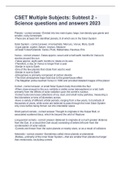
CSET Multiple Subjects: Subtest 2 -Science questions and answers 2023Planets -Divided into two main types: large, low-density gas giants and smaller, rocky terrestrials -There are at least 341 identified planets, 8 of which are in the Solar System Solar System -4 terrestrials: Mercury, Venus, Mars, Earth -4 gas giants: Jupiter, Saturn, Uranus, Neptune -At least 5 dwarf planets: Ceres, Pluto, Makemake, Haumea, Eris Venus -Takes approx. seven and a half earth months for Venus to revolve around the sun -Takes approx. eight earth months to rotate on its axis -Therefore, a day on Venus is longer than a year -Similar in size to Earth -One of the few planets that rotate from east to west -Similar in size to Earth -Atmosphere is primarily composed of carbon dioxide -This thick atmosphere traps heat due to the greenhouse effect -The Magellan probe reached Venus in 1990 and provided detailed images of the planet Comet -A small Solar System body that orbits the Sun -When close enough to the sun, exhibits a visible coma (atmosphere) or a tail, both primarily from the effects of solar radiation upon the comet's nucleus -Comet nuclei are loose collections of ice, dust, and small rocky particles, measuring a few kilometers or tens of kilometers across -Have a variety of different orbital periods, ranging from a few years, to hundreds of thousands of years, while some are believed to pass through the inner Solar System only once before being thrown out into interstellar space Short-period comets Thought to originate in the Kuiper Belt, or associated scattered discs, which lie beyond the orbit of Neptune Long-period comets -Believed to originate at a much greater distance from the Sun, in a cloud (the Oort cloud) consisting of debris left over from the condensation of solar nebula -Comets are thrown from the outer planets or nearby stars, or as a result of collisions Asteroids -Sometimes called minor planets or planetoids -Bodies—primarily of the inner Solar System—that are smaller than planets but larger than meteoroids, excluding comets -The distinction between asteroids and comets is made by visual appearance; when discovered, comets show a perceptible coma while asteroids do not Earth -Travels in an orbit that is slightly elliptical (oval), and so the distance from the sun ranges from 91.5 to 94.5 million miles -Its daily rotation deforms the earth to a flattened spheroid, with a polar radius slightly less than the equatorial radius Locations of the surface are described by a grid of latitude and longitude lines Gravity and inertia -Both gravity and inertia work together to keep planets in orbit around the sun -Inertia makes a planet travel in a straight line -By definition, inertia is the tendency of a moving object to stay in a straight line or a stationary object to remain in place -However, the power of the sun's gravity pulls the planets toward the sun -The sun's gravity pulls the planets while their inertia keeps them moving forward in an elliptical orbit around the sun -The strength of gravity in our solar system depends on both the masses of the celestial objects and the distance between them -Gravity helps to explain the tides on earth -Without inertia, a planet would be pulled into the sun
Written for
- Institution
- CSET
- Course
- CSET
Document information
- Uploaded on
- March 3, 2023
- Number of pages
- 47
- Written in
- 2022/2023
- Type
- Exam (elaborations)
- Contains
- Questions & answers
Subjects
-
cset multiple subjects subtest 2 science questions and answers 2023
-
planets divided into two main types large
-
low density gas giants and smaller
-
rocky terrestrials there are at least 341 identi

Also available in package deal