
Summary Sustainable Assessment and Management Tool GEO4-2602
Lecture 1: LCA goals and scope definition
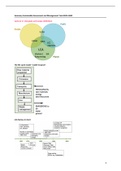
The life cycle model “cradle-to-grave’
LCA history in short
1
,ISO 14040 definition of LCA (short version)
Technique: for assessing the environmental aspects and potential impacts associated with a product
o Compiling an inventory of relevant inputs and outputs
o Evaluating potential impacts associated with inputs and outputs
o Interpreting results of inventory and impact assessment
Life cycle perspective: raw material acquisition, production, use and disposal
General impact categories: resource use, human health, ecological consequences
International standardisation
• There was a strong need for harmonising methods to ensure consistency between studies
• The first official guidelines: SETAC (1993) Guidelines for Life Cycle Assessment: a code of practice
• The formal standardisation was developed by the International Organisation of Standardisation (ISO)
o ISO 14025: environmental labels and declarations
o ISO 14040: the principles and framework (1997)
o ISO 14041: goal and scope definition (1998)
o ISO 14042: life cycle impact assessment (2000)
o ISO 14043: life cycle interpretation (2000)
o ISO 14067: greenhouse gases, carbon footprint of products, requirements, and guidelines for
quantification
• The 2006 update (ISO 14040/44)
o ISO 14040: the principles and framework (2006)
o ISO 14044: detailed requirements and guidelines (2006)
• ISO: the base of all LCA methodologies but criticized for being too ambiguous and unspecific
• The EU Joint Research Centre: international life cycle data system (ILCD), a general and detailed
guidance on LCA
• It builds on ISO 14040/14044 (2006) but addresses its main issues to ensure more consistent and
reproduceable results
Are we there yet?
No, ILCD is criticized for being internally inconsistent with respect to attributional and consequential modelling
Many other standards and guidance are developed on the application of LCA, but building on ISO 14040/14044
LCA procedure from the ISO 14040 standard
2
,Some examples of application areas for LCA
Policy
• Life cycle minimum greenhouse gas saving criteria for biofuels/bioenergy (EU renewable energy
directive, US renewable fuels standard)
• Waste: EU waste framework directive, 2008/98/EC
• EU: development of LCA-based methods for product environmental footprint (PEF), and organization
environmental footprint (OEF)
• Green procurement: Eco Cost Indicator, Milieukostenindicator, CO 2 Performance ladder
Industry
• Eco-design
• Cleaner production: identifying environmental hot spots
• Marketing purposes: through ecolabelling or Environmental Product Declarations (EPD)
• Sustainability reporting
Consumers
• Ecolabels
• Decisions support based on information from producers, academia, or media: what is better for the
environment, an electric or conventional car
Some key limitations
• Generalization and simplification are required in modelling and calculating various impacts that occur
in different places and time
o No local impacts: impacts are aggregated over geographic locations (raw material acquisition
in Africa, production in China, use in the Netherlands, waste management in Turkey)
o Static method: impacts are aggregated over time (today up until 15 or 30 years in the future
for PV panels)
o Potential instead of actual impacts
• LCA follows a best estimate principle
o Results are calculated based on average performance of processes. Risks that are rare but
have a high impact (nuclear disaster) are not considered in the impact calculations
o Similarly, impacts that are not well understood, for example health risks of micro- • LCA
follows a ‘best estimate’ principle. plastics, are still not well addressed in LCA studies.
calculations.
o Only environmental impact categories are included, and the impact categories are not
complete
Steps in LCA: Goal and Scope definition
3
, Goal and scope definition
• Goal definition
1. Research questions
2. Target group
3. Application
• Scope definition
1. Temporal, geographic, technological, economic processes
2. Impact categories
3. Level of sophistication
4. Modelling approach
5. Function, functional unit, system boundaries, reference flow
> Goal definition
1. Goal definition
• ISO requires 4 aspects to be unambiguously stated
1. What: intended application of the result
2. Why: decision context and reasons for carrying out the study
3. For who: target audience
4. Comparative studies to be disclosed to the public
• ILCD adds the following aspects
5. Limitations due to methodological choices
6. Commissioner of the study and other influential actors
1. What is the intended application?
What is intended
1. Comparing environmental impacts of specific goods or services
2. Identifying the parts of a product system that contribute most to its environmental impact (hot spot
identification)
3. Evaluating improvement potentials from changes in product designs
4. Documenting the environmental performance of products (regulatory purposes)
What is not intended
5. Environmental impact of a product in Utrecht
6. Environmental impact of a product on the 5th of December (Saint Nicholas)
2. Why: decision context and reasons for carrying out the study
6 types of applications:
1. General exploration of options
2. Innovation on company level
3. Innovation in a sector
4. Strategic planning
5. Comparison with other products
6. Ecolabels
Public comparative assertions
Special requirements (including)
• Critical review: check correct comparison of options
• Impact assessment required
• No weighting
ISO: an environmental claim regarding the superiority or equivalence of one product versus a competing
product that performs the same function
4


