

WAR
Significance of war:
War that created regime change – WWI
Wars that created some internal change – Crimea, Russo-Japanese and the Civil War
Wars that solidified the status quo – WWII and Cold War
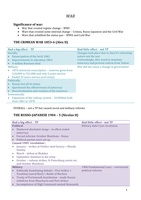
THE CRIMEAN WAR 1853-6 (Alex II)
Had a big effect – TP Had little effect – not TP
Socially: Changes took place due to Alex II’s reforming
Emancipation of the Serfs 1861 nature not the war
Improvements in education 1863 Contrastingly, Alex acted to maintain
A million Russians died autocracy and prevent reform from ‘below’
Military: War did not cause a change in government
1874 universal conscription – reserves grew from
210,000 to 553,000 and only 6 years service
Ended 25 years service (serf army)
Politically:
Russia lost all its status
Questioned the effectiveness of autocracy
Decentralisation and creation of the zemstvos
Economically:
Expansion of the railway system – 20,000km built
from 1861 to 1878
OVERALL – not a TP but caused social and military reforms
THE RUSSO-JAPANESE 1904 – 5 (Nicolas II)
Had a big effect – TP Had little effect – not TP
Political Military didn’t join revolution
Shattered absolutist image – in effect ended
autocracy
Forced reforms: October Manifesto - Duma
Political parties were set up
Caused 1905 ‘revolution’:
January – strikes at Putilov steel factory = Bloody
Sunday
March – defeat at Mukden
September mutinies in the army
October – railway strikes, St Petersburg soviet est.
and October Manifesto
Military 1906 Fundamental Laws – overturned
Publically humiliating defeats – Port Arthur + political reforms
Tsushima (naval fleet) + Battle of Murken
Treaty of Portsmouth humiliation – made Russia
withdraw from Manchuria and Port Arthur
Incompetence of High Command wasted thousands
1
Significance of war:
War that created regime change – WWI
Wars that created some internal change – Crimea, Russo-Japanese and the Civil War
Wars that solidified the status quo – WWII and Cold War
THE CRIMEAN WAR 1853-6 (Alex II)
Had a big effect – TP Had little effect – not TP
Socially: Changes took place due to Alex II’s reforming
Emancipation of the Serfs 1861 nature not the war
Improvements in education 1863 Contrastingly, Alex acted to maintain
A million Russians died autocracy and prevent reform from ‘below’
Military: War did not cause a change in government
1874 universal conscription – reserves grew from
210,000 to 553,000 and only 6 years service
Ended 25 years service (serf army)
Politically:
Russia lost all its status
Questioned the effectiveness of autocracy
Decentralisation and creation of the zemstvos
Economically:
Expansion of the railway system – 20,000km built
from 1861 to 1878
OVERALL – not a TP but caused social and military reforms
THE RUSSO-JAPANESE 1904 – 5 (Nicolas II)
Had a big effect – TP Had little effect – not TP
Political Military didn’t join revolution
Shattered absolutist image – in effect ended
autocracy
Forced reforms: October Manifesto - Duma
Political parties were set up
Caused 1905 ‘revolution’:
January – strikes at Putilov steel factory = Bloody
Sunday
March – defeat at Mukden
September mutinies in the army
October – railway strikes, St Petersburg soviet est.
and October Manifesto
Military 1906 Fundamental Laws – overturned
Publically humiliating defeats – Port Arthur + political reforms
Tsushima (naval fleet) + Battle of Murken
Treaty of Portsmouth humiliation – made Russia
withdraw from Manchuria and Port Arthur
Incompetence of High Command wasted thousands
1


