

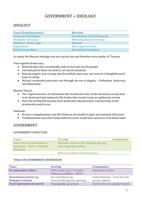
GOVERNMENT + IDEOLOGY
IDEOLOGY
Tsars (Pobedenostsov) Marxism
Autocratic/hereditary Dictatorship of the Proletariat
Feudalistic structure Withering away of the state
Religious - divine right Atheistic
Paternalistic Base-superstructure
Reform from above Revolution from below
In reality the Marxist ideology was not carried out and therefore very similar to Tsarism
Tsars against democracy:
Believed they were accountable only to God and not the people
God had placed them on earth to set moral standards
Russian empire was so large and diversified, autocracy was seen as a straightforward
ways of ruling
Nicolas I promoted autocratic rule through the use of slogans – ‘Orthodoxy, Autocracy
and Nationality’
Marxist Theory:
The 'superstructure’ of institutions that formed the base of the old tsarist society had
to be destroyed and replaced with bodies that would create an egalitarian society
Once the proletariat became more politically educated then a dictatorship of the
proletariat would occur
Stalinism:
He was a megalomaniac and did whatever he needed to gain and maintain full power
Totalitarianism was what Stalin believed Lenin would have moved to if he hadn’t died
GOVERNMENT
GOVERNMENT STRUCTURE
Tsars Overlap Communists
Some form of constitutional Absolute control of the political apex e.g.
monarchy – Duma + October patronage/Sovnarkom
Manifesto
Both used elaborate bureaucracy
TOOLS OF GOVERNMENT/REPRESSION
Tsars Overlap Communists
No informant culture Police state e.g. 3rd section + Informant culture
Okharana/CHEKA + NKVD
Reactionary terror e.g. Use of military e.g. Indiscriminate – went into the
Stolypin’s necktie kronstat/Hungarian uprising private sphere
Used repression not terror Propaganda e.g. prayer Used terror to a greater extent
1
IDEOLOGY
Tsars (Pobedenostsov) Marxism
Autocratic/hereditary Dictatorship of the Proletariat
Feudalistic structure Withering away of the state
Religious - divine right Atheistic
Paternalistic Base-superstructure
Reform from above Revolution from below
In reality the Marxist ideology was not carried out and therefore very similar to Tsarism
Tsars against democracy:
Believed they were accountable only to God and not the people
God had placed them on earth to set moral standards
Russian empire was so large and diversified, autocracy was seen as a straightforward
ways of ruling
Nicolas I promoted autocratic rule through the use of slogans – ‘Orthodoxy, Autocracy
and Nationality’
Marxist Theory:
The 'superstructure’ of institutions that formed the base of the old tsarist society had
to be destroyed and replaced with bodies that would create an egalitarian society
Once the proletariat became more politically educated then a dictatorship of the
proletariat would occur
Stalinism:
He was a megalomaniac and did whatever he needed to gain and maintain full power
Totalitarianism was what Stalin believed Lenin would have moved to if he hadn’t died
GOVERNMENT
GOVERNMENT STRUCTURE
Tsars Overlap Communists
Some form of constitutional Absolute control of the political apex e.g.
monarchy – Duma + October patronage/Sovnarkom
Manifesto
Both used elaborate bureaucracy
TOOLS OF GOVERNMENT/REPRESSION
Tsars Overlap Communists
No informant culture Police state e.g. 3rd section + Informant culture
Okharana/CHEKA + NKVD
Reactionary terror e.g. Use of military e.g. Indiscriminate – went into the
Stolypin’s necktie kronstat/Hungarian uprising private sphere
Used repression not terror Propaganda e.g. prayer Used terror to a greater extent
1


