

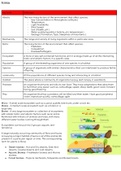
Ecology
Key term Definition
Abiotic The non-living factors of the environment that affect species.
- Gas Concentration in Atmosphere ( altitude )
- Temperature
- Light Availability
- Wind Speed
- Soil ( Health, pH )
- Water quality/quantity ( Salinity, pH, temperature )
- Geology ( Formation, Type, Steepness of mountains )
Biodiversity The range and variety of living organisms within a particular area.
Biotic The living factors of the environment that affect species.
- Predation
- Competition
- Disease/Pathogens
Ecosystem A more or less self-contained functional unit in ecology made up of all the interacting
biotic and abiotic factors in a specific area.
Population A group of interbreeding organisms of one species in a habitat.
Species A group of organisms with similar characteristics that can interbreed to produce fertile
offspring.
community All the populations of different species living and interacting in a habitat.
Habitat The place where a community of organisms live (e.g. leaf canopy in woodland).
Predator An organism that hunts and kills its own food. They have adaptations that allow them
to hunt their prey easier such as; camouflage, speed, sharp teeth, good vision, forward
facing, good hearing
Prey An organism that has a predator, will be killed and then eaten. Have good peripheral
vision, reproduce quickly, camouflage, agile
Micro - A small scale ecosystem such as a pond, puddle, tree trunk, under a rock etc.
Messo - A medium scale ecosystem such as a forest or a
large lake.
Biome - A very large ecosystem or collection of ecosystems
with similar biotic and abiotic factors such as an entire
Rainforest with millions of animals and trees, with many
different water bodies running through them.
Ecosystems can be put into 2 groups: aquatic and
terrestrial.
A large naturally occurring community of flora and fauna
occupying a major habitat. (Fauna is all of the animal life
present in a particular region or time. The corresponding
term for plants is flora.)
● Desert biomes - Hot and Dry deserts, Semi Arid
deserts, Coastal deserts and cold deserts.
● Aquatic Biomes - Freshwater biomes and Marine
biomes.
● Forest biomes - Tropical rainforests, Temperate and Boreal forests.
, ● Grassland biomes - Savanna grasslands and the Temperate Grasslands
● Tundra biomes - Arctic tundra and the Alpine tundra.
Biome
- Large ecological areas on the earth’s surface, with fauna and flora adapting to their environment.
- Biomes are often defined by abiotic factors such as climate, relief, geology, soils and vegetation.
- A biome is not an ecosystem. Plants or animals have special adaptations that make it possible for them to
exist in the area.
- Many units of ecosystems can exist within one biome.
Ecological Interdependence
● It is the relationship amongst species in an ecosystem.
● It prevents overpopulation of one species that would disrupt the ecosystem.
● Each species' existence depends upon another for its survival.
Competition
- Organisms compete for resources.
- Competition can be intraspecific (competing with organisms of the same species)
- Competition can be interspecific (competing with organisms of different species)
- Plants compete for resources just like animals, (sun)light, space, water and (nutritious) soil
- Animals compete for food, water, mates and territory.
- Members of different species will not compete for mates.
Competition in Plants
Space- Plants shed seeds far away so that the parent plant is not in competition with its offspring
Light- Used for photosynthesis. Making food using the energy from sunlight
Minerals and Nutrients in the Soil- So plants can make all the chemicals they need in their cells
Water- To keep tissues rigid and supported for photosynthesis
Why do snowdrops bloom so early?
- They are found in woodlands with lots of tall trees.
- When these leaves have leaves, they block out much of the light.
- Small plants flower early in the year when trees still have no leaves. This gives them more access to sunlight
- The dormant trees take up little water out of the soil so lots is available for small plants. This gives them a
competitive advantage.
- The plants flower, set seeds and die before the trees are in full leaf.
Food Web
Link to sheet on food webs↓
● https://docs.google.com/document/d/1GvpcY4Wops7xnWgHFrC7Xr4MLyEm9648/edit#
Adaptations in animals
What is an Adaptation?
Adaptation- A characteristic that enables an organism to survive in its environment
● Special features that allow living organisms to survive in their environment
● Animals and plants must be adapted to their habitats if they are to survive
● Animals and plants compete for scarce resources, eg. food, light and space.
● Some animals are adapted to live in extreme environments such as oceans, deserts or the arctic
Answer in order to talk about how the mutations caused a variation allowing for an adaptation for selection givin
them a competitive advantage allowing them to survive and reproduce to pass on their beneficial genes
● Mutations- My
● Variation -Very
● Adaption for selection -smart
Key term Definition
Abiotic The non-living factors of the environment that affect species.
- Gas Concentration in Atmosphere ( altitude )
- Temperature
- Light Availability
- Wind Speed
- Soil ( Health, pH )
- Water quality/quantity ( Salinity, pH, temperature )
- Geology ( Formation, Type, Steepness of mountains )
Biodiversity The range and variety of living organisms within a particular area.
Biotic The living factors of the environment that affect species.
- Predation
- Competition
- Disease/Pathogens
Ecosystem A more or less self-contained functional unit in ecology made up of all the interacting
biotic and abiotic factors in a specific area.
Population A group of interbreeding organisms of one species in a habitat.
Species A group of organisms with similar characteristics that can interbreed to produce fertile
offspring.
community All the populations of different species living and interacting in a habitat.
Habitat The place where a community of organisms live (e.g. leaf canopy in woodland).
Predator An organism that hunts and kills its own food. They have adaptations that allow them
to hunt their prey easier such as; camouflage, speed, sharp teeth, good vision, forward
facing, good hearing
Prey An organism that has a predator, will be killed and then eaten. Have good peripheral
vision, reproduce quickly, camouflage, agile
Micro - A small scale ecosystem such as a pond, puddle, tree trunk, under a rock etc.
Messo - A medium scale ecosystem such as a forest or a
large lake.
Biome - A very large ecosystem or collection of ecosystems
with similar biotic and abiotic factors such as an entire
Rainforest with millions of animals and trees, with many
different water bodies running through them.
Ecosystems can be put into 2 groups: aquatic and
terrestrial.
A large naturally occurring community of flora and fauna
occupying a major habitat. (Fauna is all of the animal life
present in a particular region or time. The corresponding
term for plants is flora.)
● Desert biomes - Hot and Dry deserts, Semi Arid
deserts, Coastal deserts and cold deserts.
● Aquatic Biomes - Freshwater biomes and Marine
biomes.
● Forest biomes - Tropical rainforests, Temperate and Boreal forests.
, ● Grassland biomes - Savanna grasslands and the Temperate Grasslands
● Tundra biomes - Arctic tundra and the Alpine tundra.
Biome
- Large ecological areas on the earth’s surface, with fauna and flora adapting to their environment.
- Biomes are often defined by abiotic factors such as climate, relief, geology, soils and vegetation.
- A biome is not an ecosystem. Plants or animals have special adaptations that make it possible for them to
exist in the area.
- Many units of ecosystems can exist within one biome.
Ecological Interdependence
● It is the relationship amongst species in an ecosystem.
● It prevents overpopulation of one species that would disrupt the ecosystem.
● Each species' existence depends upon another for its survival.
Competition
- Organisms compete for resources.
- Competition can be intraspecific (competing with organisms of the same species)
- Competition can be interspecific (competing with organisms of different species)
- Plants compete for resources just like animals, (sun)light, space, water and (nutritious) soil
- Animals compete for food, water, mates and territory.
- Members of different species will not compete for mates.
Competition in Plants
Space- Plants shed seeds far away so that the parent plant is not in competition with its offspring
Light- Used for photosynthesis. Making food using the energy from sunlight
Minerals and Nutrients in the Soil- So plants can make all the chemicals they need in their cells
Water- To keep tissues rigid and supported for photosynthesis
Why do snowdrops bloom so early?
- They are found in woodlands with lots of tall trees.
- When these leaves have leaves, they block out much of the light.
- Small plants flower early in the year when trees still have no leaves. This gives them more access to sunlight
- The dormant trees take up little water out of the soil so lots is available for small plants. This gives them a
competitive advantage.
- The plants flower, set seeds and die before the trees are in full leaf.
Food Web
Link to sheet on food webs↓
● https://docs.google.com/document/d/1GvpcY4Wops7xnWgHFrC7Xr4MLyEm9648/edit#
Adaptations in animals
What is an Adaptation?
Adaptation- A characteristic that enables an organism to survive in its environment
● Special features that allow living organisms to survive in their environment
● Animals and plants must be adapted to their habitats if they are to survive
● Animals and plants compete for scarce resources, eg. food, light and space.
● Some animals are adapted to live in extreme environments such as oceans, deserts or the arctic
Answer in order to talk about how the mutations caused a variation allowing for an adaptation for selection givin
them a competitive advantage allowing them to survive and reproduce to pass on their beneficial genes
● Mutations- My
● Variation -Very
● Adaption for selection -smart


