
NR 576 Week 4 Midterm Study Guide
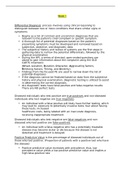
NR 576 Week 4 Midterm Study Guide Differential Diagnosis: process involves using clinical reasoning to distinguish between two or more conditions that share similar signs or symptoms • Begins as a list of common and uncommon diagnoses that are relevant to the patient's chief complaint or specific symptom. • A thorough list of potential diagnoses based on the patient's presenting symptoms must be developed and narrowed based on subjective, objective, and diagnostic data • The subjective history and review of systems are the first steps in gathering data to narrow the potential differentials, followed by the physical examination • During the HPI, a series of directed, open-ended questions are asked to gain information about the complaint using the OLD CARTS mnemonic (Onset, Location, Duration, Character, Aggravating factors, Relieving factors, Timing, and Severity). • Findings from the focused PE are used to narrow down the list of potential diagnoses. • If the diagnosis cannot be finalized based on data from the subjective history and physical examination, diagnostic testing is utilized to assist in determining the correct diagnosis. • ALL diagnostic tests have false-positive and false-negative results. There are NO perfect tests. Diseased individuals who test positive are true positives and non-diseased individuals who test negative are true negatives. • An individual with a false positive will likely have further testing, which may lead to: exposure to potentially invasive tests, fear about having these tests, increased healthcare costs, being labeled with an inaccurate diagnosis, receiving inappropriate treatment. Diseased individuals who test negative are false-negatives and non-diseased who test positive are false-positives. • An individual with a false-negative who has a potentially treatable disease may become sicker or die because the disease is not detected and treatment is delayed. Positive Predictive Value is the percentage of diseased individuals out of those who test positive. (Proportion of patients with a positive test who have the disease)........ Continue
Document information
- Uploaded on
- February 22, 2023
- File latest updated on
- February 22, 2023
- Number of pages
- 34
- Written in
- 2022/2023
- Type
- Other
- Person
- Unknown


