100% satisfaction guarantee Immediately available after payment Both online and in PDF No strings attached 4.2 TrustPilot
logo-home
Exam (elaborations)

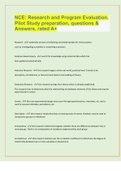
NCE: Research and Program Evaluation. Pilot Study preparation, questions & Answers, rated A+

Rating
-
Sold
-
Pages
14
Grade
A+
Uploaded on
17-02-2023
Written in
2022/2023

NCE: Research and Program Evaluation. Pilot Study preparation, questions & Answers, rated A+ Research - -systematic process of collecting and analyzing data for some purpose such as investigating a problem or answering a question Evidence-based inquiry - -search for knowledge using empirical data which has been gathered systematically Inductive Research - -this research begins at the real world, practical level. It tends to be descriptive, correlational, or historical and leads to the building of theory. Deductive Research - -this research springs from theory which is already established. This research tries to determine what the relationships are between elements of the theory and may be experimental in nature. Survey - -this non-experimental design may occur through questionnaires, interviews, etc. and is used to measure attitudes, perceptions, etc. Descriptive - -this research simply describes an existing state of events. Numbers may be used to characterize groups or individuals Comparative - -this research method investigates whether there are differences between two or more groups. There is no manipulation of conditions experienced by each group Correlational - -this research method uses the correlation coefficient to determine the degree of relationship between two or more variables or phenomena. Ex Post Facto - -Also called causal-comparative, this research design studies possible causal relationships among variables after the fact True Experiment - -This research is characterized by the use of experimental and control groups with random assignment to each. Quasi-Experiment - -This research is similar to experimental research except that randomization of subjects to treatment and control groups is not possible. It may be that no control or comparison group is available Qualitative - -Research type that emphasizes gathering data about naturally occurring phenomena (individual's and groups' living experiences) and events. Data collection may be in terms of words rather than numbers. Mixed-method research designs - -These designs combine quantitative and qualitative methods in the same research effort. The researcher retains the flexibility to use both types of designs. Typically, the designs are used sequentially. Single-subject design - -research design that studies the effects of a program or treatment on an individual or group treated as an individual, usually after a baseline has been established Action Research - -research conducted in an attempt to improve services or a program. This research may often be viewed as having an evaluative function Pilot Study - -a small-scale research effort often used to determine the feasibility of a large scale effort with emphasis on refining procedures and instrumentation Longitudinal Research - -consists of collecting data from the same group of individuals over a period of time. This is also called a panel study Cross-sectional research - -consists of collecting data from different groups at the same time and examining these differences. Meta-analysis - -research comparing findings across studies, i.e., the results of many studies are examined simultaneously and one or more research questions answered Internal Validity - -validity determined by the extent to which extraneous variables have been controlled. Instrumentation - -differences in results between two or more groups may be due to instruments which are unreliable or because the instruments are changed during the study Maturation - -results may be due to maturational or other changes in the subjects and not due to the treatment being applied. This is especially important if research data is gathered over a long period of time Mortality or Attrition - -losing subjects during the study could lead to different results than if everyone had stayed. Subjects with the most or least amount of important characteristics to the study may be the ones dropping out Experimenter bias - -the responses of the subjects may be influenced by the researcher. This may occur by treating some subjects differently, reinforcing different behaviors, as well as the presence of many other variables which deliberately or unintentionally influence subjects Statistical regression - -sometimes subjects in a study are recruited because of extreme high or low scores (e.g., self-esteem, social skills) on the dependent variable being measured External Validity - -validity determined by the extent to which the results may be generalized to people and situations beyond the study Ecological validity - -if the results can be generalized from one setting or circumstance to another Hawthorne Effect - -refers to the influence in performance which occurs when subjects receive attention or know they are participating in research Demand Characteristics - -these are all the cues, information, knowledge, and even rumors the subject has heard about the experiment, which are likely to influence his/her performance Rosenthal Effect - -these are the changes in the subject's behavior brought about by the researcher's expectations, behaviors or attitudes. Self-fulfilling expectation of doing well because it is expected Placebo - -any control treatment; should be identical to experimental treatment except for the critical item being studied Nominal - -the numbers represent the variable's qualities or categories Ordinal - -the numbers represent differences in some magnitude of the variable. You can order the data, from top to bottom, from high to low Interval - -intervals between the numbers on a scale contain the same amount of the variable throughout the scale. These provide a constant unit of measurement Ratio - -the numbers are on a scale which has a true zero. In addition the numbers can be compared by ratios Sampling - -selection of a part of the population Random Sampling - -All the individuals in the population have an equal and independent chance of being selected Stratified sampling - -This refers to selecting in such a way that major subgroups in the population will be sampled. These subgroups may be based on ethnicity, gender, age, etc Proportional stratified sampling - -This refers to randomly selecting the same proportion of individuals for the sample as they represent proportionally in the major subgroups in the population Cluster sampling - -In this sampling, the unit is not an individual but naturally occurring groups of individuals, such as classrooms or city blocks 30 - -Suggested minimal sample size for correlational research 15 - -Suggested minimal sample size for Ex Post Facto and experimental research 100 - -Suggested minimal sample size for survey research Descriptive - -Type of statistical analysis that is used to describe the data collected for a research sample or population, and include means, standard deviations, frequency counts, and percentages Inferential - -Type of statistical analysis that is used to make inferences from the sample to the population. The goal is to determine the probability of some event occurring. Parametric - -Type of statistical analysis that is used when a sample is randomly drawn from a population and the data is normally distributed. You have para (two-sided) data that yields a bell-shaped curve. Also, you assume that the variance of the sample you are studying is homogeneous (similar) to the variance of the population from which your sample is drawn. The scores would give you a normal curve -- more or less.

Show more Read less
Institution
Course


Whoops! We can’t load your doc right now. Try again or contact support.

Written for

Course

Document information

Uploaded on
February 17, 2023
Number of pages
14
Written in
2022/2023
Type
Exam (elaborations)
Contains
Questions & answers

Subjects

Content preview

NCE: Research and Program Evaluation.
Pilot Study preparation, questions &
Answers, rated A+

Research - ✔✔-systematic process of collecting and analyzing data for some purpose

such as investigating a problem or answering a question


Evidence-based inquiry - ✔✔-search for knowledge using empirical data which has

been gathered systematically


Inductive Research - ✔✔-this research begins at the real world, practical level. It tends to be

descriptive, correlational, or historical and leads to the building of theory.


Deductive Research - ✔✔-this research springs from theory which is already established.

This research tries to determine what the relationships are between elements of the theory and may be
experimental in nature.


Survey - ✔✔-this non-experimental design may occur through questionnaires, interviews, etc. and is
used to measure attitudes, perceptions, etc.


Descriptive - ✔✔-this research simply describes an existing state of events. Numbers may be used to
characterize groups or individuals


Comparative - ✔✔-this research method investigates whether there are differences between two or
more groups. There is no manipulation of conditions experienced by each group


Correlational - ✔✔-this research method uses the correlation coefficient to determine the degree of
relationship between two or more variables or phenomena.

, Ex Post Facto - ✔✔-Also called causal-comparative, this research design studies possible causal
relationships among variables after the fact


True Experiment - ✔✔-This research is characterized by the use of experimental and control groups with
random assignment to each.


Quasi-Experiment - ✔✔-This research is similar to experimental research except that randomization of
subjects to treatment and control groups is not possible. It may be that no control or comparison group
is available


Qualitative - ✔✔-Research type that emphasizes gathering data about naturally occurring phenomena
(individual's and groups' living experiences) and events. Data collection may be in terms of words rather
than numbers.


Mixed-method research designs - ✔✔-These designs combine quantitative and qualitative methods in
the same research effort. The researcher retains the flexibility to use both types of designs. Typically,
the designs are used sequentially.


Single-subject design - ✔✔-research design that studies the effects of a program or treatment on an
individual or group treated as an individual, usually after a baseline has been established


Action Research - ✔✔-research conducted in an attempt to improve services or a program. This research
may often be viewed as having an evaluative function


Pilot Study - ✔✔-a small-scale research effort often used to determine the

feasibility of a large scale effort with emphasis on refining procedures and instrumentation


Longitudinal Research - ✔✔-consists of collecting data from the same group of

individuals over a period of time. This is also called a panel study


Cross-sectional research - ✔✔-consists of collecting data from different groups at

$9.49
Get access to the full document:

100% satisfaction guarantee
Immediately available after payment
Both online and in PDF
No strings attached


Document also available in package deal

Get to know the seller

Seller avatar
Reputation scores are based on the amount of documents a seller has sold for a fee and the reviews they have received for those documents. There are three levels: Bronze, Silver and Gold. The better the reputation, the more your can rely on the quality of the sellers work.
QuickPass Chamberlain College Of Nursing
Follow You need to be logged in order to follow users or courses
Sold
410
Member since
3 year
Number of followers
304
Documents
6372
Last sold
3 weeks ago
Get all Documents you need at discount.

All nursing docs available: question banks, summaries, study guide and test banks

3.8

97 reviews

5
52
4
11
3
10
2
10
1
14

Recently viewed by you

Why students choose Stuvia

Created by fellow students, verified by reviews

Quality you can trust: written by students who passed their exams and reviewed by others who've used these notes.

Didn't get what you expected? Choose another document

No worries! You can immediately select a different document that better matches what you need.

Pay how you prefer, start learning right away

No subscription, no commitments. Pay the way you're used to via credit card or EFT and download your PDF document instantly.

Student with book image

“Bought, downloaded, and aced it. It really can be that simple.”

Alisha Student

Frequently asked questions