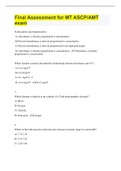
Final Assessment for MT ASCP/AMT exam (300 Questions with 100% Correct Answers) with COMPLETE SOLUTION
In absorption spectrophotometry: A) Absorbance is directly proportional to transmittance B) Percent transmittance is directly proportional to concentration C) Percent transmittance is directly proportional to the light path length D) Absorbance is directly proportional to concentration - Absorbance is directly proportional to concentration Which formula correctly described the relationship between absorbance and %T? A) A=2-log%T B) A=2+log%T C) A= -log%T - 2 D) A=1+log%T - A=2-log%T 3. Which element is reduced at the cathode of a Clark polarographic electrode? A) Silver B) Oxygen C) Chloride D) Potassium - Oxygen 4. Which of the following best represents the reference (normal) range for arterial pH? A) 7.35-7.45 B) 7.42-7.52 C) 7.28-7.68D) 6.85-7.56 - 7.35-7.45 5. What is the normal ration of bicarbonate to dissolved carbon dioxide in arterial blood? A) 1:10 B) 10:1 C) 20:1 D) 30:1 - 20:1 6. A patient's blood gas results are as follows: pH = 7.26; dco2=2.0mmol/L; HCO3-=29mmol/L. These results would be classified as: A) Metabolic acidosis B) Metabolic alkalosis C) Respiratory acidosis D) Respiratory alkalosis - respiratory acidosis 7. Which of the following is the primary mechanism of compensation for metabolic acidosis? A) Hyperventilation B) Aldosterone release C) Release of epinephrine D) Bicarbonate excretion - Hyperventilation
Document information
- Uploaded on
- February 17, 2023
- Number of pages
- 80
- Written in
- 2022/2023
- Type
- Exam (elaborations)
- Contains
- Questions & answers