

IGCSE PHYSICS – TOPIC 3
WAVES
a) PROPERTIES OF WAVES
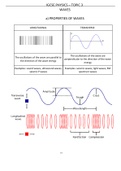
LONGITUDINAL TRANSVERSE
The oscillations of the wave are
The oscillations of the wave are parallel to
perpendicular to the direction of the wave
the direction of the wave energy
energy
Examples: sound waves, ultrasound waves, Examples: seismic waves, light waves, EM
seismic P waves spectrum waves
18
, • WAVE – an oscillation which transfers energy but not matter
• WAVELENGTH – the distance from one point on a wave to the same
point on another wave
• AMPLITUDE – the waves height measured from the middle of the
wave to the top
• FREQUENCY – the number of waves passing a point every second – Hz
• TIME PERIOD – the time taken for a single wave to pass a point -
seconds
Wave speed = frequency x wavelength
V=fxλ
Frequency = 1/time period
f = 1/T
THE DOPPLER EFFECT:
• When an object emits waves, the
wave fronts spread out
symmetrically
• If the wave sources move, the
waves can be squashed together or
stretched out
• If an object moves away from the observer, the wave us stretched, so
there is a longer wavelength and there is a lower pitch
• If the object moves towards the observer, the wave is squashed, so
there is a shorter wavelength and there is a higher pitch
19
WAVES
a) PROPERTIES OF WAVES
LONGITUDINAL TRANSVERSE
The oscillations of the wave are
The oscillations of the wave are parallel to
perpendicular to the direction of the wave
the direction of the wave energy
energy
Examples: sound waves, ultrasound waves, Examples: seismic waves, light waves, EM
seismic P waves spectrum waves
18
, • WAVE – an oscillation which transfers energy but not matter
• WAVELENGTH – the distance from one point on a wave to the same
point on another wave
• AMPLITUDE – the waves height measured from the middle of the
wave to the top
• FREQUENCY – the number of waves passing a point every second – Hz
• TIME PERIOD – the time taken for a single wave to pass a point -
seconds
Wave speed = frequency x wavelength
V=fxλ
Frequency = 1/time period
f = 1/T
THE DOPPLER EFFECT:
• When an object emits waves, the
wave fronts spread out
symmetrically
• If the wave sources move, the
waves can be squashed together or
stretched out
• If an object moves away from the observer, the wave us stretched, so
there is a longer wavelength and there is a lower pitch
• If the object moves towards the observer, the wave is squashed, so
there is a shorter wavelength and there is a higher pitch
19


