

Introduction:
This report will be looking at the lymphatic system and the purpose of it, functions of
each part, what a lymph is as well as how it's formed and what lymphocytes are. It
will also contain a case study of an interview with a patient who has lymphedema in
her upper arm due to her breast cancer treatment.
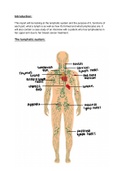
The lymphatic system:
, What does lymphatic system do:
This is basically known as the body’s ‘sewerage system’ as it maintains fluid levels in
our body tissue by removing the blood vessels leaking fluids. It also filters pathogens
from the blood. The system is made up of vessels, cells, organs linked to the
immune system. The immune system is made up of complicated cells and organs
which neutralise pathogens which cause infection.
The main function is to drain body fluids and return it back to the bloodstream.
Leakage of capillaries caused by blood pressure well as gathering fluid going into
interstitial space.
Removal of interstitial fluid
The left ventricle of the heart ejects O2 rich blood into the aorta under a high
pressure. Large branches of arteries supply upper and lower regions of the body with
blood. Within organs, arteries subdivide progressively smaller vessels and some
smaller arteries. Most arterioles connect to capillary beds which permeate into
tissue. Major roles of capillaries are distributing blood, nutrients delivered to all cells
as well as ensuring adequate oxygen while also collecting metabolic waste products
such as carbon dioxide and cellular signals such as hormones.
Approximately 85% fluid lost at end of capillary bed which is reclaimed into blood
and 15% is added to interstitial fluid bathing cells. This 20 litres of plasma goes into
the interstitial space of tissue due to capillary filtration. 17 litres is absorbed back into
the bloodstream and 3 litres is drained by the lymphatic system and emptied into the
bloodstream by vessels and ducts.
Maintenance of hydrostatic pressure
This report will be looking at the lymphatic system and the purpose of it, functions of
each part, what a lymph is as well as how it's formed and what lymphocytes are. It
will also contain a case study of an interview with a patient who has lymphedema in
her upper arm due to her breast cancer treatment.
The lymphatic system:
, What does lymphatic system do:
This is basically known as the body’s ‘sewerage system’ as it maintains fluid levels in
our body tissue by removing the blood vessels leaking fluids. It also filters pathogens
from the blood. The system is made up of vessels, cells, organs linked to the
immune system. The immune system is made up of complicated cells and organs
which neutralise pathogens which cause infection.
The main function is to drain body fluids and return it back to the bloodstream.
Leakage of capillaries caused by blood pressure well as gathering fluid going into
interstitial space.
Removal of interstitial fluid
The left ventricle of the heart ejects O2 rich blood into the aorta under a high
pressure. Large branches of arteries supply upper and lower regions of the body with
blood. Within organs, arteries subdivide progressively smaller vessels and some
smaller arteries. Most arterioles connect to capillary beds which permeate into
tissue. Major roles of capillaries are distributing blood, nutrients delivered to all cells
as well as ensuring adequate oxygen while also collecting metabolic waste products
such as carbon dioxide and cellular signals such as hormones.
Approximately 85% fluid lost at end of capillary bed which is reclaimed into blood
and 15% is added to interstitial fluid bathing cells. This 20 litres of plasma goes into
the interstitial space of tissue due to capillary filtration. 17 litres is absorbed back into
the bloodstream and 3 litres is drained by the lymphatic system and emptied into the
bloodstream by vessels and ducts.
Maintenance of hydrostatic pressure


