

London Case Study
The Character of the City
London is the capital of the UK, situated in South East England on the River Thames. The population
of Greater London is currently over 9 million, thought to rise to over 10 million by 2050, which will
make it a megacity. It is the most populous city in the UK, with 12.5% of the UK’s population living on
just 0.6% of the land.
London is the 3rd largest city in Europe, behind Istanbul and Moscow. It is the 27 th most populous city
in the world.
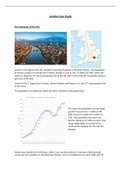
The population of London has varied over time, as shown in the graph below.
This shows the population has had rapid
growth from just over 1 million in the
1801 census to a peak of 8.6 million in
1941. The population then went into
decline, falling to 6.5 million in 1991, then
rising rapidly again. It is projected to
continue this rapid rise for the next few
decades.
London was founded by the Romans, when it was named Londinium. It became a thriving trade
centre due to it’s position on the tidal River Thames, and it’s development as a port. Cities such as
, London in the pre-industrial age were limited in size by food production, the size and shape of
growth created by the amount of food able to be produced locally or brought in by local trade
routes. During the industrial revolution there was a sharp rise in population, bought about partly by
people relocating from rural areas to be closer to the new factory workplaces. It was also due to
factors such as improvements in living conditions and health, allowing more children to live to
adulthood, and also to increasing birth rates. There was a revolution in transport and
communications, bringing new food supplies and other goods from elsewhere in the UK, allowing
London to grow and prosper. It became the largest city in the world, and the capital of the British
Empire.
After the 2nd world war the population went into decline, falling by about 2 million, due to poor
housing, air pollution and the collapse of established industries. People moved into the suburbs or
Home Counties, and commuted into London instead of living there. Since the 1990s the population
has been growing again due to government initiatives and a booming economy. Internal migration
has been negative, so the numbers moving out of London have been greater than the number of UK
residents moving in, however this balance has got smaller over time. International net migration is
positive, so more foreign born people move into London than out of it. Natural change has also been
positive, with more births than deaths boosting the population size.
The nature and impact of physical environment conditions
Poor air quality has plagued London since the first half of the 20 th century. Smog events caused by
lethal combinations of smoke and fog have been responsible for many deaths in the capital. One
example is the Great Smog of London in 1952 caused by a combination of industrial pollution and
high pressure weather conditions, which covered the city for 5 days and resulted in thousands of
deaths. Carbon dioxide emissions have been reducing since then because of the Clean Air Act in
1956, and more recent legislation such as the introduction of the Low Emission Zone and greener
buses. Nitrogen dioxide levels still breach legal limits and London still suffers from high air pollution.
The different regions of London have varying air pollution rates, with Kensington and Chelsea having
the highest rates, where 8.3% of deaths can be attributed to air pollution.
London acts as an Urban Heat Island, with the centre up to 10 degrees C warmer than the
surrounding rural areas. High temperatures have a negative effect on health, especially for
vulnerable people, and lead to greater consumption of water and energy. In the winter it can be an
The Character of the City
London is the capital of the UK, situated in South East England on the River Thames. The population
of Greater London is currently over 9 million, thought to rise to over 10 million by 2050, which will
make it a megacity. It is the most populous city in the UK, with 12.5% of the UK’s population living on
just 0.6% of the land.
London is the 3rd largest city in Europe, behind Istanbul and Moscow. It is the 27 th most populous city
in the world.
The population of London has varied over time, as shown in the graph below.
This shows the population has had rapid
growth from just over 1 million in the
1801 census to a peak of 8.6 million in
1941. The population then went into
decline, falling to 6.5 million in 1991, then
rising rapidly again. It is projected to
continue this rapid rise for the next few
decades.
London was founded by the Romans, when it was named Londinium. It became a thriving trade
centre due to it’s position on the tidal River Thames, and it’s development as a port. Cities such as
, London in the pre-industrial age were limited in size by food production, the size and shape of
growth created by the amount of food able to be produced locally or brought in by local trade
routes. During the industrial revolution there was a sharp rise in population, bought about partly by
people relocating from rural areas to be closer to the new factory workplaces. It was also due to
factors such as improvements in living conditions and health, allowing more children to live to
adulthood, and also to increasing birth rates. There was a revolution in transport and
communications, bringing new food supplies and other goods from elsewhere in the UK, allowing
London to grow and prosper. It became the largest city in the world, and the capital of the British
Empire.
After the 2nd world war the population went into decline, falling by about 2 million, due to poor
housing, air pollution and the collapse of established industries. People moved into the suburbs or
Home Counties, and commuted into London instead of living there. Since the 1990s the population
has been growing again due to government initiatives and a booming economy. Internal migration
has been negative, so the numbers moving out of London have been greater than the number of UK
residents moving in, however this balance has got smaller over time. International net migration is
positive, so more foreign born people move into London than out of it. Natural change has also been
positive, with more births than deaths boosting the population size.
The nature and impact of physical environment conditions
Poor air quality has plagued London since the first half of the 20 th century. Smog events caused by
lethal combinations of smoke and fog have been responsible for many deaths in the capital. One
example is the Great Smog of London in 1952 caused by a combination of industrial pollution and
high pressure weather conditions, which covered the city for 5 days and resulted in thousands of
deaths. Carbon dioxide emissions have been reducing since then because of the Clean Air Act in
1956, and more recent legislation such as the introduction of the Low Emission Zone and greener
buses. Nitrogen dioxide levels still breach legal limits and London still suffers from high air pollution.
The different regions of London have varying air pollution rates, with Kensington and Chelsea having
the highest rates, where 8.3% of deaths can be attributed to air pollution.
London acts as an Urban Heat Island, with the centre up to 10 degrees C warmer than the
surrounding rural areas. High temperatures have a negative effect on health, especially for
vulnerable people, and lead to greater consumption of water and energy. In the winter it can be an


