

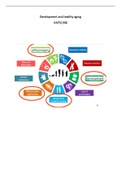
Development and healthy aging
HAP31306
,1. Introduction
Life expectancy
Human population becomes older and more people become older, however, self-perceived heath
is not increasing: after 65 years, humans are predisposed to diabetes type II, cancer and
cardiovascular disease. However, some individuals have a better heart function due to diet or
exercise. This suggests that we can (or should) intervene in the aging process to achieve (or
perceive) better and healthy aging
Aging
Aging is the decline of adaptation to altered physiological circumstances with increasing age, that
is genetically determined and environmentally modulated. There are a number of processes
involved in aging:
- Inflammaging: altered intercellular communication
- Genomic instability
- Telomere attrition
- Development: epigenetic alterations (multiple generations: evolution)
- Loss of proteosis
- Deregulated nutrient sensing (molecular mechanisms)
- Mitochondrial dysfunction (molecular mechanisms)
- Cellular senescence
- Stem cell exhaustion
The bold topics are the discussed during the course, in the context of live-bearing mammals.
Aging starts at conception, because the environment of the embryo can determine a lot about how
you age.
,Dutch Famine: De Hongerwinter
At the end of WWII, food stocks ran out, resulting in a famine. Before the famine, rations were 1800
kcal per day, and at the end of the famine, this decreased to 580 kcal per day. They looked into the
effect of the Dutch Famine on pregnant women, per trimester. It was concluded that women who
were exposed to the famine in late gestation gained no weight in the third trimester and had an
impaired tolerance to glucose. These babies were lighter, shorter, thinner and had a smaller head
circumference. Babies exposed to famine in early gestation were slightly heavier and larger. These
individuals suffered from an increase in obstructive airway disease and had an increase in
microalbuminuria (kidney disfunction). Later in life, these babies had an 3-fold increase in coronary
heart disease, more atherogenic lipid profile, decreased levels of factor VII and lower self-perceived
health. Exposure to the famine in the early or mid-gestation resulted in more weight gain in both
the mothers and the babies. However, they had an impaired glucose tolerance.
, 2. Evolution of the mammalian placenta
2.1 Development of the placenta in humans
The beginning of a pregnancy starts with fusion of the oocyst and the spermatozoid. This fusion is called
fertilization, forming a zygote. This zygote starts to divide into multiple cells through mitosis. After four
days, a morula is formed, which is a multi-celled stage, which is shaped into a round shape.
This morula absorbs fluid, which causes rearrangement. After this, the embryo is called a blastocyst.
The blastomeres at the periphery constitute of the cytotrophoblast which will later become the fetal
part of the placenta. The blastomeres at the centre of the blastocyst become the inner cell mass which
will give rise to the embryo. The fluid filled cavity is called the blastocoel. At this stage, the blastocyst
will also implant itself in the uteral lining. During the first week, the embryo obtains nutrients and
eliminate waste by simple diffusion because the placenta has not developed yet. However, due to the
rapid growth of the embryo, this becomes a less efficient method of exchange of molecules. This causes
rise of the early placenta (the uteroplacental circulatory system). For this to be realised, the mother
and the embryo will do the following processes at the same time:
- Embryo: the cytotrophoblast proliferates locally to form extensions called villi
- Mother: the endometrium (outer layer of the uterus) will be increasingly vascularised in response
to the embryo (decidual reaction)
This results in the vascular systems lying close to each other and can interact by diffusion. However,
these blood systems are never mixed. They are separated by four tissue layers:
- Endothelial cells of the fetal blood vessel
- Loose connection of the core villus
- Layer of cytotrophoblast
- Layer of syncitiotrophoblast
As the embryo grows, the placenta does too. It will develop the
umbilical cord, which consists of two arteries and one vein.
- Arteries: from the embryo to the placenta, transporting
deoxygenated, nutrient-depleted blood
- Vein: from the placenta to the embryo, transporting
oxygenated, nutrient-rich blood
HAP31306
,1. Introduction
Life expectancy
Human population becomes older and more people become older, however, self-perceived heath
is not increasing: after 65 years, humans are predisposed to diabetes type II, cancer and
cardiovascular disease. However, some individuals have a better heart function due to diet or
exercise. This suggests that we can (or should) intervene in the aging process to achieve (or
perceive) better and healthy aging
Aging
Aging is the decline of adaptation to altered physiological circumstances with increasing age, that
is genetically determined and environmentally modulated. There are a number of processes
involved in aging:
- Inflammaging: altered intercellular communication
- Genomic instability
- Telomere attrition
- Development: epigenetic alterations (multiple generations: evolution)
- Loss of proteosis
- Deregulated nutrient sensing (molecular mechanisms)
- Mitochondrial dysfunction (molecular mechanisms)
- Cellular senescence
- Stem cell exhaustion
The bold topics are the discussed during the course, in the context of live-bearing mammals.
Aging starts at conception, because the environment of the embryo can determine a lot about how
you age.
,Dutch Famine: De Hongerwinter
At the end of WWII, food stocks ran out, resulting in a famine. Before the famine, rations were 1800
kcal per day, and at the end of the famine, this decreased to 580 kcal per day. They looked into the
effect of the Dutch Famine on pregnant women, per trimester. It was concluded that women who
were exposed to the famine in late gestation gained no weight in the third trimester and had an
impaired tolerance to glucose. These babies were lighter, shorter, thinner and had a smaller head
circumference. Babies exposed to famine in early gestation were slightly heavier and larger. These
individuals suffered from an increase in obstructive airway disease and had an increase in
microalbuminuria (kidney disfunction). Later in life, these babies had an 3-fold increase in coronary
heart disease, more atherogenic lipid profile, decreased levels of factor VII and lower self-perceived
health. Exposure to the famine in the early or mid-gestation resulted in more weight gain in both
the mothers and the babies. However, they had an impaired glucose tolerance.
, 2. Evolution of the mammalian placenta
2.1 Development of the placenta in humans
The beginning of a pregnancy starts with fusion of the oocyst and the spermatozoid. This fusion is called
fertilization, forming a zygote. This zygote starts to divide into multiple cells through mitosis. After four
days, a morula is formed, which is a multi-celled stage, which is shaped into a round shape.
This morula absorbs fluid, which causes rearrangement. After this, the embryo is called a blastocyst.
The blastomeres at the periphery constitute of the cytotrophoblast which will later become the fetal
part of the placenta. The blastomeres at the centre of the blastocyst become the inner cell mass which
will give rise to the embryo. The fluid filled cavity is called the blastocoel. At this stage, the blastocyst
will also implant itself in the uteral lining. During the first week, the embryo obtains nutrients and
eliminate waste by simple diffusion because the placenta has not developed yet. However, due to the
rapid growth of the embryo, this becomes a less efficient method of exchange of molecules. This causes
rise of the early placenta (the uteroplacental circulatory system). For this to be realised, the mother
and the embryo will do the following processes at the same time:
- Embryo: the cytotrophoblast proliferates locally to form extensions called villi
- Mother: the endometrium (outer layer of the uterus) will be increasingly vascularised in response
to the embryo (decidual reaction)
This results in the vascular systems lying close to each other and can interact by diffusion. However,
these blood systems are never mixed. They are separated by four tissue layers:
- Endothelial cells of the fetal blood vessel
- Loose connection of the core villus
- Layer of cytotrophoblast
- Layer of syncitiotrophoblast
As the embryo grows, the placenta does too. It will develop the
umbilical cord, which consists of two arteries and one vein.
- Arteries: from the embryo to the placenta, transporting
deoxygenated, nutrient-depleted blood
- Vein: from the placenta to the embryo, transporting
oxygenated, nutrient-rich blood



