ESS IB Test Review
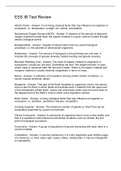
Abiotic Factor - Answer- A non-living, physical factor that may influence an organism or ecosystem; i.e. temperature, sunlight, pH, salinity, precipitation Biochemical Oxygen Demand (BOD) - Answer- A measure of the amount of dissolved oxygen required to break down the organic material in a given volume of water through aerobic biological activity Biodegradable - Answer- Capable of being broken down by natural biological processes; i.e. the activities of decomposer organisms Biodiversity - Answer- The amount of biological or living diversity per unit area. It includes the concepts of species diversity, habitat diversity and genetic diversity. Biomass/ Standing Crop - Answer- The mass of organic material in organisms or ecosystems, usually per unit area. Sometimes the term "dry weight biomass" is used where mass is measured after the removal of water. Water is not organic material and inorganic material is usually relatively insignificant in terms of mass. Biome - Answer- A collection of ecosystems sharing similar climatic conditions; i.e. tundra, tropical rainforest, desert. Biosphere - Answer- That part of the Earth inhabited by organisms, that is, the narrow zone (a few km thick) in which plants and animals exist. It extends from the upper part of the atmosphere (where birds, insects and wind-blown pollen may be found) down to the deepest part of the Earth's crust to which living organisms venture. Biotic Factor - Answer- A living, biological factor that may influence an organism or ecosystem; i.e. predation, parasitism, disease, competition. Carrying Capacity - Answer- The maximum number of species or "load" that can be sustainably supported by a given environment. Climax Community - Answer- A community of organisms that is more or less stable, and that is in equilibrium with natural environmental conditions such as climate; the end point of ecological succession. Community - Answer- A group of populations living and interacting with each other in a common habitat. Competition - Answer- A common demand by 2 or more organisms upon limited supply of a resource; i.e. food, water, light, space, mates, nesting sites. It may be intraspecific or interspecific.
Document information
- Uploaded on
- February 5, 2023
- Number of pages
- 10
- Written in
- 2022/2023
- Type
- Other
- Person
- Unknown