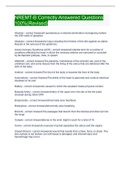
NREMT-B Correctly Answered Questions 100%(Revised}
NREMT-B Correctly Answered Questions 100%(Revised} Abortion A spontaneous or elective termination of pregnancy before the 20th week of gestation Abrasion An injury resulting from friction of the skin against an object. Results in the removal of the epidermis. Acute Coronary Syndrome (ACS) A blanket term for a number of conditions affecting the heart in which the coronary arteries are narrowed or occluded by fat deposits (plaque), clots, or spasm Afterbirth The placenta, membranes of the amniotic sac, part of the umbilical cord, and some tissues from the lining of the uterus that are delivered after the birth of the baby. Anterior The front of the body or towards the front of the body Automaticity The ability of the heart to generate and conduct electrical impulses on its own. Battery An assault in which the assailant makes physical contact. Brachial Artery Artery of the upper arm; the site of the the pulse checked during infant CPR Bradycardia Abnormally slow heartbeat Bradypnea Abnormally slow breathing Bronchi The passages that branch from the trachea and direct air into the lungs Carpals Bones in the wrist. Eight in each for a total of 16 Cervix A muscular ring that separates the uterus and the vagina Closed Wound A wound that results from a blow, force, or strain. The skin surface is not broken, but soft tissue is damaged, and internal injury and hemorrhage may occur. Compensated Shock Early state of shock during which the body's compensatory mechanisms are able to maintain normal perfusion. Crush Injury An injury caused when force is transmitted from the body's exterior to its internal structures. Bones can be broken; muscles, nerves, and tissues damaged; and internal organs ruptured, causing internal bleeding. Cyanosis A bluish discoloration of the skin and mucous membranes. Decompensated Shock Occurs when the body can no longer compensate for low blood volume or lack of perfusion. Late signs such as decreasing blood pressure become evident. Defibrillation 1) Application of an electric shock to the myocardium through the chest wall to restore normal cardiac rhythm; 2) Conversion of a dysrhythmia to a normal rhythm by applying electric shock to the chest Diagnosis A decision made based on the information regarding the patients history and the results of a physical examination Dialysis A procedure to remove waste products from the blood of patients whose kidneys no longer function Distention A condition of being stretched, inflated, or larger than normal. Dorsal Being or located near, on, or toward the back or posterior part of the human body Duty to Act An obligation to provide care to a patient Dyspnea Difficult or labored breathing; shortness of breath Epidermis Outer layer of skin Ethical Having to do with morals, values, right and wrong Exhalation (Expiration) A passive process in which the intercostal (rib) muscles and the diaphragm relax, causing the chest cavity to decrease in size and air to flow out of the lungs. Expressed Consent A type of consent in which a patient gives express authorization for provision of care or transport. Femur A heavy, long bone that forms the leg above the knee; longest bone in the body Fibula A long thin bone positioned laterally alongside the tibia in the lower leg; this bone bears no weight Fowler Position A sitting position. Glucose A simple sugar that acts as an energy source for cells. Hallucinogens Drugs that create hallucinations or alter perceptions of the external environment and inner awareness. Hemorrhage Excessive or profuse bleeding Hemorrhagic Shock Severe bleeding or loss of body fluid. Blood pressure decreases, thus blood flow is reduced to cells, tissue, and organs. Hives Eruption of itching and burning swellings on the skin Hyperglycemia Abnormally high concentration of glucose in the blood Hypertension Abnormally high blood pressure Hyperthermia Abnormally high body temperature Hypoglycemia Abnormally low blood sugar level Hypotension Abnormally low blood pressure Hypothermia Abnormally low body temperature Ingested Poisons Poisons that are swallowed. Inhalation (Inspiration) An active process in which the intercostal (rib) muscles and the diaphragm contract, expanding the size of the chest cavity and causing air to flow into the lungs. Irreversible Shock Final stage of shock in which organs and cells are so damaged that recovery is impossible and death is inevitable. Jaw-Thrust Maneuver Technique to open the airway by placing the fingers behind the angle of the jaw and bringing the jaw forward; used for patients who may have a cervical spine injury. Joint Junction between two or more bones or cartilage Laceration A wound or irregular tear of the flesh Larynx A cartilaginous structure at the top of the trachea which connects the pharynx to the trachea. Also known as the "voice box" Ligament Attaches bone to bone Mandible Lower jaw bone Maxillae Bones of the upper jaw Mental Status Level of responsiveness Midline An imaginary line drawn down the center of the body, dividing it into right and left halves. Moral Concerned with the principles of right and wrong behavior Nasal Canula Two-pronged plastic device for delivering oxygen into the nose; one prong is inserted into each nares. Nature of Illness what is medically wrong with a patient Nervous System The fast-acting control system of the body, it responds to internal and external changes by activating appropriate muscles and glands Nitroglycerin A medication that increases cardiac perfusion by causing arteries to dilate; you may be allowed to help the patient self-administer the medication. Occlusion Closure of a blood vessel due to blockage Off-line Medical Direction Consists of standing orders issued by the medical director that allow EMT's to give certain medications or perform certain procedures without speaking to the medical director or another physician On-line Medical Direction Consists of orders from the on-duty physician given directly to an EMT in the field by radio or telephone Orbits Eye sockets Ovaries Egg-producing organs within the female reproductive system. Palmar Reflex When you place your finger in an infant's palm, they will grasp it Palpation Examination preformed by touch Pancreas Digestive organ that regulates the hormones Insulin and Glucagon Partial Thickness Burn (2nd Degree Burn) a burn in which the first layer of skin (epidermis) is burned through and the dermis (second layer) is damaged. Burns of this type cause reddening, blistering, and a mottled appearence. Pelivs the bony structure formed by the hip bones, the sacrum, and the coccyx; lower part of the trunk of the body that serves as a support for the vertebral column Pharynx Connects nasal and oral cavities with the larynx and esophagus Plasma Liquid component of blood in which the blood cells in whole blood are normally suspended Platelets Small parts of the blood that cause clotting to stop bleeding, trap pathogens, and prevent additional pathogens from entering the body. Prone Lying face down Protocols A set of treatment guidelines written for the EMT to follow Pupil Adjustable opening in the center of the eye through which light enters Radiation Energy that is radiated or transmitted in the form of rays or waves or particles Radius Bone in forearm "on the thumb side" Recovery Position A side-lying position used to maintain a clear airway in unconscious patients without injuries who are breathing adequately Respiratory Arrest When breathing stops completely Routes of Entry Pathways into the body, generally by absorption, ingestion, injection, or inhalation. Scapula Either of two flat triangular bones one on each side of the shoulder in human beings. Shock A condition in which the circulatory system fails to provide sufficient circulation to enable every body part to perform its function; also called hypoperfusion. Side Effect Any reaction or consequence that results from medication or therapy. Sprain An injury in which the ligaments holding bones together are stretched too far and tear Sternum Breastbone Strain A condition resulting from damaging a muscle or tendon Stroke A sudden attack of weakness or paralysis that occurs when blood flow to an area of the brain is interrupted Sucking Chest Wound An open or penetrating chest wall wound through which air passes during inspiration and expiration, creating a sucking sound. Supine Lying flat on one's back; facing upward Tachycardia Abnormally rapid heartbeat Tachypnea An abnormally rapid rate of respiration usually or more than 20 breaths per minute Tendon Attaches muscle to bone Thorax The body region between the head and the abdomen Tort A civil wrong committed against a person or property Trachea Tube that connects the pharynx and larynx to the lungs, allowing the passage of air Traction Splint A splint that applies constant pull along the length of the lower extremity to help stabilize the fractured bone and to reduce muscle spasms in the limb; this type of splint is used primarily on femoral shaft fractures Trending Changes in a patient's condition over time, such as slowing respirations or rising pulse rate, that may show improvement or deterioration, and that can be shown by documenting repeated assessments. Unified Command Command organization in which several agencies work independently but cooperatively Universal Dressing A large bulky dressing (trauma dressing) Uppers Stimulants such as amphetamines that affect the central nervous system to excite the user Valve A flap of tissue in the heart or a vein that prevents blood from flowing backward Vein A blood vessel that carries blood back to the heart Ventral At the belly side of the human body Venule The very small veins that connect capillaries to the larger veins White Blood Cells Blood cells that perform the function of destroying disease-causing microorganisms Xiphoid Process Lower, narrow portion of the sternum Abandonment Leaving a patient after care has been initiated and before the patient has been transferred to someone with equal or greater medical training Abruptio Placentae Premature separation of the placenta from the uterine wall Activated Charcoal A powder prepared from charred wood, usually premixed with water used to treat a poisoning or overdose when substance was swallowed and is still in the digestive tract Advance Directive Written documentation that specifies medical treatment for a competent patient should the patient become unable to make decisions; also called a living will or health care directive. Agonal Respirations Slow, shallow, irregular respirations or occasional gasping breaths; usually seen in patients in cardiac arrest Allergic Reaction A condition in which the body produces antibodies to foreign material such as food, plant pollens, or medication Atria 2 upper chambers of the heart Auscultation Any diagnostic procedure that listens to body sounds. AAA (abdominal aortic aneurysm) A rapidly fatal condition in which the walls of the aorta in the abdomen weaken and blood leaks into the layers of the vessel, causing it to bulge. Avulsion An injury in which soft tissue is torn completely loose or is hanging as a flap. Behavioral Emergencies An emergency in which the patient's presenting problem is some disorder of mood, thought, or behavior that interferes with their activities of daily living Bilateral Present on two sides Body Mechanics Coordinated efforts of the musculoskeletal and nervous systems to maintain proper balance, posture, and body alignment Cardiac Output Amount of blood that leaves the heart Cartillage flexible tissue that gives support and protection but isn't rigid Cerebrospinal Fluid A solution that fills the hollow cavities of the brain and circulates around the brain and spinal cord Comminuted Fracture Bone breaks and fragments of bone are found in the tissue Abdomen The body cavity that contains many of the major organs of digestion and excretion. It is located below the diaphragm and above the pelvis. Abdominal-thrust maneuver The preferred method to dislodge a severe airway obstruction in adults and children; also called the Heimlich maneuver. Accessory Muscles The secondary muscles of respiration. They include the neck muscles (sternocleidomastoids), the chest pectoralis major muscles, and the abdominal muscles. Acetylsalicylic Acid (ASA/Aspirin) A medication that is an antipyretic (fever reducer), analgesic (pain reliver), anti-inflammatory, and a potent inhibitor of platelet aggregation (clumping). Acidosis The buildup of excess acid in the blood or body tissues. Action The therapeutic effect of a medication on the body. Active Shooter Event An act of terror in which firearms are used in an ongoing assault of multiple people. Activities of Daily Living (ADLs) personal daily care tasks, including bathing, skin, nail, and hair care, walking, eating and drinking, mouth care, dressing, transferring, and toileting Acute Myocardial Infarction (AMI) A heart attack; death of heart muscle following obstruction of blood flow to it. Acute in this context means "new" or "happening right now." Acute Stress Reactions Reaction to stress that occurs during a stressful situation. Americans with Disabilities Act (ADA) Comprehensive legislation that is designed to protect individuals with disabilities against discrimination. Addiction A state of overwhelming obsession or physical need to continue the use of a substance. Adduction motion toward the midline ("adding" to the body) Adenosine Triphosphate (ATP) one of the principal chemical compounds that living things use to store and release energy Adolescent An individual 12 to 18 years old adrenal glands a pair of endocrine glands that sit just above the kidneys and secrete hormones (epinephrine and norepinephrine) when stimulated by the nervous system. Advanced EMT (AEMT) An individual who has training in specific aspects of advanced life support, such as intravenous therapy, and the administration of certain emergency medications. Adrenergic Pertaining to nerves that release the neurotransmitter norepinephrine, or noradrenaline (such as adrenergic nerves, adrenergic response). The term also pertains to the receptors acted on by norepinephrine, that is, the adrenergic receptors. advanced life support (ALS) Advanced lifesaving procedures used to treat medical conditions, such as cardiac monitoring, administration of intravenous fluids and medications, and the use of advanced airway adjuncts. Adventitious Breath Sounds Abnormal breath sounds such as wheezing, stridor, rhonchi, and crackles. Adverse effects unintended and usually undesired effects that may occur with use of the drug Aerobic Metabolism Metabolism that can proceed only in the presence of oxygen. Aerosol-Generating Procedure Any airway manipulation that induces the production of aerosols that may present a risk for airborne transmission of pathogens, such as CPR. Afterload The force or resistance against which the heart pumps. Agonist A medication that causes stimulation of receptors. Air Ambulances Fixed-wing and rotary-wing (known as helicopters) aircrafts that have been modified for medical care; used to evacuate and transport patients with life-threatening injuries to treatment facilities.
Document information
- Uploaded on
- February 1, 2023
- Number of pages
- 14
- Written in
- 2022/2023
- Type
- Exam (elaborations)
- Contains
- Questions & answers