Part Two: The historical context
Chapter Two: The rise of modern international order
Historical international orders
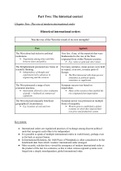
Was the rise of the West the result of its own strengths?
For: Against:
The West alone had inclusive political Very few, if any, of the materials that were
institutions. fundamental to the rise of the West
➢ Negotiation among elites and links originated from within Western-societies.
between elites and publics ➢ E.g. cotton or gold and silver mines
The Enlightenment promoted new forms of For many centuries, Asian powers were held
scientific thinking. in respect, even awe, in many parts of
➢ Independence of thought and Europe.
experiments led to advances in ➢ The West interacted with Asian powers
engineering and the sciences sometimes as political equals,
sometimes as supplicants
The West pioneered a range of new European success was based on
economic practices. imperialism.
➢ Innovations allowed a clear evaluation ➢ Many of the resources that enabled the
of profit → hallmark of commercial rise originated from imperialism
capitalism
The West enjoyed unusually beneficial European power was premised on multiple
geographical circumstances. forms of inequality.
➢ E.g. locations of coal and iron ➢ Western powers established a global
economy in which they imposed their
own price and production system
Key points:
● International orders are regularized practices of exchange among discrete political
units that recognize each other to be independent.
● It is possible to speak of multiple international orders in world history, perhaps even
as far back as ancient Sumer.
● In International Relations, the 1648 Peace of Westphalia is often considered to be the
benchmark date from which ‘modern’ international order emerged.
● More recently, scholars have viewed the emergence of modern international order as
the product of the last two centuries, as this is when various regional systems were
forged into a deeply interdependent, global international order.
, How did modern international order emerge?
Key dates in the emergence of modern international order:
1789/1791 The French and Haitian revolutions begin a long ‘wave’ of ‘Atlantic
Revolutions’ that lasts until the 1820s. They introduced new ideas
(republicanism and popular sovereignty) and challenged the central place of
slavery in the economy.
1842 In the First Opium War the British defeat China, perhaps the greatest
classical Asian power.
1857 The Indian Revolt (=opstand) prompts Britain to assume formal control of
the Indian subcontinent, while serving as a forerunner to anti-colonial
movements.
1862 The British Companies Act marks a shift to limited liability firms, opening
the way to the formation of transnational corporations as significant
international actors.
1865 The International Telecommunications Union becomes the first standing
intergovernmental organization, symbolizing the rise of permanent
institutions of global governance.
1866 The opening of the first transatlantic telegraph cable begins the wiring
together of the planet with immediate communication.
1884 The Prime Meridian Conference establishes world standard time, easing the
integration of trade, diplomacy, and communication.
1905 Japan defeats Russia in the Russo-Japanese War, becoming the first
non-Western, non-white great power.
Key points:
● After 1800, there was a ‘great divergence’ between some Western states and much of
the rest of the world.
● There were three main sources of the ‘great divergence’:
○ Industrialization;
○ The ‘rational state;
○ Imperialism.
● These three dynamics served as the mutually reinforcing foundations of modern
international order.
● These dynamics were deeply intertwined with international processes, most notably
industrialization with de-industrialization, and rational states with imperialism.
, The consequences of the global transformation
Case study 2.1: The standard of civilization
● ‘Standard of civilization’ = the idea that people around the world could be ranked,
culturally and/or racially.
○ Civilized: white, Christian people of the white West
○ Barbarians: mostly light-skinned peoples with an urban ‘high culture’
○ Savages: mostly dark-skinned peoples without an urban ‘high culture’
○ Privileged belligerents: inhabitants of the ‘civilized world’
○ Unprivileged belligerents: those living outside the ‘civilized world’
During the 19th and 20th century rules were set to determine the scope of legitimate violence:
it should be discriminate and proportional. Unprivileged were considered to be outside such
rules and violence in ‘uncivilized’ was without legal restrictions.
The standard of civilization was also central in how Western powers interacted with other
people, for example unequal treaties, partial takeovers and formal colonization.
Becoming a ‘civilized’ member of international society meant not just abiding by European
law and diplomacy, but also becoming an imperial power.
It is important to note that the standard of civilization was a moving target. The shift to an
idea of ‘civilization’ based on ‘modern’ capacities of a state meant that, in theory, less so in
practice, every state could be ‘civilized’ and was a ladder that could be climbed.
Key points:
● A major consequence of the global transformation was the ‘shrinking of the planet’
via steamships, railways, and the telegraph.
● These technologies increased the ‘regularized exchanges’ that serve as the
foundations of international order.
● These exchanges were increasingly managed by IGOs and INGOs.
● The modern international order that emerged during the 19th century was profoundly
unequal. The sources of this inequality included racism and economic exploitation.
Case study 2.2: Imperialism with Chinese characteristics
At the heart of imperialism was a claim about the material, cultural, and moral superiority of
the West. The decline of China illustrates the ways in which imperialism served to transform
international order.
During the 19th century, Western powers pressed China to open up to higher levels of trade
(lucrative (illegal) opium trade). In 1840 Britain used a minor incident involving the arrest of
two British sailors to instigate conflict (‘First Opium War’), which it won easily. The
(unequal) Treaty of Nanjing followed. After defeat in the Second Opium War of 1856-60,
China signed more unequal treaties.
, If these treaties weakened China, so did domestic unrest. During the 1850’s the ‘Taiping
Rebellion’ spread. The conflict severely diminished imperial control and destroyed both land
and livelihoods. In 1898 Empress Dowager Cixi fanned a wave of assertive nationalism,
including the ‘Boxer Rebellion’ that sought to overturn the unequal rights held by
Westerners. The defeat of the Boxers by a coalition of Western forces led to the stationing of
foreign troops in China, as well as a range of new concessions, for example, key aspects of
public finances were handed over to Western powers.
All in all, China’s experience of Western imperialism was deeply destructive.
Conclusion
International order can be defined as ‘regularized practices of exchange among discrete
political units that recognize each other to be independent’. There have been many
international orders in world history. However, it’s only over the past two centuries that one
has emerged that’s global in scale and deeply interdependent politically, economically and
culturally.
The world has undergone a major transformation enabled by imperialism, the emergence of
industrialization, and rational states. These dynamics have deepened both interdependence
and inequality to unprecedented levels.
The legacies of this period are profound: global economy, global system of states, global
communication and transportation systems, many IGOs and INGOs, etc. Equally important
are imperialism, racism and economic exploitation. Although the world continues to be based
largely on Western terms, this is changing.
Chapter Two: The rise of modern international order
Historical international orders
Was the rise of the West the result of its own strengths?
For: Against:
The West alone had inclusive political Very few, if any, of the materials that were
institutions. fundamental to the rise of the West
➢ Negotiation among elites and links originated from within Western-societies.
between elites and publics ➢ E.g. cotton or gold and silver mines
The Enlightenment promoted new forms of For many centuries, Asian powers were held
scientific thinking. in respect, even awe, in many parts of
➢ Independence of thought and Europe.
experiments led to advances in ➢ The West interacted with Asian powers
engineering and the sciences sometimes as political equals,
sometimes as supplicants
The West pioneered a range of new European success was based on
economic practices. imperialism.
➢ Innovations allowed a clear evaluation ➢ Many of the resources that enabled the
of profit → hallmark of commercial rise originated from imperialism
capitalism
The West enjoyed unusually beneficial European power was premised on multiple
geographical circumstances. forms of inequality.
➢ E.g. locations of coal and iron ➢ Western powers established a global
economy in which they imposed their
own price and production system
Key points:
● International orders are regularized practices of exchange among discrete political
units that recognize each other to be independent.
● It is possible to speak of multiple international orders in world history, perhaps even
as far back as ancient Sumer.
● In International Relations, the 1648 Peace of Westphalia is often considered to be the
benchmark date from which ‘modern’ international order emerged.
● More recently, scholars have viewed the emergence of modern international order as
the product of the last two centuries, as this is when various regional systems were
forged into a deeply interdependent, global international order.
, How did modern international order emerge?
Key dates in the emergence of modern international order:
1789/1791 The French and Haitian revolutions begin a long ‘wave’ of ‘Atlantic
Revolutions’ that lasts until the 1820s. They introduced new ideas
(republicanism and popular sovereignty) and challenged the central place of
slavery in the economy.
1842 In the First Opium War the British defeat China, perhaps the greatest
classical Asian power.
1857 The Indian Revolt (=opstand) prompts Britain to assume formal control of
the Indian subcontinent, while serving as a forerunner to anti-colonial
movements.
1862 The British Companies Act marks a shift to limited liability firms, opening
the way to the formation of transnational corporations as significant
international actors.
1865 The International Telecommunications Union becomes the first standing
intergovernmental organization, symbolizing the rise of permanent
institutions of global governance.
1866 The opening of the first transatlantic telegraph cable begins the wiring
together of the planet with immediate communication.
1884 The Prime Meridian Conference establishes world standard time, easing the
integration of trade, diplomacy, and communication.
1905 Japan defeats Russia in the Russo-Japanese War, becoming the first
non-Western, non-white great power.
Key points:
● After 1800, there was a ‘great divergence’ between some Western states and much of
the rest of the world.
● There were three main sources of the ‘great divergence’:
○ Industrialization;
○ The ‘rational state;
○ Imperialism.
● These three dynamics served as the mutually reinforcing foundations of modern
international order.
● These dynamics were deeply intertwined with international processes, most notably
industrialization with de-industrialization, and rational states with imperialism.
, The consequences of the global transformation
Case study 2.1: The standard of civilization
● ‘Standard of civilization’ = the idea that people around the world could be ranked,
culturally and/or racially.
○ Civilized: white, Christian people of the white West
○ Barbarians: mostly light-skinned peoples with an urban ‘high culture’
○ Savages: mostly dark-skinned peoples without an urban ‘high culture’
○ Privileged belligerents: inhabitants of the ‘civilized world’
○ Unprivileged belligerents: those living outside the ‘civilized world’
During the 19th and 20th century rules were set to determine the scope of legitimate violence:
it should be discriminate and proportional. Unprivileged were considered to be outside such
rules and violence in ‘uncivilized’ was without legal restrictions.
The standard of civilization was also central in how Western powers interacted with other
people, for example unequal treaties, partial takeovers and formal colonization.
Becoming a ‘civilized’ member of international society meant not just abiding by European
law and diplomacy, but also becoming an imperial power.
It is important to note that the standard of civilization was a moving target. The shift to an
idea of ‘civilization’ based on ‘modern’ capacities of a state meant that, in theory, less so in
practice, every state could be ‘civilized’ and was a ladder that could be climbed.
Key points:
● A major consequence of the global transformation was the ‘shrinking of the planet’
via steamships, railways, and the telegraph.
● These technologies increased the ‘regularized exchanges’ that serve as the
foundations of international order.
● These exchanges were increasingly managed by IGOs and INGOs.
● The modern international order that emerged during the 19th century was profoundly
unequal. The sources of this inequality included racism and economic exploitation.
Case study 2.2: Imperialism with Chinese characteristics
At the heart of imperialism was a claim about the material, cultural, and moral superiority of
the West. The decline of China illustrates the ways in which imperialism served to transform
international order.
During the 19th century, Western powers pressed China to open up to higher levels of trade
(lucrative (illegal) opium trade). In 1840 Britain used a minor incident involving the arrest of
two British sailors to instigate conflict (‘First Opium War’), which it won easily. The
(unequal) Treaty of Nanjing followed. After defeat in the Second Opium War of 1856-60,
China signed more unequal treaties.
, If these treaties weakened China, so did domestic unrest. During the 1850’s the ‘Taiping
Rebellion’ spread. The conflict severely diminished imperial control and destroyed both land
and livelihoods. In 1898 Empress Dowager Cixi fanned a wave of assertive nationalism,
including the ‘Boxer Rebellion’ that sought to overturn the unequal rights held by
Westerners. The defeat of the Boxers by a coalition of Western forces led to the stationing of
foreign troops in China, as well as a range of new concessions, for example, key aspects of
public finances were handed over to Western powers.
All in all, China’s experience of Western imperialism was deeply destructive.
Conclusion
International order can be defined as ‘regularized practices of exchange among discrete
political units that recognize each other to be independent’. There have been many
international orders in world history. However, it’s only over the past two centuries that one
has emerged that’s global in scale and deeply interdependent politically, economically and
culturally.
The world has undergone a major transformation enabled by imperialism, the emergence of
industrialization, and rational states. These dynamics have deepened both interdependence
and inequality to unprecedented levels.
The legacies of this period are profound: global economy, global system of states, global
communication and transportation systems, many IGOs and INGOs, etc. Equally important
are imperialism, racism and economic exploitation. Although the world continues to be based
largely on Western terms, this is changing.