

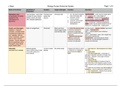
L.Kleyn Biology Human Endocrine System Page 1 of 5
Name of hormone gland/site of location target cell/organ function disorders
production
Thyroxine (high Thyroid gland - each lobe Trachea (just All body cells 1. incr. the basal metabolic Hypothyroidism - under-activity (weight gain)—
concentration of iodine consists of many hollow below the rate of the body cells low metabolic rate > early stages of
needed for the follicles which are lined larynx) 2. normal fn. of the life=Cretinism - stunted physical growth &
manufacture of with cuboidal epithelium nervous system mental develop. Adulthood= myxoedema
3. normal fn. of the heart Hyperthyroidism (graves disease) (weight
thyroxine)
4. tissue growth and loss)- overactivity = swelling exophthalmic
development goiter(swollen thyroid gland caused by lack of
iodine) incr. metabolic rate - bulging eyes
Insulin and Glucagon Islets of Langerhans Pancreas Brain and liver, G: control the glucose levels too little insulin = diabetes mellitus (high blood
diabetes = frequent blood sugar levels in blood by causing the sugar) = hyperglycemia
urination, constant thirst, and all body cells conversion of glycogen type 1 - unpreventable (from childhood
unexplained weight loss, stored in muscles and liver onwards)
incr. appetite, blurred to glucose type 2 - preventable - later in life *weight loss,
I : reduces blood glucose diet control, exercise etc.
vision, tiredness, sores=
levels by causing the hypoglycemia - low blood glucose levels -
slow to heal, chronic conversion of glucose fainting etc. too little glucagon produced —
disease - Insulin reduces (excess) into glycogen nausea and dizziness
blood sugar(beta cells),
Glucagon raises blood
sugar (alpha cells)
Adrenalin Adrenal glands on top of each the whole body Prepares the body for action > 1. heart rate incr., blood pressure incr, blood
secreted from medulla mass of yellow tissue made kidney in response to a change in flow incr
of an outer cortex & an the environment (fight or 2. pupils dilate
inner medulla flight) 3. incr blood sugar level - conversion of
glycogen 2 glucose, secretion of insulin from
pancreas - reduced = less sugar removed
from the blood
4. rate of CR incr.
5. incr blood supply to muscles & heart &
decr blood flow to the digestive system & skin,
blood vessels in skin constrict & skin becomes
pale
6. dilate the bronchioles, incr rate & depth of
breathing ⁂ more 02 delivered to cells for CR
7. incr. muscle tone = respond more quickly
8. incr. mental awareness
, L.Kleyn Biology Human Endocrine System Page 2 of 5
Name of hormone gland/site of location target cell/organ function disorders
production
Cortisol Adrenal glands on top of each the whole body Formation of glucose from
secreted from the cortex mass of yellow tissue made kidney (blood) non-carb molecules (fats & -
of an outer cortex & an proteins) & the deposition of
inner medulla fat in the body
cortisone Adrenal glands medicinal purposes for
- - inflammatory conditions -
Testosterone Cells of Leydig in testis testis the body and sex Stimulates the development
organs of the sex organs and is
responsible for the
development of the
Secondary male sex
characteristics
Oestrogen Primary follicle (dev. ovary endometrium and 1. Thickens endometrium
follicle in the ovary) body cells in preparation for the
implantation of a zygote
2. inhibits more FSH
production
3. critical amt. stimulates
production of LH
( negative feedback
FSH )(secondary sex
characteristics)
Progesterone Corpus luteum ovary endometrium in 1. maintains the lining of
uterus the uterus (prevents
placenta menstruation)
2. inhibits FSH and LH
( neg. feedback LH ;
neg. feedback FSH )
Name of hormone gland/site of location target cell/organ function disorders
production
Thyroxine (high Thyroid gland - each lobe Trachea (just All body cells 1. incr. the basal metabolic Hypothyroidism - under-activity (weight gain)—
concentration of iodine consists of many hollow below the rate of the body cells low metabolic rate > early stages of
needed for the follicles which are lined larynx) 2. normal fn. of the life=Cretinism - stunted physical growth &
manufacture of with cuboidal epithelium nervous system mental develop. Adulthood= myxoedema
3. normal fn. of the heart Hyperthyroidism (graves disease) (weight
thyroxine)
4. tissue growth and loss)- overactivity = swelling exophthalmic
development goiter(swollen thyroid gland caused by lack of
iodine) incr. metabolic rate - bulging eyes
Insulin and Glucagon Islets of Langerhans Pancreas Brain and liver, G: control the glucose levels too little insulin = diabetes mellitus (high blood
diabetes = frequent blood sugar levels in blood by causing the sugar) = hyperglycemia
urination, constant thirst, and all body cells conversion of glycogen type 1 - unpreventable (from childhood
unexplained weight loss, stored in muscles and liver onwards)
incr. appetite, blurred to glucose type 2 - preventable - later in life *weight loss,
I : reduces blood glucose diet control, exercise etc.
vision, tiredness, sores=
levels by causing the hypoglycemia - low blood glucose levels -
slow to heal, chronic conversion of glucose fainting etc. too little glucagon produced —
disease - Insulin reduces (excess) into glycogen nausea and dizziness
blood sugar(beta cells),
Glucagon raises blood
sugar (alpha cells)
Adrenalin Adrenal glands on top of each the whole body Prepares the body for action > 1. heart rate incr., blood pressure incr, blood
secreted from medulla mass of yellow tissue made kidney in response to a change in flow incr
of an outer cortex & an the environment (fight or 2. pupils dilate
inner medulla flight) 3. incr blood sugar level - conversion of
glycogen 2 glucose, secretion of insulin from
pancreas - reduced = less sugar removed
from the blood
4. rate of CR incr.
5. incr blood supply to muscles & heart &
decr blood flow to the digestive system & skin,
blood vessels in skin constrict & skin becomes
pale
6. dilate the bronchioles, incr rate & depth of
breathing ⁂ more 02 delivered to cells for CR
7. incr. muscle tone = respond more quickly
8. incr. mental awareness
, L.Kleyn Biology Human Endocrine System Page 2 of 5
Name of hormone gland/site of location target cell/organ function disorders
production
Cortisol Adrenal glands on top of each the whole body Formation of glucose from
secreted from the cortex mass of yellow tissue made kidney (blood) non-carb molecules (fats & -
of an outer cortex & an proteins) & the deposition of
inner medulla fat in the body
cortisone Adrenal glands medicinal purposes for
- - inflammatory conditions -
Testosterone Cells of Leydig in testis testis the body and sex Stimulates the development
organs of the sex organs and is
responsible for the
development of the
Secondary male sex
characteristics
Oestrogen Primary follicle (dev. ovary endometrium and 1. Thickens endometrium
follicle in the ovary) body cells in preparation for the
implantation of a zygote
2. inhibits more FSH
production
3. critical amt. stimulates
production of LH
( negative feedback
FSH )(secondary sex
characteristics)
Progesterone Corpus luteum ovary endometrium in 1. maintains the lining of
uterus the uterus (prevents
placenta menstruation)
2. inhibits FSH and LH
( neg. feedback LH ;
neg. feedback FSH )


