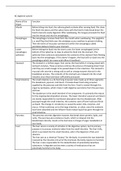
8C digestive system
Name of the Function
Organ
Mouth Before biting into food, the salivary glands activate after sensing food. We chew
the food into pieces and the saliva mixes with the food to help break down the
food to become easily digested. After swallowing, the tongue proceeds the food
into the throat and into the oesophagus.
Oesophagus The oesophagus receives food from the mouth when swallowing. The epiglottis
is a small flap that folds over the windpipe as you swallow to prevent choking.
Then the series of muscular contractions within the oesophagus called
peristalsis delivers food to your stomach.
Lower Before letting the food into the storm case, the lower oesophageal (at the
oesophagus bottom of the tube) has to relax to allow the food into the stomach. The
sphincter sphincter then contracts and prevents the contents of the stomach from flowing
back into the oesophagus. If this doesn’t happen, the food will run back into the
oesophagus which can cause acid reflux or heartburn.
Stomach The stomach is a hollow organ that carries the food while it is being mixed with
stomach enzymes. These enzymes continue the process of breaking down food
until they are small enough to be passed down to the intestines. The stomach's
mucosal cells secrete a strong acid as well as strong enzymes that aid in the
breakdown process. The contents of the stomach are released into the small
intestine once they have been sufficiently processed.
Small intestine The small intestine is a 22-foot long muscular tube made up of three segments:
the duodenum, jejunum, and ileum. It breaks down food using enzymes
supplied by the pancreas and bile from the liver. Food is moved through this
organ by peristalsis, which mixes it with digestive secretions from the pancreas
and liver.
The duodenum is the small intestine's first component. It's primarily the reason
for the ongoing decomposition process. The lower intestine's jejunum and ileum
are mainly responsible for nutritional absorption into the bloodstream. After
passing through the small intestine, the contents start off semi-solid and finish
up liquid. The change in consistency is caused by water, bile, enzymes, and
mucus. It then continues on to the large intestine, or colon, once the nutrients
have been absorbed and the leftover-food residue liquid has gone through the
small intestine.
Pancreas The pancreas secretes digestive enzymes that break down protein, lipids, and
carbs. The pancreas also produces insulin, which is released into the
bloodstream directly. Insulin is the hormone in charge of sugar metabolism in
your body.
Liver The liver serves a variety of activities in the digestive system, but its primary
purpose is to process nutrients taken from the small intestine. The liver's bile,
which is secreted into the small intestine, aids in the digestion of fats and
vitamins.
The liver acts as a chemical "factory" for the body. It converts the raw materials
received by the intestine into all of the chemicals the body requires to function.
The liver is also responsible for the detoxification of potentially hazardous
substances. It degrades and secretes a variety of medications that are
potentially harmful to the body.
Name of the Function
Organ
Mouth Before biting into food, the salivary glands activate after sensing food. We chew
the food into pieces and the saliva mixes with the food to help break down the
food to become easily digested. After swallowing, the tongue proceeds the food
into the throat and into the oesophagus.
Oesophagus The oesophagus receives food from the mouth when swallowing. The epiglottis
is a small flap that folds over the windpipe as you swallow to prevent choking.
Then the series of muscular contractions within the oesophagus called
peristalsis delivers food to your stomach.
Lower Before letting the food into the storm case, the lower oesophageal (at the
oesophagus bottom of the tube) has to relax to allow the food into the stomach. The
sphincter sphincter then contracts and prevents the contents of the stomach from flowing
back into the oesophagus. If this doesn’t happen, the food will run back into the
oesophagus which can cause acid reflux or heartburn.
Stomach The stomach is a hollow organ that carries the food while it is being mixed with
stomach enzymes. These enzymes continue the process of breaking down food
until they are small enough to be passed down to the intestines. The stomach's
mucosal cells secrete a strong acid as well as strong enzymes that aid in the
breakdown process. The contents of the stomach are released into the small
intestine once they have been sufficiently processed.
Small intestine The small intestine is a 22-foot long muscular tube made up of three segments:
the duodenum, jejunum, and ileum. It breaks down food using enzymes
supplied by the pancreas and bile from the liver. Food is moved through this
organ by peristalsis, which mixes it with digestive secretions from the pancreas
and liver.
The duodenum is the small intestine's first component. It's primarily the reason
for the ongoing decomposition process. The lower intestine's jejunum and ileum
are mainly responsible for nutritional absorption into the bloodstream. After
passing through the small intestine, the contents start off semi-solid and finish
up liquid. The change in consistency is caused by water, bile, enzymes, and
mucus. It then continues on to the large intestine, or colon, once the nutrients
have been absorbed and the leftover-food residue liquid has gone through the
small intestine.
Pancreas The pancreas secretes digestive enzymes that break down protein, lipids, and
carbs. The pancreas also produces insulin, which is released into the
bloodstream directly. Insulin is the hormone in charge of sugar metabolism in
your body.
Liver The liver serves a variety of activities in the digestive system, but its primary
purpose is to process nutrients taken from the small intestine. The liver's bile,
which is secreted into the small intestine, aids in the digestion of fats and
vitamins.
The liver acts as a chemical "factory" for the body. It converts the raw materials
received by the intestine into all of the chemicals the body requires to function.
The liver is also responsible for the detoxification of potentially hazardous
substances. It degrades and secretes a variety of medications that are
potentially harmful to the body.