Structure and Bonding
- Covalent Bonding: A chemical bond that involves the sharing
of electron pairs between atoms
- Ionic Bonding: The transfer of electrons from metal atoms to
non metal atoms, forming Ions (+/-) gain or lose electrons
- Isotopes: 2 or more types of an element with the same
number of protons but a different number of neutrons
- GIANT COVALENT STRUCTURES: All structures are covalent,
high melting and boiling points. Hard but brittle.
- In giant covalent structures the atoms form strong bonds by
sharing electrons
- DO NOT conduct electricity
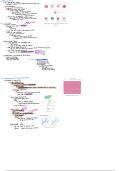
- Structure Of Diamond:
- Pattern repeated to form a pyramid shape
- Very hard, hardest natural substance
- High melting and boiling points
- Cannot conduct electricity because, no free electrons to
carry a charge
- Structure Of Graphite:
- Giant structure made up of layers
- Held together by weak forces of attraction
- Soft, Slippery
- Weak bonds, HOWEVER STRONG COVALENT BONDS
BETWEEN CARBON ATOMS
- CAN conduct electricity
- Oxygen is held together by a DOUBLE COVALENT BOND
- Carbon Dioxide is held together by a CHEMICAL BOND
- Ionic substance diagram are made up +/- particles
- Ionic Bonds are formed between a METAL & NON - METAL
- Ionic Bonds are stronger than covalent bonds
- Covalent Bonding: A chemical bond that involves the sharing
of electron pairs between atoms
- Ionic Bonding: The transfer of electrons from metal atoms to
non metal atoms, forming Ions (+/-) gain or lose electrons
- Isotopes: 2 or more types of an element with the same
number of protons but a different number of neutrons
- GIANT COVALENT STRUCTURES: All structures are covalent,
high melting and boiling points. Hard but brittle.
- In giant covalent structures the atoms form strong bonds by
sharing electrons
- DO NOT conduct electricity
- Structure Of Diamond:
- Pattern repeated to form a pyramid shape
- Very hard, hardest natural substance
- High melting and boiling points
- Cannot conduct electricity because, no free electrons to
carry a charge
- Structure Of Graphite:
- Giant structure made up of layers
- Held together by weak forces of attraction
- Soft, Slippery
- Weak bonds, HOWEVER STRONG COVALENT BONDS
BETWEEN CARBON ATOMS
- CAN conduct electricity
- Oxygen is held together by a DOUBLE COVALENT BOND
- Carbon Dioxide is held together by a CHEMICAL BOND
- Ionic substance diagram are made up +/- particles
- Ionic Bonds are formed between a METAL & NON - METAL
- Ionic Bonds are stronger than covalent bonds