

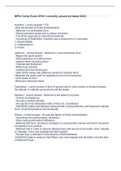
MPA Comp Exam GPA1 correctly answered latest 2023
MPA Comp Exam GPA1 correctly answered latest 2023Hamilton 1778 -Was the founder of Public Administration - Believed in a centralized Govt. - Strong executive power and a unitary command - Top-Down approach to hierarchical authority - According to Kettl(2003), Hamilton was a proponent of 3 principles: 1- Responsibility 2- Independence 3- Power Jefferson - Believed in a de-centralized Govt. - Began the spoils system - Was suspicious of a strong Govt. - wanted weak executive power - Championed federalism - Bottom-Up authority - wanted local and limited govt. - Kettl (2003) states that Jefferson wanted to maintain MLK; =Maintain the power with the legislature and not the executive. =Limit power to Govt =Maximize individual liberty Federalism A form of government in which power is divided between the federal, or national, government and the states Madison - Believed in the balance of power - Checks and Balances - He was a modern pluralist - He was the most influential crafter of the U.S. Constitution - Kettl(2003) states that Madison believed that a strong effective, well balanced national Govt. could bring balance and prosperity. Wilson - He was the father of Public Administration - He defined the politics/admin. dichotomy - Was a strong advocate of efficiency - Believed that Govt. should be managed in a businesslike manner and that it should be compared to one another - Believed that in order to improve effectiveness and service to the public, Govt. needed to: Manage, Train, and evaluate the Merit system. - He also was a champion in the Science of Administration -Kettl(2003) state in essence that Wilson was more aligned with Hamilton, less the idea of National Power. -Shafritz(2008) states that Wilson was strongly concerned with organizational efficiency and effectiveness, which he states is productivity at its simplest form. The Study of Administration Wilson, Woodrow 1887 """Father of Public Administration;"" government should be run like a business; easier to write a constitution than to run one; decentralization of government; monarchy vs. democracy" Politics and Administration Goodnow, Frank 1900 "Three major functions of government - each needs to be separate; the Politics-Administration Dichotomy; there is harmony as long as everyone knows their specific role; policies are the will of the state, administration is the execution of policy" Problems of Municipal Administration Addams, Jane 1904 "Provide services to all the people - represent the majority; cities are the focal point of progress" Scientific Management Taylor, Frederick 1912 ""Father of Scientific Management;"" Four principles of management; careful choice of employees and train them well; getting management to do their part; there is ""one best way;"" working harmoniously" The Movement of Budgetary Reform in the State Willoughby, William 1918 "Budget reform; checks and balances; proper budget methods; reporting system; budgets should operate like in business; authority over the budget lays with the legislature; government will be more efficient and economical" Structure of Bureaucracy Weber, Max 1922 "Demand for trained administration; positions held for life; principles of hierarchy; possession of education and qualifications; office = vocation; pay is determined by status" Introduction to the Study of Public Administration White, Leonard 1926 "Using resources efficiently to conduct public business; PA is execution of public business; PA uses materials and people to get things done; overspending and higher taxation generates the need for PA; no distinction between government levels - PA is PA" The Giving of Orders Follet, Mary Parker 1926 "Emphasized the ""law of the situation;"" orders are best when circular; uses face to face suggestions; orders do not take the place of training; changing the habit-patterns of people; depersonalization of orders" Notes on the Theory of Organization Luther Gulick 1937 "Division of work; workers should only have one boss; coordination of work; POSDCORB; workers should have technical specialties to maximize efficiency; organizing the executive" Report of the President's Committee on Administrative Mgmt Report of the President's Committee on Administrative Mgmt The Brownlow Commission 1937 "Overhaul of the Executive Branch; the expansion of the White House staff; administration efficiency; solified the merit system; identified the highest authority for Executive Branch. " Informal Organizations and their Relation to Formal Organizations Chester Barnard 1938 "Identified the role of informal organizations; employees must accept organization formal or informal; informal organization is important to the formal organization " Bureaucratic Structure and Personality Robert Merton 1957 "Hierarchy of structure of bureaucracy; the idea of dysfunction, over conformity, depersonalization of relationships; recognized the monopolistic nature of public administration." The Lack of Budgetary Theory V.O. Key Jr. 1940 "How the value of the administration affect the distribution of funds; budget does reflect public interest." The Theory of Human Motivation Abraham Manslow 1943 "The hierarchy of needs; motivations are based on physiological needs such as safety, love, esteem, self-actualization, etc." Government is Different Paul Appleby 1945 "Government is different than business; three aspects that differentiate 1) scope of impact, 2)consideration of public accountability, 3) political care; everything related to the public administration is public interest; identified transitional issues between private and public industry." The Proverbs of Administration Herbert Simon 1946 "Less levels of organization; efficiency through specialization, span of control; hierarchy; grouping of workers; unity of command; the principles of efficiency" The Administrative State: Conclusion Dwight Waldo 1948 "Division of government between 1)decision 2)executioncentralization versus de-centralization; scientific management influencing administration study; gap between administration curriculum and expectations and responsibilities of administration" The Cooptative Mechanism Phillip Selznick 1949 Identified formal and informal cooptation; the affects of social powers on an organization; states that a bureaucratic organization would experience a state of tension between authority and society. Report of Commission on Org. of the Executive Branch of Government The Hoover Commission Report 1949 "Presidential authority vs. representative; decentralized activities over centralized control; overlapping duplication; regulations too rigid" The Human Side of Enterprise Douglas Murray McGregor 1957 "Human nature of man; Theory X vs. Theory Y (big message, understand it well for future PA classes)" The Science of "Muddling Through" Charles E. Lindblom 1959 "Incrementalism; values influence policy; root comprehensive and branch limited comparison method" Organizations and the System Concept Daniel Katz & Robert L. Kahn 1966 "Organizational system concepts; open vs. closed systems. Input; through-put; output; systems as cycles of events; input-negative feedback-coding process; the steady state and dynamic homeostasis; differentiation; equifinality" The Road to PPB: The Stages of Budget Reform Allen Schick 1966 "PPBS (Planning, Programming Budgeting System); identify stages of budget; cost benefits analysis; beginning stage of management by objectives" The American System Morton Grodzins 1966 "Chaos of gov't; structure of gov't as organized chaos creates - functions overlap, confusion and complications." Organizations of the Future Warren Bennis 1967 "Predicts a new social system; predictability/order/precision; bureaucracy is is vulnerable in organizations of the future." Policy Analysts: A new professional role in government service Yehezkel Dror 1967 "Need for a new profession - policy analysts; built upon characteristics of system analysts with understanding of political feasibility, social and economic impacts, incorporate futuristic thinking and individual motivation to formulate policy" The Life Cycle of Bureaus Anthony Downs 1967 "Advocates vs. zealots; 4 ways to form bureaus; why bureaus expand and dead of bureaus" Rescuing Policy Analysis from PPBS Aaron Wildavsky 1969 "Accessed damage of PPBS; identify inertia; no one can do PPBS; quantification vs. qualitative (emphasis of policy analysis); policy analysis prevail over PPBS" Administrative Decentralization and Political Power Herbert Kaufman 1969 "Cycles of administrative reform; ship to core value;dissatisfaction with centralization; look for commonality" The End of Liberalism: The Indictment Theodore J. Lowi 1969 "Liberal government does not plan; weak decentralized government; incapable of long range planning; own goals: not public interest
Document information
- Uploaded on
- January 24, 2023
- Number of pages
- 7
- Written in
- 2022/2023
- Type
- Exam (elaborations)
- Contains
- Questions & answers


